Subject: Beyond GDP: Critiquing Gender Blindness in Korean Economics
Introduction
Hello! It’s [Daily Hangeul], here to upgrade your Korean skills to a professional level!
Today, we are diving into a intellectually stimulating topic: Feminist Economics (페미니즘 경제학). Specifically, we will learn how to critique the “gender blind spots” of mainstream economics in Korean.
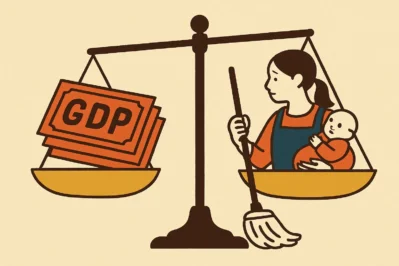
Recently in Korea, discussions about the “Care Economy” (돌봄 경제) and the “Ultra-low Birth Rate” (초저출생) have become major social issues. Experts are arguing that traditional economic indicators, like GDP, fail to capture the value of invisible labor, often performed by women. If you want to participate in high-level debates or understand op-eds in Korean newspapers about these structural issues, this lesson is for you.
Let’s learn the sophisticated vocabulary needed to discuss these pressing social matters!
Key Expressions
Here are 3 advanced expressions to help you critique economic structures like a native intellectual.
1. 재생산 노동 (Reproductive Labor)
- Pronunciation: [Jaesaengsan nodong]
- English Meaning: Reproductive labor (Domestic work, caregiving, child-rearing)
- Detailed Explanation:
While “Productive Labor” (생산 노동) produces goods and services, 재생산 노동 refers to the work necessary to sustain the workforce, such as cooking, cleaning, and caring for children. In mainstream economics, this is often undervalued. Use this term when arguing that housework is essential economic activity, not just “helping out.” - 💡 Pronunciation Tip:
- Pronunciation: [재생산 노동]
- Unlike some words, this is pronounced almost exactly as it is written. However, keep the rhythm steady. In ‘재생산’, the ‘산’ is clear. Ensure you don’t slur the ‘ㄴ’ (n) batchim.
2. 성별 임금 격차 (Gender Wage Gap)
- Pronunciation: [Seongbyeol imgeum gyeokcha]
- English Meaning: Gender wage gap
- Detailed Explanation:
Korea frequently ranks high among OECD nations for its 성별 임금 격차. This is a crucial term in sociology and economics. It refers to the disparity in earnings between men and women. You can use this when discussing structural inequality in the workplace. - 💡 Pronunciation Tip:
- Actual Pronunciation: [성별 임금 껵차]
- Notice that ‘격차’ becomes [껵차 (kkyeok-cha)]. This is due to Tensification (경음화). Because the first syllable ‘격’ ends with a ‘ㄱ’ (k) sound, the following ‘ㅊ’ (ch) sound doesn’t change, but if it were a plain consonant like ‘ㄷ, ㅂ, ㅅ, ㅈ’, they would tense up. However, here the emphasis often naturally makes the ‘ㄱ’ feel stronger or creates a slight pause, and sometimes speakers emphasize the ‘격’ strongly. Correction: Actually, strictly speaking, ‘격차’ is [격차]. However, in ‘임금 격차’, speakers often emphasize it. Let’s look at a better rule example:
- Let’s look at ‘맹점’ (Blind spot) from our topic title. It is pronounced [맹쩜]. The soft ‘ㅈ’ becomes a tense ‘ㅉ’ after the nasal sound in this compound word context.
3. 유리 천장 (Glass Ceiling)
- Pronunciation: [Yuri cheonjang]
- English Meaning: Glass ceiling
- Detailed Explanation:
This metaphor describes the invisible barrier that prevents a certain demographic (usually women) from rising beyond a certain level in a hierarchy. In Korean corporate culture discussions, you will hear this often regarding promotions to executive positions. - 💡 Pronunciation Tip:
- Actual Pronunciation: [유리 천장]
- Be careful with ‘천’ (cheon). It is an aspirated consonant (ㅊ), so a burst of air must come out. It is different from ‘전’ (jeon).
Example Dialogue
Let’s see how these terms are used in a serious discussion about a recent news report.
Min-ji (Economist): 이번 OECD 보고서 보셨어요? 한국의 성별 임금 격차가 여전히 심각하더라고요.
(Did you see this OECD report? Korea’s gender wage gap is still serious.)
Hyun-woo (Sociologist): 네, 봤습니다. 문제는 주류 경제학이 여전히 재생산 노동의 가치를 제대로 평가하지 않는다는 점이에요.
(Yes, I saw it. The problem is that mainstream economics still doesn’t properly evaluate the worth of reproductive labor.)
Min-ji: 맞아요. 가사 노동을 단순히 ‘사랑’이나 ‘희생’으로 포장할 게 아니라, 경제적 지표에 포함시켜야 해요. 그래야 유리 천장 문제도 근본적으로 해결될 수 있습니다.
(That’s right. Instead of packaging domestic labor simply as “love” or “sacrifice,” we must include it in economic indicators. Only then can the glass ceiling problem be fundamentally solved.)
Culture Tip & Trend Deep Dive
🧐 Why is “Care Work” (돌봄 노동) the hottest topic in Korea right now?
Recently, the term ‘독박 육아’ (Solo parenting / One-sided child-rearing burden) has been widely used on social media, but academic circles are pushing for a shift in perspective using Feminist Economics.
The current trend in Korea is moving away from simply blaming individuals for low birth rates. Instead, people are critiquing the structural blindness of the economy.
- Trend Alert: Nowadays, younger generations and intellectuals prefer the term ‘저출생’ (Low Birth) instead of ‘저출산’ (Low Childbirth).
- 저출산 (Jeo-chul-san): Focuses on women bearing children (placing the responsibility on women).
- 저출생 (Jeo-chul-saeng): Focuses on the birth of babies relative to the population (a societal phenomenon).
Using terms like 재생산 노동 (Reproductive labor) and 저출생 (Low birth) shows that you have a deep, high-level understanding of modern Korean society and its gender dynamics!
Wrap-up & Practice
Today, we explored how to critique mainstream economics through the lens of gender. These expressions will help you participate in high-level debates about Korean society.
📝 Mini Quiz:
Fill in the blanks with the expressions we learned today!
- “Housework and childcare are forms of economically valuable __________.”
(가사와 육아는 경제적으로 가치 있는 [ ]입니다.) -
“We need to break the invisible __________ to allow more women into executive roles.”
(더 많은 여성이 임원이 되기 위해서는 보이지 않는 [ ]을/를 깨야 합니다.)
Answers: 1. 재생산 노동 (Reproductive labor), 2. 유리 천장 (Glass ceiling)
Did you find this post useful? If you have any thoughts on the “Care Economy,” please leave a comment in Korean using today’s expressions!
See you next time on [Daily Hangeul]!