Korean Kindness: How to Ask for Help Crossing the Street
Hello! Welcome to [Daily Hangul], here to upgrade your Korean skills!
Have you ever stood at a busy intersection in a new city, feeling a little overwhelmed? Today, we’re going to learn some super useful phrases to politely ask for help in Korean. This is perfect for when you’re navigating a bustling city. You know, nowadays in Korea, the ‘ppalli-ppalli’ (빨리빨리, hurry-hurry) culture is real, especially in big cities like Seoul. Everyone is moving fast! But don’t worry, Koreans are also very kind. Knowing how to ask for help politely can turn a stressful moment into a friendly local interaction. Let’s learn how to ask someone to help you cross the street!
Key Expressions You Need to Know
Here are three essential phrases to master.
1. 저기요 (Jeogiyo)
- Pronunciation [Romanized]: Jeogiyo
- English Meaning: Excuse me.
- Detailed Explanation: This is the magic word to politely get a stranger’s attention in Korea. It literally means “over there,” but it’s used to call out to someone you don’t know. It’s friendly, respectful, and perfect for starting a conversation with anyone on the street.
- 💡 Pronunciation Tip:
- The pronunciation is quite straightforward! Just say [Jeo-gi-yo]. Make sure to add the ‘요 (yo)’ at the end, as it makes the expression polite. Without ‘요’, it can sound a bit blunt.
2. 좀 도와주세요 (Jom dowajuseyo)
- Pronunciation [Romanized]: Jom do-wa-ju-se-yo
- English Meaning: Please help me (a little).
- Detailed Explanation: This is a versatile and polite way to ask for assistance. ‘좀 (jom)’ means ‘a little’ and it’s added to make requests sound softer and more humble. ‘도와주세요 (dowajuseyo)’ is the polite form of ‘to help’. You can use this phrase in many situations, not just for crossing the street!
- 💡 Pronunciation Tip:
- The ‘와 (wa)’ sound in ‘도와 (dowa)’ is a combination of ‘ㅗ (o)’ and ‘ㅏ (a)’. Try saying ‘o-a’ very quickly, and you’ll get the [wa] sound. Remember, the ending ‘-주세요 (juseyo)’ is a key pattern for making polite requests in Korean.
3. 길 건너는 것 좀 도와주시겠어요? (Gil geonneoneun geot jom dowajusigesseoyo?)
- Pronunciation [Romanized]: Gil geon-neo-neun geot jom do-wa-ju-si-gess-eo-yo?
- English Meaning: Could you please help me cross the street?
- Detailed Explanation: This is the full, super-polite sentence! Let’s break it down:
- 길 (gil): Street / Road
- 건너는 것 (geonneoneun geot): The act of crossing
- 좀 도와주시겠어요? (jom dowajusigesseoyo?): This is an even more polite and formal way of asking for help than ‘-주세요’. It shows extra respect, which is great when talking to strangers, especially those older than you.
- 💡 Pronunciation Tip:
- Notice the word ‘건너는 (geonneoneun)’. The final consonant ‘ㄴ (n)’ in the first syllable ‘건 (geon)’ flows smoothly into the next syllable ‘너 (neo)’. So, you pronounce it as one continuous sound: [geon-neo-neun]. This linking of sounds is very common in Korean and will make you sound much more natural!
Example Dialogue
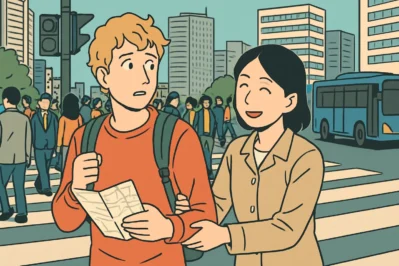
Let’s see how these phrases work in a real conversation on a busy street in Seoul!
- A (Tourist): 저기요.
- (Jeogiyo.)
- Excuse me.
- B (Local): 네? 무슨 일 있으세요?
- (Ne? Museun il isseuseyo?)
- Yes? Can I help you with something?
- A (Tourist): 죄송하지만, 길 건너는 것 좀 도와주시겠어요?
- (Joesonghajiman, gil geonneoneun geot jom dowajusigesseoyo?)
- I’m sorry to bother you, but could you please help me cross the street?
- B (Local): 아, 네! 그럼요. 제 팔 잡으세요.
- (A, ne! Geureomyo. Je pal jabeuseyo.)
- Oh, yes! Of course. Please hold my arm.
- A (Tourist): 정말 감사합니다!
- (Jeongmal gamsahamnida!)
- Thank you so much!
Culture Tip & Trend Deep Dive
In Korea, there’s a deep-rooted cultural concept called ‘정 (jeong)’, which is a feeling of connection, community, and affection. Because of ‘정’, many people, especially the older generation, are genuinely happy to help a stranger in need.
Even with the modern ‘ppalli-ppalli’ culture, where everyone seems to be in a rush, a polite request can break through the hustle. Using a phrase like “길 건너는 것 좀 도와주시겠어요?” shows great respect for the other person’s time and makes them more willing to stop and help.
So, don’t be shy! Using these phrases is not just about getting help; it’s about connecting with the local culture and experiencing the warmth of Korean ‘정’ firsthand. You’ll find that people are much friendlier than they might look in a crowded city!
Wrap-up & Practice Time!
Great job today! You’ve learned how to get someone’s attention with ‘저기요’ and politely ask for help crossing the street with ‘길 건너는 것 좀 도와주시겠어요?’.
Now, let’s test your knowledge!
- Fill in the blank: To get a stranger’s attention before asking a question, you should say: __________.
- Quick Quiz (O/X): Is it more polite to say “도와주세요” or “도와주시겠어요?” when asking a stranger for help? (Hint: The longer one is usually more formal and polite!)
Leave your answers in the comments below! Try making your own sentence using one of today’s expressions. We can’t wait to see you practice