Hello! This is [Maeil Hangeul], here to upgrade your Korean skills! 👋
Today, we are going to dive into a very relaxing and artistic topic: Making Pottery at a Workshop.
Recently in Korea, “One-day Classes” (원데이 클래스) have become a huge trend among the MZ generation. Instead of just going to cafes, friends and couples visit workshops to make rings, bake cakes, or create their own pottery! It is considered a “Healing Hobby” (힐링 취미) because touching the soft clay helps relieve stress.
Are you ready to learn some useful expressions for your own pottery adventure? Let’s get started!
✨ Key Expressions
Here are 4 essential expressions you can use or hear during a pottery class.
1. 어떻게 만들어요?
- Pronunciation: [Eotteoke mandureoyo?]
- English Meaning: How do I make this?
- Explanation: This is a must-know phrase for any learner! You use “어떻게 (how)” + “verb stem + -어요?” to ask for the method. If you don’t know how to shape the clay, ask the teacher this!
- 💡 Pronunciation Tip:
- When the final consonant ‘ㅎ’ (h) meets the initial consonant ‘ㄱ’ (g), they combine to make a strong ‘ㅋ’ (k) sound. This is called ‘Aspiration’.
- So, write it as ‘어떻게’, but pronounce it strongly as [eotteoke] (like eo-tteo-ke).
2. 중심을 잘 잡아야 해요.
- Pronunciation: [Jungsimeul jal jabaya haeyo.]
- English Meaning: You need to center it well. / You have to find the center balance.
- Explanation: In pottery, finding the center on the spinning wheel is the most important step. “-아야/어야 해요” is a B1 grammar point meaning “have to” or “must.” The teacher will likely say this to you often!
- 💡 Pronunciation Tip:
- Here, we see ‘Liaison’ (linking sounds).
- In ‘중심을‘, the ‘ㅁ’ moves to the empty ‘ㅇ’ spot -> [jungsimeul].
- In ‘잡아야’, the ‘ㅂ’ moves to the next spot -> [jabaya]. It sounds much smoother than saying each block separately!
3. 손에 힘을 빼세요.
- Pronunciation: [Sone himeulppaeseyo.]
- English Meaning: Please relax your hands. (Lit: Please take the strength out of your hands.)
- Explanation: Beginners often tense up their hands, which can ruin the clay. “힘을 빼다” means “to relax” or “to loosen up.” The teacher uses “-(으)세요” to give a polite instruction.
- 💡 Pronunciation Tip:
- Pay attention to ‘빼’ (ppae). This is a Tensed Sound (Double Consonant). You need to build up air pressure behind your lips and release it sharply, with no breathy air coming out. It’s much stronger than a soft ‘b’.
4. 언제 완성돼요?
- Pronunciation: [Eonje wanseongdwaeyo?]
- English Meaning: When will it be finished?
- Explanation: Pottery needs to be baked in a kiln, so you can’t take it home immediately. Use this phrase to ask when your masterpiece will be ready!
- 💡 Pronunciation Tip:
- ‘완성’ (wanseong) ends with ‘ㅇ’ (ng), so it flows naturally into ‘돼’ (dwae).
- Be careful with the vowel ‘왜’ (wae) in ‘돼요’. It sounds similar to the English word “way.”
💬 Real-Life Conversation
Let’s see how these expressions work in a real Pottery One-day Class.
(Situations: Minji is trying the spinning wheel for the first time.)
Minji: 선생님, 이거 너무 어려워요. 어떻게 만들어요?
(Teacher, this is too hard. How do I make this?)Teacher: 너무 긴장하지 마세요. 손에 힘을 빼세요.
(Don’t be too nervous. Please relax your hands.)Minji: 이렇게요? 흙 느낌이 정말 부드러워요!
(Like this? The feeling of the clay is really soft!)Teacher: 네, 맞아요! 물레가 돌 때 중심을 잘 잡아야 해요.
(Yes, that’s right! When the wheel spins, you need to center it well.)Minji: 네, 알겠습니다. 제 컵은 언제 완성돼요?
(Okay, I understand. When will my cup be finished?)Teacher: 굽는 데 시간이 걸려서, 2주 뒤에 받을 수 있어요.
(It takes time to bake, so you can receive it in 2 weeks.)
🇰🇷 Culture Tip & Trend Check
Why is everyone going to “Gongbang” (공방 – Workshops)?
In the past, traditional culture was seen as something “old.” But lately, popular K-Dramas and Instagram influencers have made ceramic arts very trendy.
Specifically, the “Moon Jar” (달항아리) is iconic in Korea right now. It’s a white porcelain jar that looks like a full moon. Even if it’s not perfectly round, that imperfection is considered beautiful.
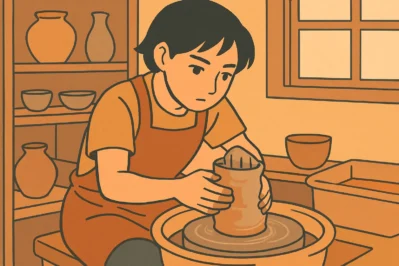
Young Koreans visit these workshops not just to learn, but to take “Gamseong” (Vibe/Mood) photos for their social media. The image of focusing on the spinning wheel with an apron on is considered very cool and artistic!
If you visit a pottery workshop in Korea, try asking the teacher: “여기 포토존이 어디예요?” (Where is the photo zone here?) 😉
📝 Wrap-up & Practice
Today we learned how to survive a Korean pottery class! You learned how to ask for methods, understand instructions about relaxing your hands, and ask about the completion time.
Let’s practice! Fill in the blank:
If the teacher thinks you are pressing the clay too hard, they will say:
“손에 ( )을 빼세요!”
(Hint: Strength / Power)
Answer: ________ (Check the Key Expressions section!)
Leave your answer in the comments below! Have you ever tried making pottery? Tell us about it!
See you in the next lesson! 안녕! (Bye!) 👋