
Weighing Lives: Mastering Korean for Medical Ethics Debates
Hello! It’s your guide to the next level of Korean, [Maeil Hangul]!
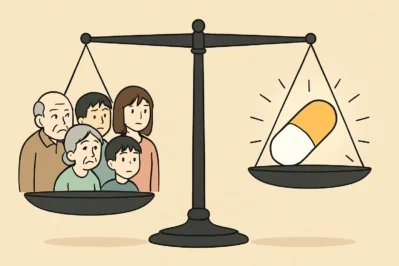
Today, we’re diving into a topic that is both challenging and incredibly relevant: medical ethics. You’ve mastered daily conversation, so now it’s time to equip you with the language to discuss complex societal issues. We’ll be learning how to debate the fair distribution of limited medical resources. Lately in Korea, there have been intense public discussions about which new, expensive drugs the national health insurance should cover, especially given the strain of a rapidly aging population. This isn’t just an academic exercise; it’s a real, ongoing conversation in Korean society, and with today’s lesson, you’ll be able to understand and participate in it.
Core Expressions for the Debate
Here are three key phrases that are essential for discussing this topic with nuance and precision.
1. 한정된 의료 자원 (Hanjeongdoen Uiryo Jawon)
- Romanization: [han-jeong-dwen-ui-ryo-ja-won]
- English Meaning: Limited medical resources
- Detailed Explanation: This is a formal, academic term that forms the basis of our entire discussion. It refers to the finite nature of medical supplies, personnel (doctors, nurses), hospital beds, and funds. When you want to sound knowledgeable and set the stage for a serious debate, this is the perfect phrase to use.
한정되다means “to be limited,”의료means “medical,” and자원means “resources.” - 💡 Pronunciation Tip: Notice how
한정된 의료flows together. The finalㄴ(n) sound of된links smoothly to the의vowel that follows it, making the pronunciation closer to [hanjeongdoen-uiryo] rather than two separate words. This is a common liaison (연음) rule that makes your Korean sound much more natural.
2. 분배의 정의 (Bunbae-ui Jeong-ui)
- Romanization: [bun-bae-e-jeong-eui]
- English Meaning: Distributive justice
- Detailed Explanation: This is a philosophical concept crucial for this debate. It refers to the socially just allocation of goods, in this case, healthcare. Is it just to give the resource to the person who can pay? To the youngest person? To the person who has the best chance of a full recovery? This term allows you to frame the problem in ethical terms.
- 💡 Pronunciation Tip: The particle
의is famously tricky! When used as a possessive marker like here (분배의), it is often pronounced as [에/e]. So, while written asBunbae-ui, it sounds like [Bunbae-e] in natural speech. At the beginning of a word,의사(doctor), it’s [ui]. And in other cases like주의, it’s often [i]. Mastering this will significantly boost your fluency.
3. 형평성에 어긋나다 (Hyeongpyeongseong-e Eogeunnada)
- Romanization: [hyeong-pyeong-sseong-e-eo-geun-na-da]
- English Meaning: To go against equity/fairness
- Detailed Explanation: This is a powerful phrase to express that a decision or policy is unfair.
형평성means “equity” or “fairness,” which is slightly different from평등(equality). It implies a fairness that considers individual circumstances.어긋나다means “to be out of line” or “to go against.” Use this to build a strong counter-argument. For example, “Prioritizing only the wealthy goes against equity.” (부유층만 우선시하는 것은 형평성에 어긋난다.) - 💡 Pronunciation Tip: In
어긋나다, the final consonantㅅfrom긋moves over to the next syllable, which starts with a vowel. So, instead ofeogeut-nada, it’s pronounced [어근나다/eogeunnada]. This re-syllabification rule (연음) is fundamental in Korean and is key to smooth pronunciation.
Example Dialogue
Here’s how these expressions might appear in a real discussion between two university students, Min-jun (A) and Seo-yeon (B).
A (민준): 뉴스 봤어? 새로 나온 고가의 항암제가 결국 건강보험 적용이 안 된대.
(Bwasseo? Saero naon goga-ui hang-amjega gyeolguk geongangboheom jeogyong-i an doendae.)
Did you see the news? They said the new, expensive cancer drug won’t be covered by national health insurance after all.
B (서연): 안타깝다. 이게 바로 한정된 의료 자원 때문에 생기는 고질적인 문제지. 모든 사람을 만족시킬 수는 없으니까.
(Antakkapda. Ige baro hanjeongdoen uiryo jawon ttaemun-e saenggineun gojiljeogin munjiji. Modeun saram-eul manjok-sikil suneun eopseunikka.)
That’s a shame. This is a chronic problem that arises precisely because of limited medical resources. You can’t satisfy everyone.
A (민준): 그래도 치료 효과가 확실하다면 기회를 줘야 하는 거 아니야? 특정 환자들만 배제하는 건 분배의 정의 관점에서도 문제가 있어 보여.
(Geuraedo chiryo hyogwaga hwaksilhadamyeon gihoereul jwoya haneun geo aniya? Teukjeong hwanjadeulman baejehaneun geon bunbae-ui jeong-ui gwanjeom-eseodo munjega isseo boyeo.)
Still, if the treatment is proven effective, shouldn’t they be given a chance? Excluding certain patients seems problematic even from a distributive justice perspective.
B (서연): 동의해. 나이나 지불 능력 같은 기준으로 생명의 가치를 매기는 건 형평성에 어긋나지. 더 심도 있는 사회적 합의가 필요해.
(Dong-uihae. Naina jibul neungnyeok gateun gijuneuro saengmyeong-ui gachireul maegineun geon hyeongpyeongseong-e eogeunnaji. Deo simdo inneun sahoejeok habuiga piryohae.)
I agree. Placing a value on life based on criteria like age or ability to pay goes against equity. We need a deeper social consensus.
Culture Tip: The ‘Social Consensus’ (사회적 합의)
In the dialogue, Seo-yeon mentions the need for a “사회적 합의 (sahoejeok habui)” or “social consensus.” This is a concept you’ll hear frequently in Korean discussions about contentious issues. Rather than a top-down decision, there’s a strong cultural emphasis on reaching a collective agreement through public discourse, hearings, and media debates. When discussing topics like medical resource allocation, Koreans value a process that considers various ethical frameworks, including efficiency (utilitarianism) and fairness (equity). Knowing this term shows you understand not just the language, but the cultural context of Korean debate. The decisions made by the National Health Insurance Service (국민건강보험공단) are constantly scrutinized by the public, making this a living, breathing debate you can follow in the news.
Let’s Practice!
Ready to test your understanding?
- Fill in the blank:
모든 국민에게 공평한 의료 혜택을 제공하는 것은 ___________ 문제와 직결된다.
(Providing fair medical benefits to all citizens is directly connected to the problem of _____________.) -
Your Turn: Imagine a situation where a single organ is available for transplant, and there are two candidates: a 20-year-old artist with a lower chance of survival and a 60-year-old scientist with a very high chance of survival. Using the phrase “형평성에 어긋나다” or “분배의 정의”, write one sentence in Korean expressing your opinion.
We tackled a difficult but fascinating topic today! You are now equipped with the sophisticated language needed to engage in important social debates.
Try answering the practice questions in the comments below. I can’t wait to read your thoughts