Unlock Korea’s Bookstores: How to Ask for Recommendations Like a Local!
안녕하세요! 여러분의 한국어 실력을 업그레이드해 줄 [매일한글] (Maeil Hangeul)입니다!
Hello! This is [Maeil Hangeul], here to upgrade your Korean skills!
Have you ever walked into a beautiful bookstore in Korea, surrounded by thousands of books, and felt a little lost? Today, we’re going to fix that! We’ll learn essential Korean phrases to help you ask for book recommendations and find your next favorite read.
Nowadays in Korea, visiting unique independent bookstores (독립서점, dokrip-seojeom) is a huge trend, especially among young people. These aren’t just places to buy books; they’re cultural hubs! Knowing how to chat with the staff will completely transform your experience. Let’s get started!
Core Expressions You Need to Know
Here are three key phrases that will make you sound like a natural in any Korean bookstore.
1. 요즘 잘 나가는 책이 뭐예요? (What’s a popular book these days?)
- Pronunciation [Romanization]: Yojeum jal naganeun chaegi mwoyeyo?
- English Meaning: What’s a book that’s selling well these days?
- Detailed Explanation: This is the most natural way to ask for a bestseller or a trendy book. The phrase 잘 나가다 (jal nagada) literally means “to go out well,” and it’s a common slang-like expression used for items that are popular and selling fast. It’s friendly and casual, perfect for a bookstore setting.
- 💡 Pronunciation Tip:
> The magic happens in 잘 나가는 [jal-la-ga-neun]. In Korean, when a syllable ending in aㄹ (l)consonant is followed by a syllable starting withㄴ (n), theㄴ (n)sound changes to aㄹ (l)sound. This is called ‘liquidization’. So, instead of saying “jal na-ga-neun,” you smoothly connect them and say [jallaganeun]. It makes your pronunciation sound much more fluid and native! Another example is the ancient kingdom신라 (Silla), which is pronounced [실라/silla], not [sin-ra].
2. 이 책은 어떤 내용이에요? (What is this book about?)
- Pronunciation [Romanization]: I chaegeun eotteon naeyongieyo?
- English Meaning: What kind of content does this book have? / What’s this book about?
- Detailed Explanation: Once a book catches your eye or someone recommends one, this is the perfect follow-up question. 어떤 (eotteon) means “what kind of,” and 내용 (naeyong) means “contents” or “story.” You can use this phrase not just for books, but also for movies, dramas, or TV shows!
- 💡 Pronunciation Tip:
> Let’s look at 내용이에요 [내용이에 요/naeyong-ieyo]. This is a classic example of ‘linking sound’ (연음/yeoneum). When a syllable ends with a consonant (like용/yong) and the next syllable starts with the silentㅇ (ieung), the consonant sound “moves over” to fill the empty spot. So, you don’t pause between “naeyong” and “ieyo.” Instead, you link them together smoothly: [naeyongieyo]. It’s like how책을 (chaegeul)becomes [채글/chae-geul].
3. 같이 읽을 만한 책 추천해 주세요. (Please recommend a book worth reading together.)
- Pronunciation [Romanization]: Gachi ilgeul manhan chaek chucheonhae juseyo.
- English Meaning: Please recommend a book that would be good to read together.
- Detailed Explanation: This phrase is incredibly useful and polite. It uses the grammar -(으)ㄹ 만하다 (-(eu)l man-hada), which means “to be worth doing.” So, 읽을 만한 책 (ilgeul manhan chaek) means “a book worth reading.” 같이 (gachi) means “together,” and 추천해 주세요 (chucheonhae juseyo) is the polite way to say “please recommend.”
- 💡 Pronunciation Tip:
> The key here is 같이 (gachi). It’s written as ‘gat-i’, but it’s never pronounced that way. It’s pronounced [gachi]. When the final consonantㅌ (t)is followed by a syllable starting with an ‘ㅣ (i)’ sound, it transforms into aㅊ (ch)sound. This rule is called ‘palatalization’. It happens to make the pronunciation softer and easier. Think of it like a shortcut! A similar example is굳이 (gudi), which is pronounced [구지/guji].
Example Dialogue in a Bookstore
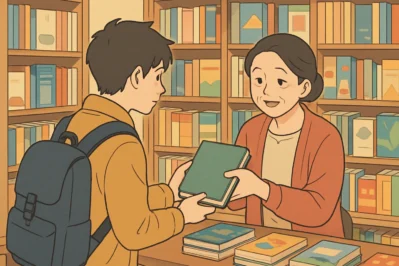
Let’s see these phrases in action! Imagine you’re at a trendy independent bookstore in Seoul.
- A (You): 안녕하세요! 저기… 요즘 잘 나가는 책이 뭐예요?
- (Annyeonghaseyo! Jeogi… yojeum jal naganeun chaegi mwoyeyo?)
- (Hello! Excuse me… What’s a popular book these days?)
- B (Staff): 아, 네! 요즘에는 김 작가님의 신작 ‘서울의 별을 보는 사람’이 인기가 많아요.
- (A, ne! Yojeumeneun Kim jakganim-ui sinjak ‘Seourui byeoreul boneun saram’i ingiga manayo.)
- (Oh, yes! The new book by author Kim, ‘The Seoul Stargazer,’ is very popular right now.)
- A (You): 아, 그렇군요. 이 책은 어떤 내용이에요?
- (A, geureokun-yo. I chaegeun eotteon naeyongieyo?)
- (Oh, I see. What is this book about?)
- B (Staff): 서울에서 각자 다른 꿈을 꾸는 청춘들의 이야기예요. 아주 감동적이에요.
- (Seoureseo gakja dareun kkumeul kkuneun cheongchundeuri iyagiyeyo. Aju gamdongjeogieyo.)
- (It’s a story about young people chasing different dreams in Seoul. It’s very touching.)
- A (You): 와, 좋네요! 그럼 이 책이랑, 친구랑 같이 읽을 만한 책 추천해 주세요.
- (Wa, jonneyo! Geureom i chaek-irang, chin-gurang gachi ilgeul manhan chaek chucheonhae juseyo.)
- (Wow, that sounds great! Then please recommend this one, and also a book worth reading together with a friend.)
Culture Tip & Trend Deep Dive
In Korea, the owner of an independent bookstore is often called a 책방지기 (chaekbangjigi), which means “book room keeper.” They are usually passionate readers who have carefully selected every book in their store.
Unlike large chain stores, asking a chaekbangjigi for a recommendation is a huge part of the experience. They love sharing their favorite books! Using the phrase “추천해 주세요” (Please recommend) shows that you trust their taste and are open to discovering something new and special that you might not find on a bestseller list.
Pro-tip: When you visit a dokrip-seojeom, try starting the conversation by complimenting the store’s atmosphere (“서점 분위기가 너무 좋아요” – Seojeom bunwigi-ga neomu joayo). This will make the chaekbangjigi happy and lead to an even friendlier chat!
Let’s Practice!
Time to check what you’ve learned!
- Fill in the blank: You want to ask the staff for a book that’s selling well.
> 요즘 ______ ______ 책이 뭐예요? - Make a sentence: How would you ask what a book titled “부산의 밤” (Busan-ui Bam / The Night of Busan) is about?
You did an amazing job today! Now you’re ready to explore Korean bookstores with confidence.
Why not try using one of today’s expressions in the comments below? I’d love to see you practice! Happy reading! 다음에 또 만나요! (See you next time!)