Weaving the Future: How Looms Spun a Social Revolution
Hello! Welcome back to [Maeil Hangeul], your guide to upgrading your Korean to a truly advanced level!
Today, we’re stepping into a time machine and traveling back to the Industrial Revolution. Why? Because understanding this pivotal period is essential for engaging in high-level discussions about Korean economic history, social structure, and even modern-day issues. We’ll be focusing on two game-changing inventions: the spinning jenny and the power loom, and learning the sophisticated Korean vocabulary needed to discuss their impact.
You might wonder what this has to do with today’s Korea. Well, the principles of rapid industrialization and efficiency born in that era are the very foundation of Korea’s “Miracle on the Han River” (한강의 기적). Understanding these historical roots will unlock a deeper comprehension of Korean society. Let’s get started!
Core Expressions for Historical Analysis
Here are some key terms and grammatical structures you’ll need to discuss this topic like a native expert.
1. 방적기 (Bangjeokgi) / 역직기 (Yeokjikgi)
- Pronunciation [Romanization]: [Bang-jeok-gi] / [Yeok-jik-gi]
- English Meaning: Spinning Jenny / Power Loom
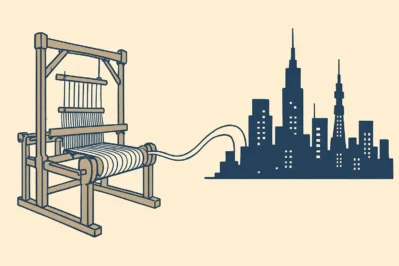
- Detailed Explanation: These are the foundational inventions of the textile industry. 방적기 (紡績機) is the machine that spins raw fibers (like cotton) into thread. 역직기 (力織機) is the machine that weaves that thread into cloth using mechanical power. These terms are derived from Hanja (Chinese characters), which is common in advanced Korean academic vocabulary. Mastering them is a key step to sounding more fluent in formal contexts.
- 💡 Pronunciation Tip: In 역직기 [yeokjikgi], notice the final consonant ‘ㄱ’ (k) in ‘역’ and the initial consonant ‘ㅈ’ (j) in ‘직’. While they are separate syllables, fluent speech often links them smoothly. The key is to pronounce the ‘ㄱ’ as an unreleased stop, creating a crisp separation before the ‘직’. It’s not “yeo-keu-jik-gi,” but a sharp “[yeok-jik-gi]”.
2. ~로 인해 촉발되다 (~ro inhae chokbaldoeda)
- Pronunciation [Romanization]: [~ro in-hae chok-bal-doe-da]
- English Meaning: to be triggered by / to be sparked by
- Detailed Explanation: This is a sophisticated and powerful way to express cause and effect, perfect for historical and academic writing. While
~때문에simply means “because of,”~로 인해 촉발되다carries the nuance of a specific event or factor acting as a catalyst that ignites a much larger phenomenon. It implies a more dramatic and pivotal starting point.- Example: 산업 혁명은 방적기의 발명으로 인해 촉발되었다. (The Industrial Revolution was sparked by the invention of the spinning jenny.)
- 💡 Pronunciation Tip: The magic of liaison (연음) happens in 인해. The final consonant ‘ㄴ’ (n) from ‘인’ links smoothly to the next syllable, making it sound like [inhae], not [in-hae]. Similarly, 촉발되다 is pronounced [촉빨되다 – chok-ppal-doe-da] due to consonant tensification, where the ‘ㅂ’ following a ‘ㄱ’ sound becomes a tense ‘ㅃ’ sound. This is a classic rule that makes you sound incredibly natural.
3. 대량 생산 체제 (Daeryang saengsan cheje)
- Pronunciation [Romanization]: [Dae-ryang saeng-san che-je]
- English Meaning: Mass production system
- Detailed Explanation: This term is the heart of industrialization. Let’s break down the Hanja: 대(大) for ‘large’, 량(量) for ‘quantity’, 생산(生産) for ‘production’, and 체제(體制) for ‘system’. It describes the factory-based system that replaced the pre-industrial 가내 수공업 (ganae sugongeop), or ‘domestic handicraft industry’. This concept is crucial for discussing economics, business, and history.
- 💡 Pronunciation Tip: In 생산 [saengsan], the final ‘ㅇ’ (ng) in ‘생’ is a nasal sound made at the back of your throat. Ensure you don’t release it like an “-nguh” sound in English. It should be a clean stop, followed immediately by the ‘산’ syllable. Practice making the ‘ng’ sound and holding it.
4. 노동 집약적 (Nodong jipyakjeok)
- Pronunciation [Romanization]: [No-dong jip-yak-jeok]
- English Meaning: Labor-intensive
- Detailed Explanation: This adjective describes an industry or process that requires a large amount of human labor. Hanja breakdown: 노동(勞動) for ‘labor’, and 집약적(集約的) for ‘intensive’ or ‘concentrated’. The early textile industry, despite its new machines, was incredibly 노동 집약적. The direct opposite is 자본 집약적 (jabon jipyakjeok), or ‘capital-intensive’.
- 💡 Pronunciation Tip: The final ‘ㅂ’ (b) sound in 집 [jip] is an unreleased stop. This means you form the ‘p’ sound with your lips but don’t release the puff of air. It creates a subtle but clear stop before the next syllable, ‘약’. It’s not “ji-beu-yak-jeok,” but a crisp [jip-yak-jeok].
Sample Dialogue: University Students’ Discussion
Let’s see how these terms play out in a natural, high-level conversation.
- A: 김 교수님의 산업 혁명 강의, 정말 흥미로웠어요. 특히 방적기와 역직기가 섬유 산업에 미친 영향이 인상 깊더라고요.
(Professor Kim’s lecture on the Industrial Revolution was fascinating. I was particularly impressed by the impact of the spinning jenny and the power loom on the textile industry.) - B: 맞아요. 가내 수공업에서 대량 생산 체제로의 전환은 정말 결정적인 순간이었죠. 생산성의 폭발적인 증가를 가져왔으니까요.
(I agree. The transition from a domestic handicraft industry to a mass production system was a truly pivotal moment. It brought about an explosive increase in productivity.) - A: 정말 그래요. 그 기술 혁신으로 인해 사회 구조 전체의 변화가 촉발되었다는 점이 놀라워요. 도시화도 가속화되었고요.
(Absolutely. It’s amazing that the entire social structure’s transformation was sparked by that technological innovation. Urbanization was accelerated as well.) - B: 그렇죠. 하지만 그 이면에는 노동 집약적인 공장의 열악한 노동 환경이라는 어두운 측면도 있었어요. 기술 발전의 양면성을 보여주는 전형적인 사례예요.
(True. But on the other side, there was the dark aspect of poor working conditions in the labor-intensive factories. It’s a classic example of the two-sided nature of technological progress.)
Culture & Trend Deep Dive
Why is this relevant now? In Korea, discussions about the 4차 산업혁명 (4cha saneop hyeongmyeong), or the Fourth Industrial Revolution (AI, robotics, etc.), are constant in the news and business circles. Pundits and scholars frequently draw parallels between today’s changes and the first Industrial Revolution.
When you read a Korean newspaper editorial about AI’s impact on the job market, you will see arguments about whether it will create a new 대량 생산 체제 of data, or how it will change 노동 집약적 industries. By mastering the vocabulary we learned today, you are equipping yourself not just to discuss history, but to understand and participate in contemporary high-level discourse about Korea’s future. You’ll be able to understand the historical context that shapes modern anxieties and hopes about technology.
Wrap-up & Practice
Today, we explored the vocabulary needed to discuss the profound changes brought by the Industrial Revolution. We learned:
* 방적기 / 역직기 (Spinning Jenny / Power Loom)
* ~로 인해 촉발되다 (to be sparked by)
* 대량 생산 체제 (Mass production system)
* 노동 집약적 (Labor-intensive)
Now, let’s put your knowledge to the test!
1. Fill in the blank:
스마트폰의 등장은 미디어 소비 방식에 거대한 변화를 _________.
(The emergence of the smartphone __________ a massive change in the way we consume media.)
2. Short Answer (in Korean):
What is the term for a capital-intensive industry, the opposite of
노동 집약적?
Share your answers in the comments below using the expressions we learned today! How did the Industrial Revolution change your country’s history? We’d love to hear your thoughts.