
Go Green in Korean: Let’s Reduce Our Carbon Footprint! 👣
Hello! It’s your favorite Korean booster, [Maeil Hangeul], here to upgrade your language skills!
Have you ever wanted to talk about important global issues like climate change in Korean? Today, we’re going to learn how to do just that! We’ll focus on practical phrases for discussing how to live a more eco-friendly life.
Lately in Korea, especially among the MZ generation, being environmentally conscious is a huge trend. From “plogging” (picking up litter while jogging) to participating in a “Yong-gi-nae” (courage/container) challenge, young Koreans are actively finding ways to protect our planet. Learning today’s phrases will not only help you join these important conversations but also make you sound like a trendy, socially aware speaker!
Let’s get started!
Core Expressions for an Eco-Warrior
Here are three essential phrases you need to know to discuss reducing your environmental impact.
1. 탄소 발자국을 줄이다 (Tanso baljagugeul jurida)
- Pronunciation [Romanized]: Tanso baljagugeul jurida
- English Meaning: To reduce (one’s) carbon footprint
- Detailed Explanation: This is the key phrase for our topic! 탄소 발자국 (tanso baljaguk) is the direct Korean translation of “carbon footprint.” 줄이다 (jurida) is a versatile verb meaning “to reduce” or “to decrease.” You can use this phrase to state your goal or describe your eco-friendly actions. It’s a slightly formal but common expression you’ll hear in news reports, campaigns, and thoughtful conversations.
-
💡 Pronunciation Tip: The “ㅇ” consonant
In Korean, the consonant ‘ㅇ’ has two sounds. When it’s at the beginning of a syllable block like in 을 (eul), it’s silent—just a placeholder. But when it’s a final consonant (받침), like in 발자국 (baljaguk), it makes the “ng” sound you hear in “singing.” So, remember: silent at the start, “ng” at the end!
2. 분리수거를 철저히 하다 (Bullisugeoreul cheoljeohi hada)
- Pronunciation [Romanized]: Bullisugeoreul cheoljjeohi hada
- English Meaning: To sort recycling thoroughly
-
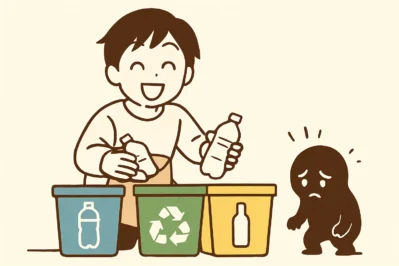
Detailed Explanation: If you’ve ever been to Korea, you know recycling is serious business! 분리수거 (bullisugeo) means “separate collection” or “recycling.” The adverb 철저히 (cheoljeohi) means “thoroughly” or “meticulously,” which perfectly describes the Korean approach to recycling. Use this phrase to show you’re committed to recycling properly.
-
💡 Pronunciation Tip: Tensing after ‘ㄹ’
Notice the romanization is [cheoljjeohi], not cheoljeohi. Why? In Korean, when a consonant like ‘ㅈ (j)’ comes after a final ‘ㄹ (l)’ consonant, it often becomes “tensed,” producing a stronger, sharper sound like ‘ㅉ (jj).’ So, instead of a soft “jeo,” you pronounce it with a punchy “jjeo.” This will make you sound much more natural!
3. 일회용품 사용을 자제하다 (Ilhoeyongpum sayongeul jajaehada)
- Pronunciation [Romanized]: Ilhoeyongpum sayongeul jajaehada
- English Meaning: To refrain from using single-use products
-
Detailed Explanation: 일회용품 (ilhoeyongpum) literally means “one-time-use items” and refers to disposables like plastic cups, straws, and cutlery. The verb 자제하다 (jajaehada) means “to refrain from” or “to control oneself.” It implies a conscious effort to avoid something, which is perfect for talking about changing habits. It’s a bit more formal than simply saying “안 쓰다 (an sseuda),” which means “to not use.”
-
💡 Pronunciation Tip: Linking Sound (연음)
Let’s look at 사용을 [sayongeul]. The word 사용 (sayong) ends with the consonant ‘ㅇ’ (ng), and it’s followed by the object particle 을 (eul). Because the ‘ㅇ’ in ‘을’ is just a silent placeholder, the final consonant from the previous block links to it. The ‘ㅇ’ (ng) sound from ‘용’ smoothly connects to ‘을’, creating the fluid sound [sayongeul]. This linking rule, called 연음 (yeoneum), is fundamental in Korean!
Example Dialogue
Let’s see how these expressions work in a real conversation between two friends, Minjun and Sora.
민준 (Minjun): 소라야, 요즘 SNS에서 ‘용기내 챌린지’ 봤어? 너무 멋있는 것 같아.
Sora, have you seen the ‘Yong-gi-nae Challenge’ on social media lately? I think it’s so cool.
소라 (Sora): 응, 봤어! 나도 그래서 요즘 탄소 발자국을 줄이려고 노력 중이야.
Yeah, I have! That’s why I’m trying to reduce my carbon footprint these days.
민준 (Minjun): 정말? 구체적으로 뭐 하고 있는데?
Really? What are you doing specifically?
소라 (Sora): 별건 아니고, 분리수거를 철저히 하고 카페 갈 때 텀블러를 챙겨서 일회용품 사용을 자제하고 있어.
Nothing major. I’m sorting my recycling thoroughly and bringing a tumbler to cafes to refrain from using single-use products.
민준 (Minjun): 와, 대단하다! 나도 내일부터 시작해야겠다.
Wow, that’s awesome! I should start tomorrow, too.
Culture Tip & Trend Deep Dive
In Korea, environmentalism isn’t just a topic; it’s a lifestyle.
- The “Yong-gi-nae” (용기내) Challenge: This is a popular social media movement. The word 용기 (yong-gi) has a clever double meaning: “courage” and “container.” Participants show “courage” by taking their own reusable “containers” to restaurants or markets for takeout, reducing packaging waste. If you use the phrase “저도 용기내 챌린지에 동참하고 있어요” (I’m also participating in the Yong-gi-nae challenge), you’ll definitely impress your Korean friends!
-
Discounts for Tumblers (텀블러 할인): Almost every café in Korea, from big chains like Starbucks to small local shops, offers a discount (usually 300-500 won) if you bring your own cup or tumbler (개인 컵/텀블러). It’s a simple, everyday way people practice what we learned today.
Let’s Practice!
Time to check your understanding!
1. Fill in the blank:
To protect the environment, we should try to reduce our use of __________.
(환경을 보호하기 위해 ________ 사용을 줄여야 해요.)
- A) 대중교통 (public transportation)
- B) 일회용품 (single-use products)
- C) 텀블러 (tumbler)
2. Make a sentence!
What is one action you will take this week to reduce your carbon footprint? Write your answer in Korean using one of the expressions we learned today!
- Example: 저는 분리수거를 철저히 할 거예요. (I will sort my recycling thoroughly.)
Great job today! Protecting the planet is a global effort, and now you can be a part of that conversation in Korean.
Leave a comment below with your answer to the practice question! I can’t wait to read your eco-friendly goals. 화이팅! (Fighting!)