
Moving Out in Korea? Say Goodbye to Your Neighbors!
Hello! This is [Maeil Hangul], here to upgrade your Korean skills!
Today, we’re going to learn some very useful and warm phrases for a situation you might experience while living in Korea: moving out and saying goodbye to your neighbors. Knowing how to say a proper farewell will leave a wonderful final impression and show your respect for the people you’ve lived near.
These days in Korea, the tradition of giving gifts when moving is still alive, but it’s changing! Instead of the classic rice cakes (tteok), many young people now give small, trendy gifts like fancy salt or cookies from a famous local bakery. But no matter what you give, the kind words you say are the most important part. Let’s learn how to say them!
Core Expressions for a Warm Farewell
Here are three essential phrases you need to know.
1. 저 이사 가요. (I’m moving.)
- Pronunciation [Romanization]: Jeo isa gayo.
- English Meaning: I’m moving.
- Detailed Explanation: This is the most direct and common way to tell someone you are moving.
- 저 (jeo) is the polite way to say “I.”
- 이사 (isa) means “moving (homes).”
- 가요 (gayo) is the present tense of the verb 가다 (gada), which means “to go.”
It’s a polite and friendly phrase you can use with any neighbor.
- 💡 Pronunciation Tip:
The Korean어(eo) sound in 저 (jeo) can be tricky. It’s similar to the “u” sound in the English word “sun” or “but.” Try to make the sound from the back of your throat without rounding your lips. It’s not “joe,” but more like “juh.”
2. 그동안 감사했습니다. (Thank you for everything until now.)
- Pronunciation [Romanization]: Geudongan gamsahaetseumnida.
- English Meaning: Thank you for everything (during the time I’ve been here).
-
Detailed Explanation: This is a very polite and heartfelt way to express gratitude for the entire period you’ve known someone.
- 그동안 (geudongan) means “during that time” or “in the meantime.”
- 감사했습니다 (gamsahaetseumnida) is the formal, past-tense form of “to be thankful.”
This phrase shows deep appreciation and is perfect for a final goodbye.
- 💡 Pronunciation Tip:
Notice the ending -습니다 (-seumnida). The letter ‘ㅂ’ (b) is written, but it’s pronounced like an ‘ㅁ’ (m) sound here. This is a common sound change rule called ‘nasalization.’ When a consonant like ‘ㅂ’ (b/p) comes before a nasal sound like ‘ㄴ’ (n), it changes to sound more like it. So, instead of saying “gamsahaet-seup-nida,” the natural Korean pronunciation is [gamsahaet-seum-nida].
3. 건강하세요. (Please stay healthy.)
- Pronunciation [Romanization]: Geonganghaseyo.
- English Meaning: Please stay healthy. / Take care.
-
Detailed Explanation: This is one of the most common and warmest ways to say goodbye in Korean. It’s more than just “goodbye”; it’s a sincere wish for the other person’s well-being. You can use it in many situations, not just when you’re moving.
-
💡 Pronunciation Tip:
The Korean letter ㅇ (ng) at the end of a syllable block, like in 건 (geon) and 강 (gang), has an “ng” sound, like in the English word “sing.” However, when ‘ㅇ’ is at the beginning of a syllable, like in 이 (i) or 아 (a), it is completely silent! Also, the ㅎ (h) in 하세요 (haseyo) is often pronounced very softly, almost like a breath of air.
Example Dialogue
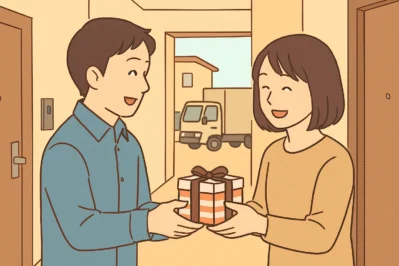
Let’s see how these expressions are used in a real conversation! Imagine you (A) are knocking on your neighbor’s (B) door with a small box of cookies.
- A: (똑똑) 안녕하세요, 이웃님.
(Ttok ttok) Annyeonghaseyo, iunnim.
(Knock, knock) Hello, neighbor. -
B: 어, 안녕하세요! 무슨 일이세요?
Eo, annyeonghaseyo! Museun irriseyo?
Oh, hello! What’s going on? -
A: 저 내일 이사 가요. 그동안 시끄럽게 한 건 없었는지 모르겠네요. 이거 작은 선물이에요. 그동안 감사했습니다.
Jeo naeil isa gayo. Geudongan sikkeureopge han geon eopseonneunji moreugenneyo. Igeo jageun seonmurieyo. Geudongan gamsahaetseumnida.
I’m moving tomorrow. I hope I wasn’t too noisy. This is a small gift. Thank you for everything. -
B: 웬일이에요! 이사 가신다니 정말 아쉽네요. 너무 조용하고 좋은 이웃이었는걸요. 건강하세요!
Wenirieyo! Isa gasindani jeongmal aswimneyo. Neomu joyonghago joeun iusieonneungeollyo. Geonganghaseyo!
Oh my goodness! I’m so sad to hear you’re moving. You were such a quiet and great neighbor. Take care!
Culture Tip: The New Wave of Moving-Day Gifts!
In the past, the absolute standard for a moving-day gift was 이사떡 (isa-tteok), or moving rice cakes. Specifically, red bean rice cakes called sirutteok were given to neighbors to share good fortune and block bad spirits.
But today, especially among the MZ Generation (Millennials & Gen Z) in Korea, the trend has shifted! People now prefer to give gifts that reflect their personal style. This could be:
* A box of macarons or cookies from a famous local bakery.
* A bag of specialty coffee beans from a popular café.
* A bottle of high-quality sesame oil or fancy salt.
This new trend is seen as more modern and thoughtful. So, when you say “그동안 감사했습니다” while handing over a small, curated gift, you’ll look like a true Korean local who is totally up-to-date with the latest trends!
Let’s Practice!
You’ve learned so much today! Let’s check your understanding.
1. Fill in the blank: You are telling your neighbor that you are moving. What do you say?
저 오늘 ______ ______. (Jeo oneul ______ ______.)
2. What would you say? You want to give your neighbor a final, warm farewell and wish them well. Which phrase is best?
A) 안녕하세요 (Annyeonghaseyo)
B) 건강하세요 (Geonganghaseyo)
C) 괜찮아요 (Gwaenchanayo)
Great job, everyone! Moving can be sad, but saying a proper goodbye makes it a much better experience.
Now it’s your turn! Try making a sentence with one of today’s expressions in the comments below. We can’t wait to read them!