
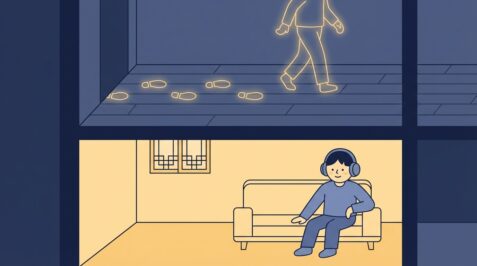
Surviving the “Foot Hammer”: How to Handle Noise Complaints in Korea Like a Diplomat
Phase 1: The Hook — More Than Just Noise
안녕하세요! Daily Hangul’s Senior Editor here.
Picture this: It’s 11:00 PM on a Tuesday. You’ve just finished a long day of work (perhaps a hoesik involving one too many rounds of soju) and you’re lying in bed at your Seoul apartment. Suddenly, it starts.
Thump. Thump. Thump.
It sounds like a giant is practicing hopscotch directly above your head. In Korea, we call this the “Foot Hammer” (발망치 – bal-mang-chi).
In K-Dramas, you often see neighbors storming upstairs, banging on doors, and screaming. But in real life? That is a surefire way to get the police involved for hyeop-bak (intimidation).
Handling cheong-gan so-eum (inter-floor noise) in Korea requires the diplomatic skills of a UN ambassador. It involves high-level indirect speech, face-saving strategies, and specific cultural navigation. Today, we aren’t just learning to complain; we are learning the art of polite confrontation.
Phase 2: Deep Dive — The Art of Softening the Blow
For C1 learners, the goal isn’t just communication; it’s nuance. Direct accusation causes loss of face (chaemyeon).
1. “혹시 댁에서 나는 소리가 아닐 수도 있는데…”
(Hoksi daeg-eseo naneun sori-ga anil sudo inneunde…)
- Pronunciation: [Hok-shi daeg-eh-seo na-neun so-ri-ga ah-nil su-do in-neun-deh]
- Meaning: “It might not be the sound coming from your house, but…”
- Editor’s Insight: This is the ultimate “face-saving” opener. Even if you are 100% sure the elephants are wrestling upstairs, you must start by suggesting you might be wrong. It lowers their defense mechanisms.
- Situation Spectrum:
[🚫 Casual Friends] ———— [✅ Neighbors/Strangers] ———— [✅ Building Management]- 🤔 Think About It: Why does Korean communication prioritize “giving an out” (the possibility of error) over factual accuracy in conflicts? How does this relate to Kibun (feeling/mood)?
2. “발소리가 조금 울리는 것 같아서요.”
(Balsori-ga jogeum ullineun geot gataseoyo.)
- Pronunciation: [Bal-so-ri-ga jo-geum ul-li-neun geot ga-ta-seo-yo]
- Meaning: “It seems like the sound of footsteps is echoing a bit.”
- Nuance Shift: You aren’t saying “You are loud.” You are saying “The sound is echoing.” This shifts the blame from the person to the building structure.
- K-Culture Moment: In the movie Parasite, the semi-basement family is hyper-aware of their sensory impact on others. In Korea, acknowledging the shared physical space implies, “We are victims of thin walls together.”
- Situation Spectrum:
[🚫 Direct Accusation] ———— [✅ Indirect Observation] ———— [✅ Polite Complaint]3. “늦은 시간이라 조금만 배려 부탁드려도 될까요?”
(Neujeun sigan-ira jogeum-man baeryeo butak-deuryeodo doelkkayo?)
- Pronunciation: [Neu-jeun shi-gan-i-ra jo-geum-man bae-ryeo bu-tak-deu-ryeo-do doel-kka-yo]
- Meaning: “Since it is late, could I ask for a little consideration?”
- Editor’s Insight: The keyword here is 배려 (Baeryeo – Consideration). This is a magic word in Korean society. You aren’t demanding rights; you are appealing to their sense of community and propriety.
Phase 3: Textbook vs. Real Life
| Context | 📖 Textbook Korean | 🗣️ Real Korean (C1 Level) | 💡 Why the difference? |
|---|---|---|---|
| The Problem | “너무 시끄러워요.” (It’s too loud.) | “방음이 잘 안 되는 편이라서요.” (The soundproofing isn’t very good here.) | Direct criticism is aggressive. Blaming the building softens the conflict. |
| The Request | “조용히 해 주세요.” (Please be quiet.) | “실내 슬리퍼 착용을 부탁드려도 될까요?” (Could I ask you to wear indoor slippers?) | Specific, constructive suggestions are better than vague commands. |
| Closing | “감사합니다.” (Thank you.) | “서로 조심하면 좋을 것 같아요.” (It would be good if we both are careful.) | Implies mutual effort (“I will be careful too”), reinforcing equality. |
Phase 4: Cultural Deep Dive — The “Intercom” Nunchi
4-1. Non-verbal: The Intercom Etiquette
In modern Korean apartments, going directly to a neighbor’s door is often considered aggressive and scary.
– The Rule: Use the Intercom (인터폰) first. If that fails, contact the Security Office (경비실).
– The Post-it Culture: A politely written Post-it note on the door with a small drink (like Bacchus or Vita500) is often more effective than a face-to-face confrontation. It shows Jeong (affection/connection) even in conflict.
4-2. K-Culture Connection: Apartment Hierarchy
In dramas like Sky Castle or Penthouse, vertical position equates to power. In reality, sound travels down. The person above physically holds power over your peace. This creates a psychological tension unique to Korean apartment living, often called “Apartment Stress Syndrome.”
Phase 5: Immersive Roleplay — The Intercom Call
Setting: It is 11:30 PM. You have an important presentation tomorrow. The neighbor upstairs seems to be moving furniture. You decide to call via the wall-pad intercom.
Characters:
– YOU: A tired office worker trying to be polite but firm.
– Neighbor (민수): A young man who doesn’t realize how thin the floors are.
(Phone rings)
민수: 여보세요? 누구세요?
(Yeoboseyo? Nuguseyo?) – Hello? Who is this?
YOU: 아, 안녕하세요. 저 아래층 사는 사람인데요.
(Ah, annyeonghaseyo. Jeo arae-cheung saneun saram-indeyo.) – Ah, hello. I’m the person living downstairs.
민수: 아, 네. 무슨 일이세요?
(Ah, ne. Museun ir-iseyo?) – Ah, yes. What is it?
🔀 Decision Point: How do you address the noise?
- Option A: “지금 가구 옮기세요? 너무 시끄러워서 잠을 못 자겠어요.” (Direct accusation)
- Option B: “죄송한데, 윗집에서 쿵쿵거리는 소리가 좀 크게 들려서 연락드렸어요.”
- Option C: “거기 당장 멈추세요! 경찰 부릅니다!” (Hostile)
✅ Best Choice: Option B
Analysis: You start with “I’m sorry” (for calling late), then describe the sound objectively. Option A puts Min-su on the defensive. Option C escalates a minor issue into a war.
(Choosing Option B)
민수: 아, 죄송합니다. 제가 짐을 좀 정리하고 있어서요. 소리가 그렇게 큰가요?
(Ah, joesonghamnida. … Sori-ga geureoke keun-gayo?) – Sorry. I’m organizing things. Is the sound that loud?
YOU: 네, 건물이 좀 울리는 편이라서요. 밤에는 조금만 주의해 주시면 감사하겠습니다.
(Ne, geonmuri jom ullineun pyeon-iraseoyo. Bam-eneun jogeumman ju-uihae jusimyeon gamsahagessseumnida.)
(🎭 Action: Keep your voice calm and low, not agitated.)
Phase 6: 10-Second Shadowing Drill
Practice this sentence until it sounds smooth and non-aggressive. Focus on the hesitation markers.
🥺 Polite & Cautious Tone:
“혹시 / 아이들이 뛰나요? / 건물이 좀 울려서 / 소리가 크게 들리네요.”
(Hoksi / aideuri ttwinayo? / geonmuri jom ullyeoseo / soriga keuge deullineyo.)
“By any chance / are children running? / The building echoes a bit / so the sound is quite loud.”
Phase 7: K-Culture Mini Glossary
| Korean | Romanization | Meaning | Context |
|---|---|---|---|
| 층간 소음 | Cheong-gan so-eum | Inter-floor noise | The legal and social term for noise between apartment floors. |
| 발망치 | Bal-mang-chi | Foot hammer | Slang for heavy heel-walking that sounds like hammering. |
| 쪽지 | Jjok-ji | Note/Message | Leaving a handwritten note on the door (often preferred over knocking). |
| 경비실 | Gyeong-bi-sil | Security Office | The mediators. Call them first if you are shy or angry. |
Phase 8: Traveler’s Survival Kit (Airbnb/Guesthouse Edition)
Even if you aren’t living here long-term, you might stay in an Airbnb or Guesthouse. Thin walls are everywhere.
🆘 Survival Expression #1: The “Apology”
If you are the one making noise and a neighbor complains:
– 🇰🇷 “아, 죄송합니다. 여행 중이라 잘 몰랐어요. 조용히 하겠습니다.”
– (Ah, joesonghamnida. Yeohaeng jung-ira jal mollasseoyo. Joyonghi hagessseumnida.)
– Meaning: “Ah, I’m sorry. I’m traveling so I didn’t realize. I will be quiet.”📌 Editor’s Note:
Korean apartments (officetels) often have “ondol” (heated floors). This hard flooring amplifies sound much more than carpeted Western floors. Always wear the provided slippers!
Phase 9: Think Deeper — Space & Sensitivity
🧠 One Step Further: The Architecture of Conflict
Why is cheong-gan so-eum such a massive social issue in Korea, leading to strict laws and even news headlines? It’s not just about rude neighbors; it’s about rapid urbanization. 60% of Koreans live in apartments. The swift construction boom of the 80s and 90s often prioritized speed over insulation.Furthermore, Korean culture values the collective peace. Disturbing a neighbor isn’t just annoying; it’s seen as breaking the social contract of “living together.”
💬 Your Turn: In your country, if a neighbor is loud, do you confront them directly, call the police, or just ignore it? How does your culture handle shared spaces?
Phase 10: FAQ & Troubleshooting
Q: Can I just call the police (112)?
A: Technically, yes, but for C1 learners: Don’t do it immediately. Police often consider this a civil dispute and won’t intervene unless there is violence or immediate threat. Calling police escalates the situation to a point of no return. Use the Security Office (Management Office) first.
Q: Is it rude to buy slippers for my upstairs neighbor as a gift?
A: It can be passive-aggressive (


