
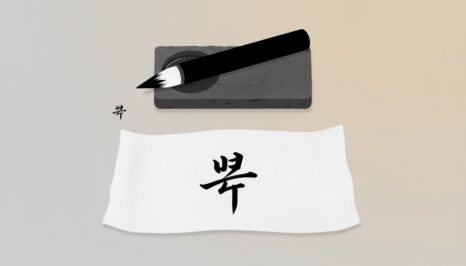
Write Like a K-Drama King: Surviving Your First Calligraphy Class 🖌️
Phase 1: The Immersive Hook
Hello! This is your Daily Hangul Editor.
Imagine this scene: You are watching a historical K-Drama (Sageuk). The King sits in a dimly lit room, staring intensely at a blank sheet of paper. He takes a deep breath, dips a large brush into black ink, and with one swift motion—Swoosh!—he writes a powerful message that changes the fate of the kingdom. 📜
Now, cut to reality. You are in a nice Hanok (traditional house) in Bukchon, holding a brush for the first time. You want to look cool like that King, but your hand is shaking, and you’re afraid of spilling black ink all over your white pants.
Don’t panic! Taking a Seoye (Calligraphy) class is one of the most popular cultural activities for tourists in Korea. But how do you ask for help without breaking the meditative silence? Today, I’ll teach you the expressions that will make your teacher say, “Wow, you have the soul of a scholar!” Let’s get our hands dirty (hopefully not literally)!
Phase 2: Deep Dive into Key Expressions
Here are the 3 essential phrases to survive the inkstone.
1. 이거 어떻게 잡아요? (Igeo eotteoke jabayo?)
- Pronunciation: [I-geo uh-dduh-keh ja-ba-yo?]
- jab sounds like the ‘job’ in “Great job!”
- Meaning: “How do I hold this?”
- Igeo (This) + Eotteoke (How) + Jabayo (Hold/Grab)
- K-Culture Moment: In romance dramas, this is the classic “flirting” moment. The main character doesn’t know how to hold the brush (or bowling ball, or pool cue), and the love interest comes from behind to “guide” their hand. 💕
- Editor’s Insight: Holding a calligraphy brush is totally different from holding a pen. You hold it vertically! If you just grab it like a pencil, the teacher might look stressed. Ask this first to show you are ready to learn properly.
- Situation Spectrum:
[🚫 Formal Boss] ———— [✅ Teacher/Stranger] ———— [✅ Friend]- 🤔 Think About It: Why is “posture” (holding the brush) considered more important than the writing itself in the beginning? What does this say about the Korean emphasis on basics and attitude?
2. 망쳤어요… (Mang-cheo-sseo-yo…)
- Pronunciation: [Mang-chuh-ssuh-yo]
- Mang sounds like a gong crashing.
- Meaning: “I messed it up.” / “I ruined it.”
- K-Culture Moment: You’ll hear this in cooking variety shows when a celebrity burns the kimchi pancake. “Ah! Mangcheosseoyo!” (It’s ruined!).
- Editor’s Insight: This is a very useful “self-deprecating” phrase. In a calligraphy class, you will make mistakes. Instead of just sighing, say this with a sad face 🥺. The teacher will immediately come to comfort you or give you new paper.
- Situation Spectrum:
[🚫 Solemn Ceremony] ———— [⚠️ Teacher] ———— [✅ Casual Class/Friends]
(Note: It’s okay to say to a teacher in a class setting, but don’t say it if you are writing a formal contract!)3. 종이 더 주세요. (Jongi deo juseyo.)
- Pronunciation: [Jong-ee duh ju-seh-yo]
- Meaning: “Please give me more paper.”
- K-Culture Moment: Similar to asking for more side dishes (banchan) at a restaurant. It shows you are enthusiastic and want to try again.
- Editor’s Insight: Hanji (traditional paper) is precious, but teachers love students who practice hard. Don’t be shy!
Phase 3: Textbook vs. Real Life
| Situation | 📖 Textbook Korean | 🗣️ Real Korean | 💡 Why different? |
|---|---|---|---|
| Asking for help | 선생님, 도와주십시오. (Teacher, please help me.) | 선생님, 이거 좀 봐 주세요. (Teacher, please look at this a bit.) | “Help me” sounds serious (like an emergency). “Look at this” is softer and invites feedback. |
| Making a mistake | 실수를 했습니다. (I made a mistake.) | 아, 망했다… (Ah, I’m doomed/ruined…) | “Silsu” is factual. “Manghaetta” carries the emotional frustration of the moment! |
| Finished writing | 다 썼습니다. (I have finished writing.) | 다 했어요! (I’m done!) | “Sseoda” (write) is specific, but “Hada” (do) is the universal verb for finishing a task. |
Phase 4: Cultural Deep Dive
4-1. Non-verbal: The Art of Patience (And Silence)
In Western classes, it’s good to ask many questions. In a Korean calligraphy class, silence is golden.
– Eyes: Watch the teacher’s demonstration until the very end without interrupting.
– Breathing: Experienced calligraphers breathe in rhythm with their strokes. Don’t hold your breath until you turn blue!
– Nunchi: If everyone is quietly grinding their ink, don’t start chatting loudly about your lunch plans. Read the room!
4-2. K-Culture Connection: The “Idol” New Year
Have you seen K-Pop idols writing “Happy New Year” (새해 복 많이 받으세요) with a brush on YouTube?
– Even global stars struggle with this! They often laugh when their handwriting looks like “chicken scratch” (called akpil 악필 in Korean).
– Fun Fact: Bad handwriting is charming in K-Dramas (shows innocence), but in calligraphy, we aim for Seokbong style (a famous Joseon calligrapher).
Phase 5: Immersive Roleplay Scenario
Setting: A quiet culture center in Insadong, Seoul. The smell of pine ink fills the air. You are sitting on a cushion on the floor.
Characters:
– YOU: An enthusiastic tourist trying calligraphy for the first time.
– Master Kim: An elderly calligraphy teacher wearing traditional Hanbok. Strict but kind eyes.
(Dialogue Start)
Master Kim: (Handing you a brush) 자, 마음을 비우고 시작해 보세요.
(Cha, ma-eumeul bi-u-go si-jak-hae bo-se-yo.)
[Translation: Okay, empty your mind and try starting.]
YOU: (You grab the brush like a pencil)
… Uh, wait.
🔀 Decision Point: How do you ask for correction?
A) “Is this right?” (이거 맞아요?)
B) “Teacher, how do I hold this?” (선생님, 이거 어떻게 잡아요?)
C) Just start writing and hope for the best.✅ Best Choice: B – It admits you need basics. Master Kim loves teaching basics.
⚠️ Choice A Analysis: It’s okay, but “Is this right?” implies you think you might be right. B is more humble.
YOU: 선생님, 이거 어떻게 잡아요? (Teacher, how do I hold this?)
Master Kim: (Smiling) 허허. 붓은 이렇게 세워서 잡아야 해요.
(Heo-heo. Buseun ireoke se-wo-seo ja-ba-ya haeyo.)
[Translation: Ho ho. You must hold the brush upright like this.]
YOU: (Trying again, but ink drips on the paper) 앗!
Master Kim: 괜찮아요. 다시 해 보세요.
(Gwaenchanayo. Dasi hae boseyo.)
[Translation: It’s okay. Try again.]
YOU: (Sad face) ____________!
🔀 Your Turn: Which phrase fits here?
A) 맛있어요! (It’s delicious!)
B) 망쳤어요… (I ruined it…)
C) 비싸요? (Is it expensive?)✅ Correct Answer: B – Perfect timing to use the phrase we learned!
Phase 6: 10-Second Shadowing Drill
Let’s practice the “Oops” moment. Don’t say it angrily; say it with a “cute sadness.”
- Teacher, I ruined it… (Cute/Sad) 🥺
선생님, / 저 / 망쳤어요…
(Seonsaengnim, / jeo / mang-cheo-sseo-yo…) -
Please give me one more paper! (Eager) 🙋
종이 / 한 장만 / 더 주세요!
(Jongi / han jang-man / deo juseyo!)
Phase 7: K-Culture Mini Glossary
| Korean | Romanization | Meaning | Context |
|---|---|---|---|
| 서예 | Seoye | Calligraphy | The art of writing. Often considered a form of mental training. |
| 붓 | But | Brush | Not a makeup brush! It’s made of animal hair. |
| 한지 | Hanji | Traditional Paper | Very durable paper made from mulberry trees. |
| 낙관 | Nakkwan | Red Stamp/Seal | The artist’s signature stamp used at the end of a work. |
| 명상 | Myeong-sang | Meditation | What you are supposedly doing while writing. |
Phase 8: Traveler’s Survival Kit (Insadong Edition)
If you are doing calligraphy, you are likely in Insadong or a Hanok Village. Here is how to survive the souvenir shopping afterwards.
🆘 Survival Expression #1
– 🇰🇷 “이거 수제예요?” (Igeo suje-yeyo?)
– 🗣️ Pronunciation: [Ee-geo soo-jeh-yeh-yo?]
– Meaning: “Is this handmade?”
– Why use it: Insadong has many factory-made souvenirs. Ask this to find the real treasures (or at least make the shop owner respect you).📌 Editor’s Travel Note
– Personalized Stamps (Dojang): You can carve your own name into a stone stamp in Insadong. It’s the best souvenir.
– English Names: Yes, you can write your English name in Hangul calligraphy! It looks super cool vertically.
Phase 9: Think Deeper — “The Soul of the Letter”
Think About It:
In the digital age, we type everything on smartphones. Why do Koreans still value Seoye (Calligraphy)?
In Korea, handwriting was traditionally seen as a mirror of one’s character. If your writing was messy, your mind was considered messy. Even today, despite the heavy use of technology, receiving a hand-written letter is considered extremely touching and sincere (Jeongseong 정성).
💬 Your Turn: Does your culture believe that handwriting reveals personality? Or is it just a tool? Share in the comments!
Phase 10: FAQ & Troubleshooting
Q: Can I use “망쳤어요” (I ruined it) to my boss at work?
A: ⚠️ Be careful. If it’s a small mistake (like spilling coffee), it’s funny. If it’s a major project, say “죄송합니다” (I apologize) and fix it. “망쳤어요” sounds a bit like you are giving up!
Q: Is it rude to write with my left hand?
A: Traditionally, yes, calligraphy was strictly right-handed. However, for a one-day experience class, teachers are understanding. Just ask: “왼손으로 써도 돼요?” (Can I write with my left hand?)
❌ Common Mistake:
Don’t shake the brush to dry the ink! You might splash the person next to you. Just wait patiently.
Phase 11: Wrap-up & Mission
Summary: Today we learned how to ask for help with holding the brush (어떻게 잡아요?), admit defeat gracefully (망쳤어요), and ask for a second chance (종이 더 주세요).
🚀 Action Missions:
– 🥉 Bronze: Say “Mang-cheo-sseo-yo” out loud next time you burn toast or make a typo.
– 🥈 Silver: Google your name in Korean, grab a pen, and try to write it vertically like a calligraphy master.
– 🥇 Gold: Visit a calligraphy cafe or center in Korea and ask the teacher for help in Korean!
🎬 K-Culture Mission:
Watch a clip of the K-Drama “The Red Sleeve” (옷소매 붉은 끝동). Look for the scenes involving writing and books. Notice how they hold the brush!
Phase 12: Interactive Quiz
- Situation: You are in class. You finished your writing and it looks perfect. What do you say?
- A) 망쳤어요. (I ruined it.)
- B) 다 했어요! (I’m done!)
- C) 도와주세요. (Help me.)
- Culture True or False:
- In a calligraphy class, it is polite to chat loudly to make the atmosphere fun.
- (True / False)
Answers:
1. B (Be proud!)
2. False (Silence and focus are part of the respect/meditation.)


