

Phase 1: Empathy (Story-Driven Opening)
안녕하세요! 매일한글 에디터입니다. (Hello! I’m your Daily Hangul editor.)
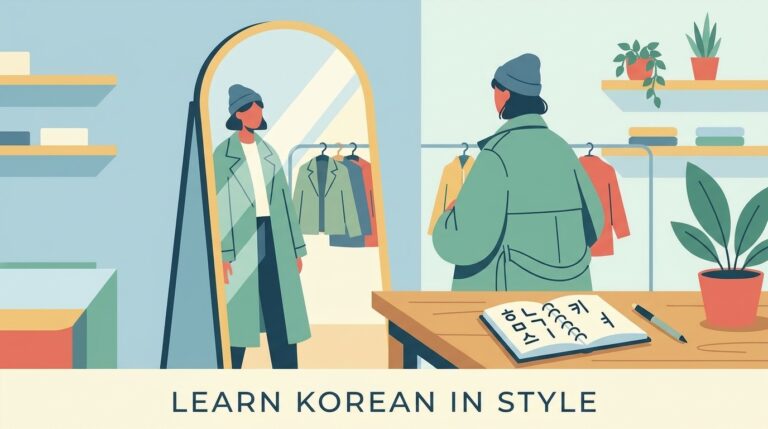
Picture this: You are standing in front of a chic, minimalist boutique in Hongdae or Seongsu-dong, Seoul. You just tried on a trendy oversized blazer or a stylish pastel knit sweater that looks straight out of an idol’s airport fashion photos. You step out of the fitting room and look at your friend or catch the eye of the friendly shop clerk. You want to ask, “Does this look good on me? Does it suit my style?”
Suddenly, your mind freezes. You know the textbook words for “good” (chota) and “clothes” (ot), but you don’t know the exact, natural phrase Koreans use when checking how an outfit looks. Saying the wrong thing might feel awkward or stiff!
Don’t worry—you’re not alone. Asking for opinions while shopping is one of the top hurdles for beginner (A2) Korean learners. Today, based on real feedback from hundreds of Daily Hangul learners, we’re breaking down the exact, natural phrases and cultural tips you need to confidently ask “How does this look on me?” in any Korean clothing shop!
Phase 2: Top 3 Core Expressions Deep Dive
1. 잘 어울려요? (Jal eoullyeoyo?)
- Pronunciation: Jal uh-wool-lyuh-yo? (Sounds like “Jal” + “a-wool” + “leo-yo”)
- Meaning: Literal: “Does it blend well?” / Real Nuance: “Does this look good on me? / Does this suit me?”
- K-Culture Moment: Seen in almost every K-drama makeover scene where the lead tries on new outfits before a big date and asks their best friend excitedly.
- Editor’s Insight: 어울리다 (eoullida) means to match, harmonize, or suit. Adding 잘 (well) makes it the most natural and polite way to ask if clothing or a hairstyle suits your overall vibe.
- Situation Spectrum: Casual: ✅ (잘 어울려?) | Semi-formal: ✅ (잘 어울려요?) | Formal: ✅ (잘 어울립니까?)
- 🤔 Think About It: In English, we often ask “Do I look good in this?” while Korean focuses on whether the item harmonizes (어울리다) with you. Notice the subtle community harmony mindset!
2. 이거 어때요? (Igeo eottaeyo?)
- Pronunciation: Ee-guh uh-ttae-yo? (Sounds like “Ee-guh” + “uh-teh-yo”)
- Meaning: Literal: “How is this?” / Real Nuance: “What do you think of this one?”
- K-Culture Moment: Browsing clothing racks in Dongdaemun with a friend, holding up a jacket against your chest to get a quick instant impression.
- Editor’s Insight: Short, versatile, and beginner-friendly! You can use this while pointing at anything—shoes, hats, colors, or full outfits.
- Situation Spectrum: Casual: ✅ (이거 어때?) | Semi-formal: ✅ (이거 어때요?) | Formal: ⚠️ (이것은 어떻습니까? – slightly stiff for retail shopping)
- 🤔 Think About It: This asks for the listener’s broad opinion without leading the answer, giving your friend room to be honest.
3. 저한테 잘 맞아요? (Jeohante jal majayo?)
- Pronunciation: Juh-hahn-teh jal mah-jah-yo? (Sounds like “Juh-han-teh” + “jal” + “mah-ja-yo”)
- Meaning: Literal: “Does it fit me well?” / Real Nuance: “Does the size/fit look right on me?”
- K-Culture Moment: When trying on pants or jackets where you are unsure if the shoulders or waist fit properly.
- Editor’s Insight: 맞다 (matda) can mean “to fit physically (size)” or “to suit one’s image.” To specify size, you can say “사이즈 잘 맞아요?” (Does the size fit?).
- Situation Spectrum: Casual: ✅ (나한테 잘 맞아?) | Semi-formal: ✅ (저한테 잘 맞아요?) | Formal: ✅ (저에게 잘 맞습니까?)
- 🤔 Think About It: Notice the humble pronoun 저 (jeo) used with ~한테 (to/for me) to stay polite with staff.
Phase 3: Textbook Korean vs. Real Korean
Situation 1: Asking if a color looks good on you
* 📖 교과서 한국어 (Textbook): 이 색깔이 제 피부에 아름답습니까? (I saekkkari je pibue areumdapseumnikka? – Is this color beautiful on my skin?)
* 🗣️ 진짜 한국어 (Real-life): 이 색깔 저한테 잘 받아요? (I saekkkal jeohante jal badayo? – Does this color suit my complexion?)
* 💡 왜 다를까? (Why the difference?): In real spoken Korean, natives use the idiom 잘 받다 (to receive well) when a color complements skin tone, rather than poetic words like 아름답다 (beautiful).
Situation 2: Asking if an outfit looks weird or awkward
* 📖 교과서 한국어 (Textbook): 이 옷이 이상한 모양입니까? (I osi isanghan moyang-imnikka? – Is this clothing of strange shape?)
* 🗣️ 진짜 한국어 (Real-life): 이거 좀 이상해요? (Igeo jom isanghaeyo? – Does this look a bit weird/off?)
* 💡 왜 다를까? (Why the difference?): Natural Korean relies on softening adverbs like 좀 (a little bit / slightly) to make questions sound soft, polite, and natural.
Phase 4: K-Culture Deep Dive & Non-Verbal Manners
4-1. 눈치 (Nunchi) & Retail Body Language
When shopping in Korean boutiques, non-verbal cues matter:
* The Gentle Turn & Arm Check: When stepping out in an outfit, do a soft half-turn towards the mirror, then make light eye contact with the clerk or friend while holding your hands lightly near your waist.
* Using “좀” (Jom) to soften requests: If something feels tight or loose, tilting your head slightly while saying “조금 큰 것 같아요…” (It seems a bit big…) signals your preference without sounding demanding.
4-2. Fashion Culture: The Korean “Fit” (핏)
In Korean fashion culture, how clothes silhouette your body is called 핏 (Fit)—like 오버핏 (Over-fit / Oversized) or 슬림핏 (Slim-fit). Korean staff love helping customers find the right 핏, so asking “이 핏 어때요?” (How does this silhouette look?) instantly makes you sound like a local insider!
Phase 5: Real-World Roleplay Scenario
Setting: A trendy clothing store in Hongdae. You are trying on a modern autumn jacket. Staff member Min-ji is standing nearby.
- You: 🎭 [Stepping out of the fitting room, looking in the mirror]
저기요, 이거 저한테 잘 어울려요?
(Jeogiyo, igeo jeohante jal eoullyeoyo? / Excuse me, does this suit me well?) - Min-ji (Clerk): 🎭 [Smiling warmly, looking at the fit]
와, 고객님! 색상이 고객님 톤이랑 정말 잘 어울리세요!
(Wa, gogaeknim! Saeksangi gogaeknim ton-irang jeongmal jal eoulriseyo! / Wow! The color matches your tone really well!) - You: 🎭 [Turning to check the shoulders]
사이즈는 어때요? 너무 커 보이지 않아요?
(Saijeuneun eottaeyo? Neomu keo boiji anayo? / How is the size? Doesn’t it look too big?) - Min-ji: 🎭 [Lightly gesturing to the shoulder line]
요즘 유행하는 예쁜 오버핏이에요. 어깨선 딱 좋아요.
(Yojeum yuhaenghaneun yeppeun obeopisieyo. Eokkaeseon ttak joayo. / It’s a trendy over-fit style. The shoulder line is just right.) - You: 🎭 [Looking at another color on the rack]
이 베이지색도 한번 입어봐도 돼요?
(I beijisaekdo hanbeon ibeobwado dwaeyo? / Can I try on this beige one too?) - Min-ji: 🎭 [Nodding enthusiastically, handing the hanger]
네, 물론이죠! 편하게 입어보세요.
(Ne, mullonijyo! Pyeonhage ibeoboseyo. / Yes, of course! Feel free to try it on.) - You: 🎭 [After trying the beige one]
둘 중에 어떤 게 더 나아요?
(Dul junge eotteon ge deo na-ayo? / Which one out of the two is better?) - Min-ji: 🎭 [Giving honest advice with a smile]
처음 입으신 블랙이 훨씬 더 깔끔하고 잘 어울려요!
(Cheo-eum ibeusin beullaegi hwolssin deo kkalkkeumhago jal eoullyeoyo! / The black one you tried first is much cleaner and suits you better!)
🔀 Interactive Branching Choice:
Min-ji recommended the black jacket. How do you respond?
- Option A: “그럼 블랙으로 할게요. 감사해요!” (Then I’ll take the black one. Thank you!)
- Option B: “이거 너무 별로예요. 다른 가게 갈게요.” (This is really bad. I’m going to another store.)
- Option C: “생각 좀 더 해보고 올게요. 감사합니다!” (I’ll think about it a bit more and come back. Thank you!)
Feedback:
* Option A (Best!): Polite, decisive, and native-like! Min-ji will happily pack it for you.
* Option B (Bad!): Way too blunt and harsh. Even if you don’t buy, Koreans soften their exit.
* Option C (Great Survival Tip!): The standard polite Korean phrase when you want to look around other shops without feeling pressured.
Phase 6: 10-Second Emotion Shadowing Drill
Practice these aloud with real emotion and rhythm (pause at /):
[😊 설레고 기대하며 / Excited & Expectant]
저기요, / 이거 저한테 / 잘 어울려요?
(Jeogiyo, / igeo jeohante / jal eoullyeoyo?)-
[🤔 진지하게 고민하며 / Thoughtful & Decisive]
둘 중에 / 어떤 색이 / 더 나아요?
(Dul junge / eotteon saegi / deo na-ayo?) -
[🥺 조심스럽고 공손하게 / Polite & Softening]
사이즈가 / 조금 큰 것 같은데, / 작은 거 있어요?
(Saijeuga / jogeum keun geot gateunde, / jageun geo isseoyo?)
Phase 7: K-Culture Mini Dictionary
- 착샷 (Chak-syat) | Outfit Proof Shot (OOTD Photo)
- Usage: Short for 착용 샷 (wearing shot). Used frequently in fashion reviews and social media: “착샷 보여주세요!” (Please show me the outfit photo!).
- 핏 (Pit) | Silhouette / Fit of clothes
- Usage: Borrowed from English “fit”, but used as a noun describing how an item shapes the body (e.g., 루즈핏 loose fit, 인생핏 life-best fit).
- 톤온톤 (Ton-on-ton) | Tone-on-tone (Monochromatic styling)
- Usage: Styling an outfit using various shades of the same color palette, a huge trend in Korean street fashion.
- 거울 셀카 (Geoul Selka) | Mirror Selfie
- Usage: Taking a photo in the store’s full-length aesthetic mirror to check the overall vibe.
Phase 8: Survival Kit for Travelers
Top 3 Survival Phrases
- 이거 입어봐도 돼요? (Igeo ibeobwado dwaeyo?)
- Pro Tip: Always ask before entering fitting rooms, especially for white tops or knitwear which might have makeup restrictions!
- 다른 색상 있어요? (Dareun saeksang isseoyo?)
- Pro Tip: Use when you love the design but want black, cream, or navy.
- 조금만 더 둘러보고 올게요. (Jogeumman deo dulleobogo olgeyo.)
- Pro Tip: The ultimate polite escape phrase when browsing without buying immediately.
Editor’s Travel Note
When navigating Korean fashion hotspots like Seongsu, Hongdae, or Express Bus Terminal Underground Mall (Goto Mall), keep cash or your T-money card handy for underground shops, and use the Naver Map app download to pinpoint indie boutiques with great reviews!
Phase 9: “One Step Deeper” (Cultural Reflection)
In many Western cultures, personal fashion is an individual statement of uniqueness. In Korea, while individuality is celebrated, fashion is also seen as a form of social harmony (어울림) and respect for the setting. When Koreans ask “잘 어울려요?”, they are looking not just at the garment, but at the balance between the person, the outfit, and the surrounding vibe.
💬 Your Turn: How do you usually ask your friends for fashion advice in your native language? Drop your favorite phrase in the comments below!
Phase 10: FAQ & Common Mistakes
Q: Can I ask the store staff ‘예뻐요?’ (Is it pretty?) instead of ‘잘 어울려요?’
A: Yes, but 예뻐요? asks if the clothes themselves are pretty, whereas 잘 어울려요? asks if the clothes look good specifically on you.
Q: What should I do if white shirts have a ‘No Fitting’ sign?
A: Many Korean boutiques protect white clothing from makeup stains. Look for signs saying “흰색 옷 착용 불가” (White clothes cannot be tried on) or ask the staff for a face cover (페이스 커버).
Q: How do I tell the clerk I’m just looking around?
A: Simply say with a light bow: “그냥 구경할게요~” (Geunyang gugyeonghalgeyo – I’m just browsing).
🚨 Common Mistakes TOP 3
- Mistake: Saying “당신한테 잘 맞아요?” (Does it fit you?)
- Correct Action: Don’t use 당신 (dangsin)! Say “저한테 잘 맞아요?” (Does it fit me?).
- Mistake: Forgetting to remove shoes before stepping onto fitting room mats.
- Correct Action: Step onto the wooden or cloth fitting mat without outdoor shoes.
- Mistake: Translating “Does this match?” as “이거 매치돼요?”
- Correct Action: Use the natural Korean verb: “이거 잘 어울려요?”.
Phase 11: Action Mission
- 🥉 Bronze Mission: Stand in front of your home mirror, pick your favorite jacket, and say “이거 저한테 잘 어울려요?” aloud 3 times.
- 🥈 Silver Mission: Post your OOTD on Instagram or TikTok and caption it in Korean: “오늘 룩 어때요? 잘 어울려요?”
- 🥇 Gold Mission: Next time you visit a Korean retail store or chat with a Korean language exchange partner, use “둘 중에 어떤 게 더 나아요?” to ask for a choice.
- 🎮 K-Culture Mission: Watch a scene in your favorite K-Drama where characters go shopping, and spot whether they say 어때? or 잘 어울려?!
Phase 12: Interactive Quiz Challenge
1. Situation Quiz: You want to ask a store clerk if an oversized jacket suits you. What is the most natural sentence?
a) 이거 나한테 예뻐?
b) 이거 저한테 잘 어울려요?
c) 이 옷이 아름답습니까?
2. Fill-in-the-Blank:
“둘 중에 어떤 게 더 ________?” (Which one out of the two is better?)
3. True or False:
In Korean fashion stores, 착샷 (Chak-syat) means asking for a discount.
👉 Click here to reveal Answers & Explanations!
- Answer: b) 이거 저한테 잘 어울려요?
- Explanation: Polite ending (-요) combined with the humble pronoun (저) and natural verb (어울리다).
- Answer: 나아요 (na-ayo)
- Explanation: 낫다 (to be better) conjugates irregularly to 나아요 in polite present tense.
- Answer: False!
- Explanation: 착샷 means an outfit photo (착용 샷 / wearing shot), not a discount!
- Explanation: 착샷 means an outfit photo (착용 샷 / wearing shot), not a discount!







