

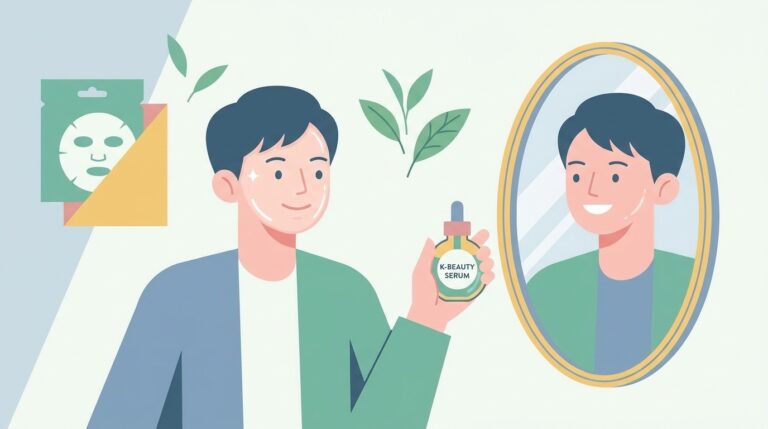
Phase 1: Empathy & K-Culture Cold Open
Hello there! This is your Daily Hangul Editor.
Imagine this: You’re walking down the vibrant streets of Myeongdong or Gangnam, and the bright, inviting lights of an Olive Young store pull you in. The latest K-Pop hit is blasting through the speakers. You confidently walk up to the skincare aisle, determined to achieve that flawless, glowing ‘K-Drama Glass Skin.’ But then, a friendly staff member approaches and asks, “고객님, 피부 타입이 어떻게 되세요?” (Customer, what is your skin type?)
Suddenly, your mind goes blank. You know the word for ‘water’ and ‘face,’ but how do you explain that your cheeks are dry, your T-zone is an oil slick, and you broke out because of the weather change? You might just grab the prettiest bottle and run, right?
Don’t worry. As someone who has navigated both the complex grammar of the Korean language and the equally complex 10-step K-Beauty skincare routine, I’m here to help. This guide is built from the real struggles of my B2-level students who wanted to shop for skincare in Seoul like true locals. If you master today’s phrases, you won’t just get better skin—you’ll get the ultimate ‘Insider’ treatment from any K-Beauty store clerk.
Let’s dive in!
Phase 2: Core Expressions Deep Dive
Here are the top 3 expressions you need to describe your skin like a true Korean beauty guru.
1. 제 피부는 수부지예요. (My skin is dehydrated oily.)
- Pronunciation: [Je pibuneun subujiyeyo.] + [su-boo-jee-yay-yo]
- Meaning: Literal: My skin is moisture-lacking oily type. / Real nuance: I have combination skin (oily on the outside, dry on the inside).
- K-Culture Moment: You’ll hear this constantly in beauty YouTube videos or idol skincare routine vlogs. It’s an essential Korean abbreviation (줄임말). When you say this to a store clerk, their eyes will light up because it shows you deeply understand K-Beauty terminology.
- Editor’s Insight: ‘수부지’ stands for 수분 부족형 지성. Koreans love categorizing skin types accurately to find the perfect product match.
- Situation Spectrum:
- Friends (Casual): ✅
- Store Clerks (Semi-formal): ✅
- Formal Presentations (Formal): ⚠️ (Better to use the full term in a very formal setting)
- 🤔 Think About It: Why do Koreans use so many abbreviations for very specific physical conditions? How does the fast-paced ‘빨리빨리 (Bbali-bbali)’ culture reflect in the way new words are formed?
2. 요즘 트러블이 자꾸 올라와요. (I keep breaking out lately.)
- Pronunciation: [Yojeum teureobeuri jakku ollawayo.] + [teu-ruh-beul-ee ohl-la-wa-yo]
- Meaning: Literal: Trouble keeps coming up lately. / Real nuance: I’m getting acne/pimples/breakouts lately.
- K-Culture Moment: Picture a K-Drama heroine looking into the mirror right before a big date, sighing deeply as she spots a pimple. She wouldn’t say “I have acne disease.” She’d complain about “trouble.”
- Editor’s Insight: While ‘여드름’ (yeodeureum) is the clinical word for acne, ‘트러블’ (trouble) is the much softer, everyday term for any kind of skin issue (pimples, redness, irritation). The verb ‘올라오다’ (to come up) perfectly captures the feeling of a pimple rising to the surface.
- Situation Spectrum:
- Friends (Casual): ✅
- Dermatologist/Clerks (Semi-formal): ✅
- Workplace (Formal): ✅ (Appropriate if discussing cosmetics)
- 🤔 Think About It: In Korean, we often use borrowed English words (like ‘trouble’, ‘stress’) but change their context slightly. Do you have ‘Konglish’ equivalent words in your native language that have shifted in meaning?
3. 촉촉한데 끈적이지 않는 걸로 추천해 주세요. (Recommend something moisturizing but not sticky.)
- Pronunciation: [Chokchokhande kkeunjeogiji anneun geollo chucheonhae juseyo.] + [chok-chok-han-deh kkeun-juh-gi-jee an-neun gul-lo]
- Meaning: Literal: Please recommend something that is moist but doesn’t stick. / Real nuance: I’m looking for a hydrating product with a lightweight finish.
- K-Culture Moment: This is the Holy Grail request in Korean skincare. Watch any K-Beauty live commerce stream, and the host will tap their cheeks showing that the product absorbs perfectly without leaving their skin sticky.
- Editor’s Insight: ‘촉촉하다’ (to be moist/hydrated) is a universally positive word in Korea. ‘끈적이다’ (to be sticky) is the enemy of the Korean summer. Using these two sensory verbs together shows you have a high level of Korean fluency.
- Situation Spectrum:
- Friends (Casual): ✅ (Change ending to ‘추천해 줘’)
- Store Clerks (Semi-formal): ✅
- Business (Formal): 🚫
- 🤔 Think About It: Korean has an incredibly rich vocabulary for textures and sensations (촉감). Why do you think sensory experiences are so highly detailed in the Korean language?
Phase 3: Textbook vs. Real Korean
[Describing Dry Skin]
* 📖 Textbook Korean: 제 피부는 매우 건조합니다. (My skin is very dry.)
* 🗣️ Real Korean: 세수하면 얼굴이 엄청 당겨요. (When I wash my face, it feels super tight/pulled.)
* 💡 Why the difference?: Real Korean focuses on the feeling rather than just stating a clinical fact. The verb ‘당기다’ (to pull/feel tight) is the most natural way to describe dry skin.
[Asking for a Recommendation]
* 📖 Textbook Korean: 여드름 약을 사고 싶습니다. (I want to buy acne medicine.)
* 🗣️ Real Korean: 트러블 진정에 좋은 거 있어요? (Do you have anything good for calming breakouts?)
* 💡 Why the difference?: ‘진정’ (calming/soothing) is a massive buzzword in K-Beauty. It sounds much more natural and knowledgeable than just asking for ‘medicine.’
Bottom Note: At the B2 level, try to move away from direct translations and start using these culturally embedded sensory words and beauty buzzwords!
Phase 4: Cultural Context — K-Culture Deep Dive
4-1. Non-Verbal Cues: The ‘Tap Tap’ Technique
When you test skincare products in Korea, never rub the product aggressively into the back of your hand. Instead, gently tap it with your fingertips. This action is called ‘톡톡 두드리다’ (tok-tok dudeurida). In Korean culture, gently tapping the skin is believed to help the product absorb better and prevents wrinkles. Doing this while speaking instantly makes you look like a K-Beauty pro.
4-2. The K-Drama Emergency Skincare Trope
Have you ever noticed in K-Dramas that whenever a character has a crucial event the next day—an interview, a wedding, or meeting the future mother-in-law—they are always shown lying in bed with a sheet mask on? This reflects the real-life concept of ‘1일 1팩’ (One day, one pack). In Korea, skincare isn’t just grooming; it’s considered self-respect and preparation. Taking care of your skin is often socially viewed as taking care of your life.
Phase 5: Interactive Roleplay Scenario
Setting: Saturday afternoon. Inside a bustling Olive Young store in Hongdae. The air smells like floral perfume and vitamin C serums. You’ve been staring at a wall of 50 different toners for five minutes.
Characters:
– YOU (The Reader): An expat living in Seoul, struggling with skin that feels dry inside but looks oily outside.
– Staff (Jiyeon, 20s): Friendly, wears an Olive Young apron, eager to help.
Dialogue:
Jiyeon: 고객님, 찾으시는 제품 있으세요?
(Gogaengnim, chajeusineun jepum isseuseyo?)
(Customer, is there a product you are looking for?)
YOU: 아, 스킨케어 제품 좀 보려고요.
(A, seukinkeeo jepum jom boryeogoyo.)
(Ah, I’m just trying to look at some skincare products.)
Jiyeon: 네~ 평소 피부 타입이 어떻게 되시는데요?
(Ne~ pyeongso pibu taibi eotteoke doesineundeyo?)
(Yes~ What is your usual skin type?)
🔀 Your Turn! How should you answer?
– A) “저는 물이 필요하고 기름이 많아요.” (I need water and have a lot of oil.)
– B) “제 피부는 수부지예요. 가벼운 거 추천해 주세요.” (My skin is dehydrated oily. Please recommend something light.)
– C) “몰라요. 제일 잘 팔리는 거 주세요.” (I don’t know. Give me the best-selling one.)✅ Best Choice: B — Reason: You accurately diagnose your skin using the local term (‘수부지’) and give the staff a clear direction (‘가벼운 거’ – lightweight).
⚠️ Choice A Analysis: This is a direct literal translation from English and sounds very awkward.
⚠️ Choice C Analysis: While efficient, it might result in buying a product that completely ruins your skin barrier!
(Continuing with Choice B)
Jiyeon: 아, 수부지시구나! 그럼 이 수분 앰플 어떠세요? 속건조를 꽉 잡아주거든요.
(A, subujisiguna! Geureom i subun aempeul eotteoseyo? Sokgeonjoreul kkwak jabajugeodeunyo.)
(Ah, you’re dehydrated oily! Then how about this moisture ampoule? It firmly fixes inner dryness.)
YOU: 오, 끈적이지는 않나요?
(O, kkeunjeogijineun annayo?)
(Oh, is it not sticky?)
Jiyeon: 네, 텍스처가 아주 가볍고 촉촉하게 마무리돼요. 한번 테스트해 보시겠어요?
(Ne, tekseucheoga aju gabyeopgo chokchokhage mamuridoeyo. Hanbeon teseuteuhae bosigesseoyo?)
(Yes, the texture is very light and it has a moisturizing finish. Would you like to test it?)
YOU: 네, 발라볼게요. 향도 은은하고 좋네요. 이걸로 할게요!
(Ne, ballabolgeyo. Hyangdo euneunhago jonneyo. Igeollo halgeyo!)
(Yes, I’ll put some on. The scent is subtle and nice. I’ll take this one!)
Phase 6: 10-Second Shadowing Drill
Let’s practice the perfect rhythm for asking a recommendation!
😊 제 피부가 / 수부지라서 그런데요, / 촉촉하고 / 가벼운 제형으로 / 추천해 주실래요?
(Je pibuga / subujiraseo geureondeyo, / chokchokhago / gabyeoun jehyeongeuro / chucheonhae jusillaeyo?)
Coach’s Tip: Pause briefly at the slashes (/). Smile nicely, and raise your pitch slightly at the end to sound polite and approachable!
Phase 7: K-Culture Mini Dictionary
1. 수부지 (Su-bu-ji)
* Romanization: subuji
* English: Dehydrated Oily Skin
* Context: Short for 수분 부족형 지성. The most commonly diagnosed skin type among young Koreans due to weather changes and indoor heating/cooling.
2. 1일 1팩 (1-il 1-paek)
* Romanization: iril ilpaek
* English: One sheet mask a day
* Context: A popular skincare trend/lifestyle in Korea to maintain ultimate skin hydration.
3. 물광피부 (Mul-gwang pibu)
* Romanization: mulgwang pibu
* English: Glass skin / Water-glow skin
* Context: The ultimate beauty standard in Korea—skin that looks so hydrated and healthy that it seems to reflect light like the surface of water.
4. 속건조 (Sok-geon-jo)
* Romanization: sokgeonjo
* English: Inner dryness
* Context: When your skin feels tight and dry from the inside, even if it looks oily or normal on the outside. K-beauty focuses heavily on fixing ‘속건조’.
Phase 8: Traveler’s Survival Kit
Heading to Myeongdong for a beauty haul? You must save these phrases!
🆘 Survival Phrases for K-Beauty Shopping
– 🇰🇷 “이거 테스트해 봐도 돼요?” (igeo teseuteuhae bwado dwaeyo?) – Can I test this?
– 🇰🇷 “혹시 이거 할인 언제까지 해요?” (hoksi igeo harin eonjekkaji haeyo?) – By any chance, until when is this on sale?
– 🇰🇷 “샘플 좀 많이 챙겨주세요~” (saempeul jom mani chaenggyeojuseyo~) – Please give me lots of samples~📌 Editor’s Travel Note
– Olive Young Sales: Look out for ‘올영세일’ (Ol-young Sale). It happens in March, June, September, and December. You can get up to 70% off!
– Tax Refund: In most big beauty stores in Korea, you can get an ‘Immediate Tax Refund’ (즉시 환급) at the register. Always bring your physical passport!
Phase 9: Critical Thinking — “One Step Deeper”
Media vs. Reality: The ‘Glass Skin’ Illusion
🧠 Think Deeper:
If you watch K-Dramas, you might think every Korean wakes up with flawless, poreless, glowing ‘물광피부’ (glass skin). While Koreans do invest heavily in their daily skincare routines, the media often obscures the reality. That perfect on-screen skin is usually the result of intense professional dermatology treatments (피부과 시술), expensive aesthetician visits, and high-end makeup techniques. The pursuit of this media-driven perfection can sometimes cause immense stress for ordinary Koreans who deal with natural ‘트러블’ (breakouts). Understanding this gap helps us appreciate K-Beauty as a fun self-care routine rather than an impossible standard.💬 Your Turn: Does the media in your culture promote a specific beauty standard that differs from reality? How do people usually react to it? Share in the comments!
Phase 10: FAQ & Avoiding Mistakes
Q: Can I ask a Korean stranger what skincare they use if their skin is really good?
Yes! Koreans generally take immense pride in their skincare. If you start with a compliment like “피부가 너무 좋으세요!” (Your skin is so good!), they will likely be thrilled to share their routine with you.
Q: How do I tell the clinic/store that my skin is sensitive?
Use the word ‘예민하다’ (yemin-hada) or ‘민감하다’ (mingam-hada). Example: “제가 피부가 좀 예민해서요.” (My skin is a bit sensitive.)
❌ Common Mistake #1: Saying “내 얼굴은 더러워요” (My face is dirty) to explain you have acne.
✅ Do this instead: Say “얼굴에 트러블이 났어요” (I got a breakout on my face). ‘더러워요’ literally means unhygienic/unwashed, which can be alarming to hear!❌ Common Mistake #2: Translating “I have oily skin” to “얼굴에 기름이 많아요.”
✅ Do this instead: Say “지성 피부예요” (I have oily skin type) or “유분기가 많아요” (I have a lot of sebum). ‘기름’ sounds like cooking oil!
Phase 11: Summary & Action Items
One-Liner Summary: To master K-Beauty shopping, stop translating clinical terms and start using sensory vocabulary like ‘수부지’, ‘트러블’, and ‘촉촉하다’!
Action Mission:
– 🥉 Bronze (Solo): Look at your skincare products at home and describe your skin type aloud in Korean.
– 🥈 Silver (Online): Go to a K-Beauty product review site (or Olive Young Global) and read the Korean reviews. Try to spot the word ‘촉촉해요’!
– 🥇 Gold (Real World): Visit a Korean cosmetic store and ask a staff member, “제 피부가 수부지인데, 제품 하나 추천해 주실래요?”
K-Culture Mission:
Search “아이돌 스킨케어 루틴” (Idol skincare routine) on YouTube. Watch a video and count how many times they use the words ‘진정’ (calming) or ‘수분’ (moisture)!
Did you discover your Korean skin type today? Let me know in the comments below!
Phase 12: Interactive Quiz
1. Situational Judgment:
You put on a moisturizer, but your face feels tight and dry from the inside. How do you describe this specific feeling to a Korean dermatologist?
– A) 피부가 너무 더러워요.
– B) 속건조가 심해요.
– C) 트러블이 올라왔어요.
(Answer: B – 속건조가 심해요 means inner dryness is severe.)
2. Fill in the Blank:
“여름이라서 너무 무거운 크림 말고, ( ______ ) 제품으로 추천해 주세요.”
(It’s summer, so instead of a heavy cream, please recommend a ______ product.)
– A) 끈적이지 않는 (not sticky)
– B) 당기는 (tight/pulling)
– C) 지성 (oily)
(Answer: A)
3. True or False – K-Culture Edition:
In Korea, it is considered rude to gently slap or tap your face while applying toner.
(Answer: False. ‘톡톡 두드리다’ (tapping) is highly encouraged in K-Beauty to help absorption and prevent skin pulling!)
Frequently Asked Questions (FAQ)
Q: What does "제 피부는 수부지예요. (My skin is dehydrated oily.)" mean in Korean and how do you pronounce it?
A: In Korean, "제 피부는 수부지예요. (My skin is dehydrated oily.)" is pronounced [Je pibuneun subujiyeyo.] and means: Literal: My skin is moisture-lacking oily type. / Real nuance: I have combination skin (oily on the outside, dry on the inside).
Q: What does "요즘 트러블이 자꾸 올라와요. (I keep breaking out lately.)" mean in Korean and how do you pronounce it?
A: In Korean, "요즘 트러블이 자꾸 올라와요. (I keep breaking out lately.)" is pronounced [Yojeum teureobeuri jakku ollawayo.] and means: Literal: Trouble keeps coming up lately. / Real nuance: I'm getting acne/pimples/breakouts lately.
Q: What does "촉촉한데 끈적이지 않는 걸로 추천해 주세요. (Recommend something moisturizing but not sticky.)" mean in Korean and how do you pronounce it?
A: In Korean, "촉촉한데 끈적이지 않는 걸로 추천해 주세요. (Recommend something moisturizing but not sticky.)" is pronounced [Chokchokhande kkeunjeogiji anneun geollo chucheonhae juseyo.] and means: Literal: Please recommend something that is moist but doesn't stick. / Real nuance: I'm looking for a hydrating product with a lightweight finish.







