Hello! I am the Lead Editor at Daily Hangul.
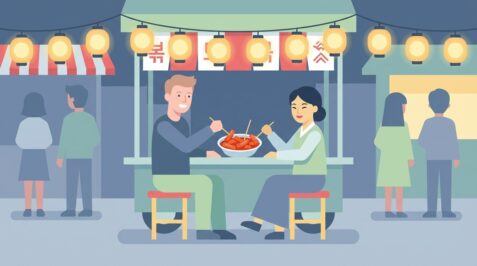
Picture this: You are sitting at a bustling street food stall in Myeongdong. The vendor hands you a plate of Tteokbokki glowing in a fiery, neon red. Your Korean friend smiles and says, “Oh, it’s not that red, it’s fine!” You take a bite, and suddenly, your soul leaves your body.
In Korea, the color red (빨간색) isn’t just a color on a palette. It is a flavor, a cultural warning sign, a K-Pop anthem, and sometimes, a strict taboo. If you only memorize the word “red” from a textbook, you are missing out on half of the culture! Let’s dive into the fascinating world of ‘Red’ in Korean and learn how to navigate it like a local.
🔍 Phase 2: Deep Dive into ‘Red’ Expressions
1. 빨간색 (Red)
- Pronunciation: ppal-gan-saek [pp sounds like a tight, tense ‘p’, almost like holding your breath before saying ‘pop!’]
- Meaning: Red color (Literal)
- K-Culture Moment: This is the iconic color of the “Red Devils” (Korean soccer fans) and the legendary girl group Red Velvet’s hit song “Red Flavor” (빨간 맛).
- Editor’s Insight: In Korean food, when someone says a dish has a “red flavor,” it means it is intensely spicy, sweet, and incredibly addictive!
- Situation Spectrum:
[🚫] ———— [⚠️] ———— [✅ Universal]- Friends (Casual): ✅
- Co-workers (Semi-formal): ✅
- Boss/Elders (Formal): ✅
- 🤔 Think About It: Notice the ‘색’ (saek) at the end? It means ‘color’ and comes from Chinese characters. Why do Koreans always attach the word ‘color’ to the end of the color’s name? Does your language do this too?
2. 안 맵게 해주세요 (Please make it not spicy)
- Pronunciation: an maep-ge hae-ju-se-yo [an map-ge heh-joo-seh-yo]
- Meaning: Please make it less/not spicy. (The ultimate survival phrase!)
- K-Culture Moment: You are at a restaurant, and every dish on the menu looks violently red. This phrase is your shield.
- Editor’s Insight: “안” (an) means “not.” Putting it right before the descriptive word is the easiest way to save your stomach without sounding rude.
- Situation Spectrum:
[🚫] ———— [⚠️] ———— [✅ Universal]- Friends (Casual): ⚠️ (Say “안 맵게 해줘” instead)
- Restaurant Staff (Polite): ✅
3. 얼굴이 빨개요 (Face is red / Blushing)
- Pronunciation: eol-gu-ri ppal-gae-yo [eol-gu-ri sounds like ‘all-goo-ree’]
- Meaning: Your face is red / flushed.
- K-Culture Moment: Think of every K-Drama where the main character drinks exactly one shot of Soju, their cheeks turn bright pink, and they confess their hidden feelings!
- Editor’s Insight: We use this when someone is embarrassed, shy, angry, or drunk. It is a very visual, everyday way to describe someone’s emotional state.
- Situation Spectrum:
[🚫] ———— [⚠️] ———— [✅ Universal]- Friends (Casual): ✅
- Boss/Elders (Formal): 🚫 (It can sound too direct or cheeky)
📖 Phase 3: Textbook vs Real Life
| Situation | 📖 Textbook Korean | 🗣️ Real Korean | 💡 Why different? |
|---|---|---|---|
| Pointing out the color | 붉은색입니다. (Bulgeun-saek-imnida) | 빨간색이에요. / 빨개요! (Ppalgan-saek-ieyo) | 붉은색 is very formal and literary. 빨간색 is the everyday spoken word. |
| Saying it’s spicy | 아주 맵습니다. (Aju maep-seumnida) | 완전 매워요! (Wanjeon mae-wo-yo) | ‘완전’ (completely) is the most popular conversational intensifier among young Koreans. |
🇰🇷 Phase 4: Cultural Deep Dive
4-1. Non-verbal Communication: The Red Ink Taboo
Here is a life-saving tip: Never write a living person’s name in red ink! In Korean culture, writing a name in red implies that the person has passed away, or it means you are wishing them bad luck or death. If you are writing a birthday card to your Korean friend, always use black or blue pens!
4-2. K-Culture Connection: Red = Spice & Soul
In Korea, red visually translates to “deliciously spicy.” The vibrant red color comes from Gochugaru (Korean chili flakes) and Gochujang (chili paste). When Koreans see a bright red bubbling stew, they don’t feel fear; they feel comfort. Red food is deeply tied to relieving stress. If you can eat red food well, Koreans will instantly treat you like an insider!
🎭 Phase 5: Immersive Roleplay
Setting: Friday evening, 7 PM. A bustling Makchang (grilled intestines) restaurant in Hongdae. The air is thick with delicious smoke. You are sitting with your Korean coworker, Minho (32, friendly and outgoing). The waiter places a sizzling, violently red pan of food on your table.
Minho: 와, 색깔 진짜 빨갛다! 너 이거 먹을 수 있어? 🌶️
(wa, saek-kkal jin-jja ppal-ga-ta! neo i-geo meo-geul su i-sseo?)
[Wow, the color is really red! Can you eat this?]
(🎭 Stage Direction: Minho points at the food with his chopsticks, looking at you with a mix of worry and excitement)
🔀 Your Turn! How do you reply?
– A) “네, 괜찮아요! 잘 먹겠습니다!” (Yes, it’s fine! I will eat well!)
– B) “아… 저 맵찔이에요. 물 좀 주세요.”
– C) “진짜요? 대박!”✅ Best Choice: B — By humorously calling yourself a ‘맵찔이’ (maep-jjil-i, a slang for someone weak to spice), you show off your native-level Korean skills, make Minho laugh, and get the water you desperately need!
⚠️ Choice A Analysis: Safe and polite, but prepare to sweat! Koreans have a very high tolerance for spice, so their “fine” might not be your “fine.”
🗣️ Phase 6: 10-Second Shadowing Drill
Let’s practice how to decline spicy food politely but firmly!
🥺 저는 / 매운 음식을 / 잘 못 먹어요.
(jeo-neun / mae-un eum-si-geul / jal mot meo-geo-yo)
“I can’t eat spicy food well.”
Tip: Pause slightly at the slashes (/) and look a little bit sad (🥺) to get maximum sympathy from the restaurant owner!
📚 Phase 7: K-Culture Glossary
| 한국어 | Romanization | English | Context |
|---|---|---|---|
| 빨간색 | ppal-gan-saek | Red | The literal color. |
| 매워요 | mae-wo-yo | Spicy | The true meaning of most red foods in Korea. |
| 맵찔이 | maep-jjil-i | Spicy-weakling | A cute, self-deprecating slang for someone who can’t handle spicy food. |
| 눈치 | nun-chi | Social sense | Reading the room (e.g., pretending it’s not spicy when everyone else is fine). |
| 불맛 | bul-mat | Fire taste | The smoky, charred flavor often found in spicy red dishes. |
🧳 Phase 8: Traveler’s Survival Kit
If you are traveling in Korea, the color red is your biggest culinary challenge. Keep these phrases in your back pocket!
🆘 Survival Phrases for the Red Food Invasion
– 🇰🇷 “이거 매워요?” (i-geo mae-wo-yo?)
– 🗣️ English Guide: ee-geo meh-wo-yo? (Is this spicy?)
– 📍 Where to use: Any street food stall, traditional market, or restaurant.
– 💡 Pro Tip: Point to the picture on the menu. If the staff hesitates or smiles nervously while saying “a little bit,” IT IS VERY SPICY. Order something else!📌 Editor’s Travel Note
– Self-Serve Water: In many Korean restaurants, water is free but you have to get it yourself. Look for the sign that says “물은 셀프” (mul-eun sel-peu). Grab a cold bottle from the fridge before you tackle that red Tteokbokki!
– Translation Apps: Use Papago! You can take a photo of the menu to check if the word ‘Spicy’ (매운/불) is hidden in the dish’s name.
🧠 Phase 9: Think Deeper — “Food & Identity”
Why is Korean food so red and spicy?
In modern Korean history, especially during periods of rapid economic growth and high-pressure work cultures, spicy red food became a beloved way to relieve stress (스트레스 풀다). Eating fiery food makes you sweat, releases endorphins, and when shared from a large communal pot, it brings people closer together. The shared experience of surviving the “Red Flavor” builds deep communal bonds!
💬 Your Turn: Do you have a “comfort food” in your culture that you eat when you are stressed? Is it a specific color? Share it in the comments!
🛡️ Phase 10: FAQ & Troubleshooting
Q: “Can I ask a Korean restaurant to make a red dish totally white (not spicy)?”
A: Usually, yes! For popular foods like Tteokbokki or Jjamppong, some places offer a “white” version (백짬뽕). However, if the dish is traditionally heavily marinated in red sauce, they might just give you a less spicy red version instead.
Q: “Is red a lucky color in Korea like it is in China?”
A: While red represents passion and energy (like the soccer team), it isn’t explicitly used for “luck” or “money” as it is in Chinese culture. And remember the red ink taboo!
❌ Common Mistake: Pronouncing ‘빨’ (ppal) like a soft English ‘P’ (as in ‘pal’).
✅ Do this instead: Hold your breath slightly and release the ‘P’ sharply without blowing out any air. Imagine the sound of a small, tight balloon popping!
🎯 Phase 11: Wrap-up & Action Items
One-Liner Summary: In Korea, red (빨간색) is the color of passion, extreme spice, and an important cultural rule you must never break!
Your Action Missions:
– 🥉 Bronze (Solo): Stand in front of a mirror and practice saying “안 맵게 해주세요” 3 times.
– 🥈 Silver (Online): Drop a comment below with your favorite red-colored K-Food!
– 🥇 Gold (Real Life): Next time you visit a Korean restaurant or market, ask “이거 매워요?” before ordering!
📺 K-Culture Mission: Watch one episode of a K-Drama today and spot the moment someone’s face turns red (얼굴이 빨개요) after drinking Soju!
🏆 Phase 12: Interactive Quiz
Test your new Daily Hangul knowledge!
1. You want to order Tteokbokki, but you hate spicy food. What is the most natural thing to say?
– A) 빨간색 주세요. (Give me red.)
– B) 안 맵게 해주세요. (Please make it not spicy.)
– C) 맵찔이 주세요. (Give me a spicy-weakling.)
2. True or False: Writing your Korean friend’s name in red ink on a birthday card is a cute way to show love.
– True
– False
(Answers: 1: B – If you say C, you are asking to eat a person! 2: False – It is a huge cultural taboo implying death or bad luck. Always use black or blue!)