Phase 1: Immersive Hook
Greeting: Hello! It’s your Daily Hangul Senior Editor here.
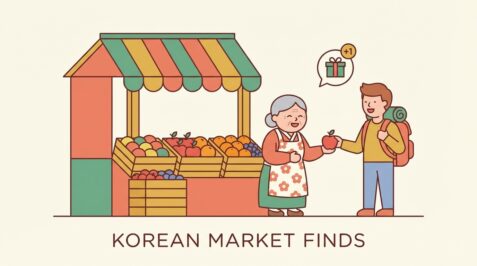
Have you ever watched a K-Drama where the main character sits at a Pojangmacha (street food tent), orders a plate of spicy stir-fried pork, and suddenly the owner places a steaming bowl of egg soup on the table?
“I didn’t order this,” the character says.
The owner just smiles and says, “Service!” (서비스)
Wait, service? In English, service means the act of serving or a utility bill. But in Korea, this magic word means “FREE GIFT.”
If you go to a Traditional Market (Sijang) in Korea and don’t know the art of asking for “Deom” (덤 – extra/bonus), you are missing out on the warmest part of Korean culture: Jeong (정).
Today, I will teach you how to charm the Sajangnim (owner) and get that extra apple or free side dish like a true local.
Phase 2: Deep Dive (Key Expressions)
Here are the 3 essential phrases to unlock the hearts of market vendors.
1. 사장님~ (Sajangnim~)
- Pronunciation: [Sa-jang-nim] + [Extend the end like you are singing]
- Meaning: Boss / CEO (Literal) vs. “Sir/Ma’am” (Real nuance)
- K-Culture Moment: In almost every K-Drama, everyone is called a CEO. Even if they own a tiny vegetable stall, they are the Sajangnim. It shows respect.
- Editor’s Insight: Never call an older vendor “Ajumma” (Auntie) or “Ahjeossi” (Uncle) if you want free stuff. It can sound rude to strangers. “Sajangnim” is the magic key that elevates their status.
- Situation Spectrum:
[🚫 Friend] ———— [⚠️ Colleague] ———— [✅ Market Vendor]- 🤔 Think About It: Why does Korean culture prefer using job titles (CEO, Manager, Teacher) instead of names or generic pronouns like “You”?
2. 서비스 주세요 (Seobiseu juseyo)
- Pronunciation: [Seo-bi-seu] + [ju-se-yo]
- Meaning: Please give me service. (Literal) -> Please give me a free bonus. (Real nuance)
- K-Culture Moment: You might hear K-Pop idols at a fan meeting say, “This fan service is for you!” It implies doing something special for free.
- Editor’s Insight: Use this when you buy a lot of items (bulk purchase). Don’t use it if you only buy one apple!
- Situation Spectrum:
[🚫 Starbucks] ———— [⚠️ Dept. Store] ———— [✅ Traditional Market]- 🤔 Think About It: In many Western cultures, asking for free things is considered rude. Why is it considered a playful “game” or “connection” in Korean markets?
3. 많이 주세요 (Mani juseyo)
- Pronunciation: [Ma-ni] + [ju-se-yo]
- Meaning: Please give me a lot.
- K-Culture Moment: A scene where a mom buys bean sprouts and the vendor grabs a huge handful to top it off. The mom says, “Aigo, mani juseyo!”
- Editor’s Insight: This is an indirect way of asking for Deom. You aren’t explicitly asking for free stuff, but you are asking for a generous portion.
- Situation Spectrum:
[✅ Casual/Market] ———— [⚠️ Restaurant] ———— [🚫 Formal Dinner]
Phase 3: Textbook vs. Real Life
| Situation | 📖 Textbook Korean | 🗣️ Real Korean | 💡 Why is it different? |
|---|---|---|---|
| asking for bonus | 이거 무료로 주실 수 있어요? (Can you give this for free?) | 사장님~ 서비스! (Boss~ Service!) | Textbook is too formal and sounds like a legal request. Real life relies on charm (Aegyo). |
| Greeting vendor | 안녕하십니까. (Hello – formal) | 안녕하세요! 사장님~ (Hello! Boss~) | Markets are lively. Formal language creates distance; you want closeness. |
| Asking for more | 더 주세요. (Give more.) | 좀 더 주세~용 (Give a lil’ more~ please) | Adding ‘yong’ or stretching the sound makes it sound cute and less demanding. |
Bottom Note: Don’t try to be too cool with slang. A polite smile with “Sajangnim~” works best for A2 learners!
Phase 4: Cultural Deep Dive
4-1. Non-verbal: The Art of “Nunchi” (Eye Measure)
Asking for Deom isn’t just about words; it’s about Nunchi.
– Bad Nunchi: The shop is super busy, the owner looks stressed, or you are buying the cheapest item.
– Good Nunchi: You are the only customer, you bought a lot, and you are smiling. This is when you strike!
4-2. K-Food Connection: The “Jeong” (Affection) Factor
In Korea, food is love. When a vendor gives you an extra tangerine after you buy a box, it’s not just a transaction. It’s Jeong (정). It means “I recognize you, and we have a connection now.”
– Critical View: Why is Jeong so important? Historically, Korea was a communal agrarian society. Sharing food was a way to ensure everyone survived. This DNA still exists in modern markets.
Phase 5: Immersive Roleplay
Setting: Sunday afternoon at Mangwon Market in Seoul. The smell of fried chicken is in the air. You stop at a fruit stall to buy strawberries (ddalgi).
Characters:
– YOU: A hungry traveler who loves strawberries.
– Sajangnim: A friendly middle-aged woman wearing a floral apron.
Dialogue:
YOU: 안녕하세요! 이 딸기 얼마예요?
(Annyeonghaseyo! I ddalgi eolmayeyo?)
(Hello! How much are these strawberries?)
Sajangnim: 한 팩에 만 원이에요. 아주 달아요!
(Han paeg-e man won-ieyo. Aju darayo!)
(10,000 won per pack. They are very sweet!)
YOU: 네, 두 팩 주세요.
(Ne, du paek juseyo.)
(Okay, give me two packs please.)
(🎭 Stage Direction: The Sajangnim puts strawberries in a black bag.)
🔀 YOUR TURN! You want to ask for a little extra (maybe a tangerine or one more strawberry). What do you say?
- A) “서비스 주세요!” (Seobiseu juseyo!) – Direct & Bold
- B) “사장님~ 맛있게 많이 주세요~” (Sajangnim~ Masitge mani juseyo~) – Polite & Charming
- C) “덤 내놔요.” (Deom naenwayo.) – Rude Command
✅ Best Choice: B). It’s subtle. You are saying “Give me a lot of the delicious ones.” Often, the owner will smile and throw in an extra one because you were polite.
⚠️ Choice A Analysis: Acceptable if you bought a lot (like 5 packs). For 2 packs, it might be too direct, but foreigners often get a pass!
Phase 6: 10-Second Shadowing Drill
Repeat this sentence to practice your rhythm and intonation.
Emotion: 😊 Charming / Cute (A little bit of Aegyo)
사장님~ / 딸기 / 많~~~이 / 주세요! (Sa-jang-nim / ddal-gi / man~~~i / ju-se-yo!)
Tip: Stretch the “man~~~i” to emphasize that you want a generous amount!
Phase 7: K-Culture Glossary
| Korean | Romanization | English | Context |
|---|---|---|---|
| 덤 | Deom | Bonus/Extra | A free item given on top of a purchase. Symbol of affection. |
| 정 | Jeong | Affection/Bond | The invisible string of connection between people in Korea. |
| 단골 | Dan-gol | Regular | A regular customer. If you become a Dan-gol, you get more Deom. |
| 서비스 | Seobiseu | Service | Konglish for “Free of charge.” |
Phase 8: Traveler’s Survival Kit
Use these when shopping at Namdaemun or Gwangjang Market!
🆘 Survival Phrases
– 🇰🇷 “이거 얼마예요?” (Igeo eolmayeyo?)
– Meaning: How much is this?
– 🇰🇷 “비싸요~” (Bissayo~)
– Meaning: It’s expensive~ (Say this with a sad face to start bargaining!)
– 🇰🇷 “깎아 주세요!” (Kkakka juseyo!)
– Meaning: Please give me a discount!
– 💡 Pro Tip: In traditional markets, CASH IS KING. You are much more likely to get Deom or a discount if you pay with cash instead of a card.
Phase 9: Think Deeper — “Language & Power”
Topic: Why do we call everyone “Sajangnim” (CEO)?
In the past, Korea had a strict caste system. Language was a tool to define hierarchy. In modern democratic Korea, that hierarchy hasn’t disappeared; it has shifted to economic status. By calling a market vendor “Sajangnim” (President/CEO), you are verbally elevating them to a position of power and respect. You are stroking their ego. In return, the “powerful CEO” shows benevolence by giving you, the humble customer, a free gift (Deom). It’s a subconscious social contract.
💬 Your Turn: In your country, how do you address shopkeepers? Do you use formal titles or just say “Excuse me”?
Phase 10: FAQ & Troubleshooting
Q: Can I ask for “Service” at a convenience store (CU, GS25)?
A: NO! Convenience store workers are part-timers who scan barcodes. They cannot give you free stuff unless it’s a “2+1” promotion printed on the shelf. Asking for Deom here will just confuse them.
Q: Can I ask for “Service” at a department store (Shinsegae, Lotte)?
A: Generally, No. Prices are fixed. However, at the cosmetics counter, you can ask for “Samples” (샘플), which is the department store version of Deom.
❌ Common Mistake #1: Saying “You” (Dangsin/Neo) to the vendor.
✅ Fix: Always use “Sajangnim” or just drop the subject entirely.
Phase 11: Wrap-up & Mission
One-Liner Summary: To get free stuff (Deom) in Korea, use the word “Service,” call the vendor “Sajangnim,” and smile with Jeong!
Action Missions:
– 🥉 Bronze: Look in the mirror and practice saying “Sajangnim~” with your most charming smile.
– 🥈 Silver: Watch a YouTube video of a Korean street food tour and count how many times you hear “Mani juseyo.”
– 🥇 Gold: Go to a Korean restaurant or market in your city. When they serve you food, try saying “Waa, mani juseyo!” (Wow, give me a lot!).
K-Culture Mission: Watch the K-Drama “Crash Course in Romance” (or any drama with a side dish store). Observe how the customers interact with the owner. Do they bow? Do they smile? That is your textbook.
Phase 12: Quiz — Interactive Challenge
Scenario: You bought 10 pairs of socks at Dongdaemun Market. The total is 20,000 won. You want one extra pair for free.
Q: Which sentence is most likely to succeed?
- “Hey! Give me one more.” (Direct English style)
- “Sajangnim~ I bought ten! Service juseyo~” (Charming Korean style)
- “I demand a refund.” (Karen style)
Answer:
Click to see answer
2. “Sajangnim~ I bought ten! Service juseyo~”
Reason: You established a reason (bulk purchase), used the respectful title (Sajangnim), and used the magic word (Service). Success rate: 99%!