

Phase 1: The Immersive Hook
Greeting: 안녕하세요! This is your Senior Editor at Daily Hangul, where we decode the Korea you won’t find in textbooks.
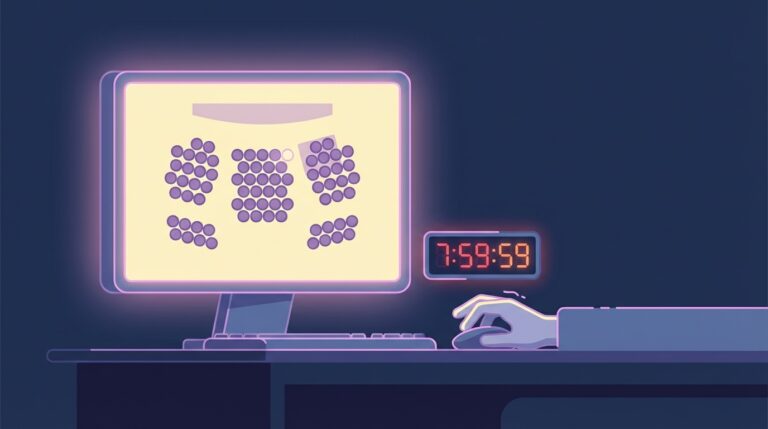
Imagine this: It is 7:59 PM KST. You are sitting in a PC Bang (Internet Cafe) in Hongdae, surrounded by the smell of instant ramen and the frantic clicking of mechanical keyboards. On your screen, the server clock counts down: 59… 58… 57… Your heart is pounding faster than the beat drop in a Stray Kids song.
Why? Because you are about to enter a war. Not a physical one, but a digital one. You are trying to book tickets for the hottest K-Musical (maybe featuring a K-Pop idol) in Seoul.
In standard Korean, buying a ticket is just “pyo-reul sada” (buying a ticket). But ask any Korean fan, and they will tell you: It is not shopping; it is survival.
If you don’t know the language of this battlefield, you won’t just lose a seat—you’ll be left staring at a grey screen wondering what happened. Today, we are learning the vocabulary of the “Blood Ticketing” war.
Phase 2: Deep Dive into Key Expressions
Here are the weapons you need for your linguistic arsenal.
1. 피켓팅 (Piketing)
- Pronunciation: [Piketing] + Sounds like ‘Pick’ + ‘Ketting’
- Meaning: Blood Ticketing (Literal) vs Total War for Tickets (Real Nuance)
- Etymology: This is a portmanteau of 피 (Pi, meaning Blood) + 티켓팅 (Ticketing). It signifies a ticketing battle so fierce it feels like you might bleed.
- K-Culture Moment: Think of that scene in Hospital Playlist where the doctors are glued to their phones trying to book a band practice room or a concert. That tension? That’s Piketing.
- Editor’s Insight: Use this when the competition is insane. If you are booking a bus ticket to a rural town on a Tuesday, that is just ticketing. If you are booking Jekyll & Hyde with Cho Seung-woo, that is Piketing.
- Situation Spectrum:
[🚫 Formal Reports] ———— [⚠️ Semi-formal] ———— [✅ Casual/Internet]- 🤔 Think About It: Why does Korean internet culture use such intense physical metaphors (Blood, War, Optical speed) for digital activities? What does this say about the “Pali-Pali” (Hurry-Hurry) culture?
2. 이선좌 (Lee-Seon-Jwa)
- Pronunciation: [I-seon-jwa] + Sounds like a person’s name, ‘Lee Sun-jwa’
- Meaning: “Already Selected Seat” (Acronym)
- Full Phrase: 이미 선택된 좌석입니다 (Imi seontaekdoen jwaseok-imnida).
- K-Culture Moment: Every K-Pop fan knows this popup. You see a beautiful purple seat (available), you click it, and BOOM—Lee-Seon-Jwa appears. It’s the villain in every fan’s story.
- Editor’s Insight: Fans personify this. They say, “I met Lee Seon-jwa today.” It sounds like they met a person, but they actually met failure.
- Situation Spectrum:
[🚫 Business Meeting] ———— [⚠️ Close Colleagues] ———— [✅ Fans/Friends]3. 광탈 (Gwangtal)
- Pronunciation: [Gwang-tal] + Rhymes with ‘Bang’ + ‘Tal’
- Meaning: Light-speed Elimination (Literal) vs Failing instantly (Real Nuance)
- Etymology: 광 (Gwang, Light/Speed) + 탈락 (Tallak, Elimination).
- Editor’s Insight: It’s not just failing; it’s failing so fast you didn’t even see the seat map. You logged in at 8:00:01, and it was already sold out.
- Situation Spectrum:
[🚫 Elders] ———— [⚠️ Peers] ———— [✅ Friends/Online]
Phase 3: Textbook vs. Real Life
| Situation | 📖 Textbook Korean | 🗣️ Real Korean (Insider) | 💡 Why the difference? |
|---|---|---|---|
| Failing to get a ticket | 표를 못 샀어요. (I couldn’t buy a ticket.) | 나 완전 광탈했어. 멘붕이야. (I was eliminated at light speed. Mental breakdown.) | Textbook focuses on the result; Real Korean focuses on the speed and emotion of the failure. |
| Asking a friend for help | 저 좀 도와주세요. (Please help me.) | 야, 용병 좀 뛰어줘. (Hey, run as a mercenary for me.) | Ticketing is a war. Friends helping you are “mercenaries” (hired soldiers). |
| Checking for cancelled tickets | 취소표가 있는지 확인해요. (Check if there are cancelled tickets.) | 취켓팅 대기 타야지. (I gotta wait for Chwiketing.) | Efficiency. Why say a full sentence when you can combine “Cancel” + “Ticketing”? |
Phase 4: Cultural Context — The “Grape” Hunt
4-1. The Visual of Success: 포도알 (Podo-al)
In Korean ticketing systems (Interpark, Melon), available seats often look like small colored circles on a white background. When you see many available seats clustered together, they look like a bunch of grapes (포도 – Podo).
– Usage: “포도알을 봤어!” (I saw the grapes! / I saw available seats!)
– Non-verbal Tip: When you are at a PC Bang ticketing, silence is golden. Don’t talk to your neighbor at 7:59 PM. That is considered extremely rude (눈치 없는 행동).
4-2. K-Drama Connection
Have you seen the drama Lovely Runner (선재 업고 튀어)? The desperation fans feel to see their idol—that energy is exactly what drives the Piketing culture. It’s not just about entertainment; it’s about proving your devotion through speed and persistence.
Phase 5: Immersive Roleplay
Setting: A smoky, neon-lit PC Bang in Seoul. Friday, 7:55 PM. You and your Korean friend, Min-su, are staring at your monitors. The musical “Dracula” tickets open in 5 minutes.
Characters:
– YOU: A foreign exchange student, nervous about your first Korean ticketing experience.
– Min-su: A veteran K-Musical fan. Takes this very seriously.
Dialogue:
Min-su: (Checking the server clock) 야, 5분 남았다. 새로고침 하지 마.
(Ya, obun namatda. Saerogochim haji ma.)
Hey, 5 minutes left. Don’t hit refresh.
(Stage Direction: Min-su cracks his knuckles)
YOU: (Trembling holding the mouse)
알겠어. 아, 너무 떨려. 심장 터질 것 같아.
(Algesseo. Ah, neomu tteollyeo. Simjang teojil geot gata.)
Okay. Ah, I’m so nervous. My heart feels like it’s going to explode.
Min-su: 걱정 마. 우리 둘 중 하나만 성공하면 돼. 내 친구들도 용병으로 불렀어.
(Geokjeong ma. Uri dul jung hanaman seonggonghamyeon dwae. Nae chingudeul-do yongbyeong-euro bulleosseo.)
Don’t worry. As long as one of us succeeds, it’s fine. I called my friends as mercenaries too.
(⏰ 8:00 PM hits. Click! Click! Click!)
Min-su: 아!! 이선좌 떴어! 젠장!
(Ah!! Iseonjwa tteosseo! Jenjang!)
Ah!! “Already Selected Seat” popped up! Damn it!
🔀 Decision Point: What do you say?
- A) “괜찮아? 다른 날짜 찾아볼까?” (Are you okay? Shall we look for another date?)
- B) “나도 광탈이야… 어떡해?” (I’m light-speed eliminated too… What do we do?)
- C) “포기하자. 밥이나 먹으러 가.” (Let’s give up. Let’s just go eat.)
✅ Best Choice: B) Showing shared frustration builds camaraderie. You are “comrades in war.”
⚠️ Choice A Analysis: Logical, but in the heat of the moment, empathy comes first. Check “Chwiketing” (cancelled tickets) first before moving dates.
🚫 Choice C Analysis: Giving up after 1 minute? In Korean fan culture, that shows a lack of passion (정성)!
Phase 6: 10-Second Shadowing Drill
Repeat after me. Feel the urgency!
- 😢 Despair (Sad):
아… / 또 / 이선좌야… / 진짜 울고 싶다.
(Ah… / tto / I-seon-jwa-ya… / jinjja ulgo sipda.)
Ah… it’s “Already Selected Seat” again… I really want to cry. -
😤 Determination (Strong):
오늘 밤 / 취켓팅으로 / 반드시 / 잡는다.
(Oneul bam / Chwiketing-euro / bandeusi / jamneunda.)
Tonight / via Chwiketing / I will surely / catch it.
Phase 7: K-Culture Glossary
| Korean | Romanization | English | Context |
|---|---|---|---|
| 용병 | Yongbyeong | Mercenary | A friend who helps you ticket for a show they won’t attend. |
| 막콘 | Makcon | Last Concert | The final show of a tour. The hardest tickets to get. |
| 취켓팅 | Chwiketing | Cancel-Ticketing | Buying cancelled tickets (usually released around 2 AM). |
| 포도알 | Podo-al | Grapes | The colored dots on the seating map representing available seats. |
| 곰손 / 금손 | Gomson / Geumson | Bear Hand / Gold Hand | Clumsy hands (bad at ticketing) vs. Golden hands (lucky/fast). |
Phase 8: Traveler’s Survival Kit (Ticketing Edition)
You are at the ticket booth in Daehangno (Korea’s Broadway) trying to buy a ticket on-site.
🆘 Survival Expression #1
– 🇰🇷 “혹시 현장 판매 표 남았나요?” (Hoksi hyeonjang panmae pyo namannayo?)
– 🗣️ Meaning: “Do you happen to have any tickets left for on-site sale?”
– 💡 Pro Tip: Not all tickets are sold online. Some are reserved for the day of the show!🆘 Survival Expression #2
– 🇰🇷 “시야 제한석이라도 괜찮아요.”
(Siya jehanseok-irado gwaenchanayo.)
– 🗣️ Meaning: “I’m okay even if it’s a restricted view seat.”
– 💡 Pro Tip: These are cheaper and often the last options available for sold-out shows.
Phase 9: Think Deeper — “Why so intense?”
🧠 The Psychology of ‘Pali-Pali’ & Collectivism
Why is ticketing in Korea a “War”? It reflects the “Pali-Pali” (Hurry-Hurry) culture, where speed is a virtue and a competitive advantage. But it also reflects high-density collectivism. When something is popular (a trend), everyone wants to be part of it simultaneously. The “Fear Of Missing Out” (FOMO) in Korea is socially driven—if you miss the “Makcon” (Last concert), you miss the shared cultural conversation the next day.
💬 Your Turn: In your country, is buying concert tickets this stressful? Do you have slang for failing to get tickets?
Phase 10: FAQ & Troubleshooting
Q: Can I buy tickets from scalpers (Ampyo)?
A: 🚫 NO. Korea is cracking down hard on Ampyo (암표). Many ticketing sites now require identity verification (matching the name on the ticket to your ID) at the venue. If you buy a scalped ticket, you might be denied entry. Stick to official Chwiketing!
Q: Is it rude to ask a Korean friend to be a ‘Yongbyeong’?
A: ⚠️ Maybe. It takes time and effort. If you ask, you should offer to buy them a meal (bap) or coffee afterwards as thanks, even if they fail. It’s about acknowledging their jeong (affection/effort).
❌ Common Mistake: Using “Sold Out” (매진) when you just mean you failed.
✅ Correction: The show is Maejin (Sold out), but you experienced Gwangtal (Elimination).
Phase 11: Wrap-up & Mission
One-Liner: Korean ticketing isn’t just shopping; it’s a battle of speed called Piketing, where you avoid Lee-Seon-Jwa to grab those Grapes!
🚀 Action Missions:
– 🥉 Bronze: Go to a Korean ticketing site (like Interpark Global) and just look at the seating map. Find the “Grapes.”
– 🥈 Silver: Use the word “광탈” (Gwangtal) in a sentence when you fail at something fast (like missing a bus).
– 🥇 Gold: Visit a PC Bang in Korea, order an iced coffee, and try to book a ticket (or just browse) to feel the vibe.
🎬 K-Culture Mission: Watch a clip of a K-Pop idol doing their own ticketing (many idols try it on live streams). Watch their reaction when they see “Lee-Seon-Jwa.” It’s universal pain!
Phase 12: Interactive Quiz
- Situation: You clicked a seat, but a popup appeared saying “Already Selected Seat.” What is the slang for this villain?
- A) Gwangtal
- B) Lee-Seon-Jwa
- C) Yongbyeong
- True or False: “Yongbyeong” means a scalper who sells tickets illegally.
- (True / False)
- Application: Your friend failed to get tickets. What is the best comfort food to suggest?
- A) Salad (to stay healthy)
- B) Chicken & Beer (Chimaek – to wash away the stress)
Answers:
1. B) Lee-Seon-Jwa (The arch-nemesis!)
2. False. Yongbyeong is a helpful friend (Mercenary). Scalper is Ampyo-sang.
3. B) In Korea, high-calorie, spicy, or fried food is the cure for stress (stress-pul-gi)!
Frequently Asked Questions (FAQ)
Q: What does "피켓팅 (Piketing)" mean in Korean and how do you pronounce it?
A: In Korean, "피켓팅 (Piketing)" is pronounced [Piketing] and means: Blood Ticketing (Literal) vs Total War for Tickets (Real Nuance)
Q: What does "이선좌 (Lee-Seon-Jwa)" mean in Korean and how do you pronounce it?
A: In Korean, "이선좌 (Lee-Seon-Jwa)" is pronounced [I-seon-jwa] and means: "Already Selected Seat" (Acronym)
Q: What does "광탈 (Gwangtal)" mean in Korean and how do you pronounce it?
A: In Korean, "광탈 (Gwangtal)" is pronounced [Gwang-tal] and means: Light-speed Elimination (Literal) vs Failing instantly (Real Nuance)







