
Phase 1: The ‘Hot’ Confusion — Immersive Hook
Greeting:
안녕하세요! (Hello!) This is your Daily Hangul Editor.
The K-Food Crisis:
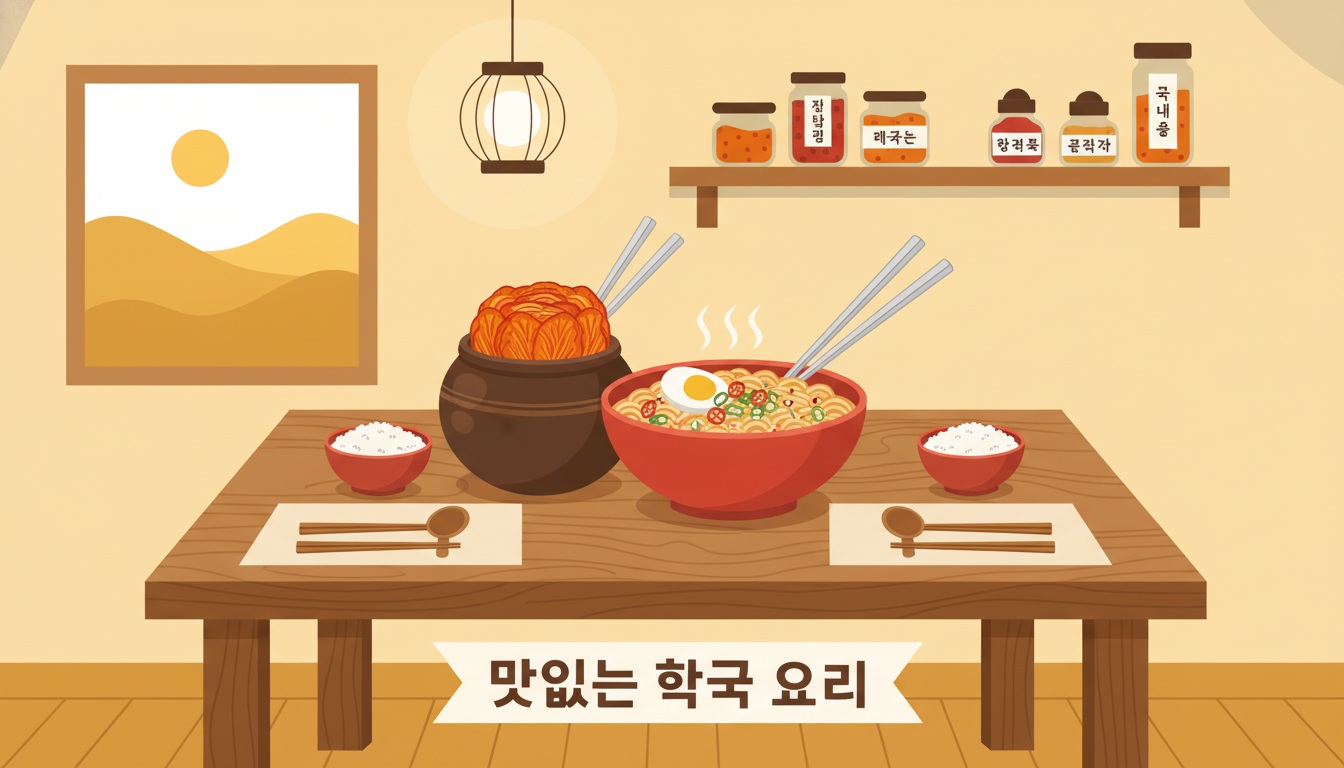
Picture this: You are watching a K-Drama. The main character is eating a bubbling red stew (Kimchi-jjigae). They take a sip, wave their hand in front of their open mouth, and shout, ‘Ah! Hot!’
Now, here is the million-dollar question: Is the soup hot because of the fire (temperature)? Or is it hot because of the chili peppers (spicy)?
In English, we use the word ‘Hot’ for both.
But in Korean? If you mix these two words up, you might accidentally tell the waiter the food is physically burning you when you just meant it’s too spicy!
Today, we will solve the mystery of ‘It’s Hot’ so you can survive your next Korean meal like a pro. Let’s go!
Phase 2: Deep Dive — The Two Types of ‘Hot’
1. 뜨거워요 (It’s hot / Temperature)
- Pronunciation: [ddeu-geo-wo-yo]
Sound Analogy: Think of ‘Duh’ + ‘Go’ + ‘War’ + ‘Yo’.- Meaning: Hot to the touch (high temperature).
- K-Culture Moment: You order a steaming hot Americano at a cafe, but the barista hands it to you without a cup holder. You almost drop it and say, ‘Ah! Ddeu-geo-wo-yo!’
- Editor’s Insight: Use this for coffee, soup, fire, or a hot summer sidewalk. Do not use this for spicy food flavor.
- Situation Spectrum:
[★ Friends: 뜨거워 (Ddeu-geo-wo)] ——— [✅ Polite: 뜨거워요 (Ddeu-geo-wo-yo)]- 🤔 Think About It: Why does Korean distinguish physical heat from flavor so strictly? Perhaps it helps avoid confusion in a culture where boiling hot soups are eaten daily?
2. 매워요 (It’s spicy / Flavor)
- Pronunciation: [mae-wo-yo]
Sound Analogy: Like a sheep saying ‘Mae’ + ‘Woe’ (sadness) + ‘Yo’.- Meaning: Spicy (chili heat).
- K-Culture Moment: The famous ‘Fire Noodle Challenge’ on YouTube. Everyone is crying and sweating. That feeling? That is Mae-wo-yo.
- Editor’s Insight: If you say this with a smile, you like it. If you say it while crying and looking for water, the waiter will understand immediately.
- Situation Spectrum:
[★ Friends: 매워 (Mae-wo)] ——— [✅ Polite: 매워요 (Mae-wo-yo)]3. 아, 시원하다! (Ah, it’s refreshing!)
- Pronunciation: [Ah, si-won-ha-da]
- Meaning: Literal: ‘It’s cool/refreshing.’ / Real nuance: ‘This hot soup relaxes my body.’
- K-Culture Moment: You will see older Korean men in dramas eating boiling hot soup and saying ‘Ah, siwonhada!’ It’s the biggest lie in the Korean language! It’s not cold; it’s emotionally satisfying.
Phase 3: Textbook vs. Real Life
| Situation | 📖 Textbook Korean | 🗣️ Real Street Korean | 💡 Why is it different? |
|---|---|---|---|
| Touch something hot | 이거 뜨거워요. (This is hot.) | 아, 뜨거! (Ah, ddeu-geo!) | When you burn your finger, you don’t have time for grammar! Short = Urgent. |
| Eating Spicy Food | 이 음식은 조금 매워요. (This food is a little spicy.) | 쓰읍… 맵다! (Sseu-eup… Map-da!) | The ‘Sseu-eup’ sound is the universal Korean sound of inhaling air to cool a burning tongue. |
Bottom Note: For A1 beginners, stick to “뜨거워요” and “매워요” to be polite and safe!
Phase 4: Cultural Deep Dive — How to Eat Like a Local
4-1. The ‘Sseu-eup’ Sound (Non-verbal)
If you watch Koreans eating spicy Tteokbokki (rice cakes), you will hear a distinct hissing sound: ‘Sseu-eup! Ha!’
This isn’t bad table manners. It’s a practical way to cool your tongue with air. If you do this, Koreans will think, “Wow, they really know how to enjoy spicy food!”
4-2. K-Food Context: The ‘Boiling’ Obsession
Unlike Western soups which are often served warm, Korean stews (Jjigae) come to the table boiling in a stone pot (Ddukbaegi).
– Why? Koreans believe food tastes best when it’s piping hot.
– Tip: Do NOT touch the black stone pot. It stays 뜨거워요 (hot) for a long time!
Phase 5: Immersive Roleplay — The Street Food Stall
Setting:
It’s a cold winter night in Myeongdong. You are at a Pojangmacha (tent stall). Steam is rising from the red spicy rice cakes (Tteokbokki).
Characters:
– YOU: A hungry traveler who can’t handle too much spice.
– Imo (Auntie): The friendly stall owner.
(Dialogue)
Imo: 떡볶이 좀 드릴까요? (Shall I give you some Tteokbokki?) 🍢
[Ddeokbokki jom deuril-kkayo?]
YOU: (Looking at the red sauce) 음… 이거 매워요? (Umm… is this spicy?)
[Eum… igeo mae-wo-yo?]
Imo: 아니요, 안 매워요! 맛있어요. (No, not spicy! It’s delicious.)
(Note: Koreans have a very high tolerance. Her ‘not spicy’ might be your ‘fire’!)
🗠️ YOUR TURN! How do you respond?
Option A: “네, 주세요.” (Yes, please give me some.)
Option B: “조금만 주세요.” (Give me just a little bit.)
Option C: “물 주세요!!!” (Water please!!!)
✅ Best Choice: B (Jo-geum-man ju-se-yo). It’s safer to try a small amount first!
⚠️ Warning: If you choose A, get your water ready. Korean “not spicy” is a lie 50% of the time!
Phase 6: 10-Second Shadowing Drill
Let’s practice! Listen to the emotion in the brackets.
- 😮 (Surprised/Touching a hot cup)
아, 뜨거워요!
[Ah, ddeu-geo-wo-yo!] -
🥵 (Sweating/Eating spicy noodles)
와, 진짜 매워요.
[Wa, jin-jja mae-wo-yo.]
(Translation: Wow, it’s really spicy.) -
😋 (Happy/Eating warm soup)
국물이 / 시원해요!
[Guk-mul-i / si-won-hae-yo!]
(Translation: The soup is refreshing!)
Phase 7: K-Culture Mini Glossary
| Korean | Romanization | English | Context |
|---|---|---|---|
| 맵찌 | Maep-jji | Spicy Loser | Slang for someone who cannot eat spicy food (Baby mouth). |
| 이모 | Imo | Auntie | Friendly term for calling older female restaurant owners. |
| 앞접시 | Ap-jeop-si | Front plate | Small extra plate to cool down your hot food. |
| 아뜨 | A-tteu | Hot! | Cute/Short sound effect when touching something hot. |
Phase 8: Traveler’s Survival Kit
🆘 Survival Phrases for ‘Hot’ Situations
🆘 Phrase #1: Can you make it less spicy?
– 🇰🇷 “덜 맵게 해 주세요.” (Deol map-ge hae ju-se-yo.)
– 🗣️ Pronunciation: [Dull map-ge hae ju-se-yo]
– 💡 Pro Tip: ‘Deol’ means ‘less’. Memorize this word if you are a Maep-jji!🆘 Phrase #2: Water, please! (Emergency)
– 🇰🇷 “물 좀 주세요.” (Mul jom ju-se-yo.)
– 🗣️ Pronunciation: [Mool jom ju-se-yo]
– 📝 Note: In many Korean restaurants, water is ‘Self’ (Self-service). Look for a sign saying “물은 셀프” (Water is Self).
Phase 9: Think Deeper — “Why do Koreans love pain?”
Food & Stress Relief:
Have you noticed that K-Drama characters always crave spicy food when they are stressed? In Korea, eating extremely spicy food (like Buldak noodles) is a popular way to relieve stress. The pain releases endorphins!
🧠 Think About It:
Does your culture have a “comfort food” for stress? Is it sweet, salty, or spicy like Korea?
Phase 10: FAQ & Troubleshooting
Q: Can I say “She is hot” using “뜨거워요”?
A: 🚫 NO!
If you say a person is “뜨거워요”, it means they have a high fever and might need a hospital. It does not mean sexy. Using physical adjectives for people works differently in Korean. Be careful!
Q: Is Kimchi considered ‘spicy’ in Korea?
A: To most Koreans, standard Kimchi is just ‘refreshing’ or ‘tasty,’ not spicy. If you ask “Is Kimchi spicy?” they will say no. But for a beginner, it might still tingle!
❌ Common Mistake: Blowing on food that is Maep-da (Spicy).
✅ Fix: Blowing air only helps with Ddeu-geop-da (Temperature). For spice, drink milk or Kool-Aid (Juicebox)!
Phase 11: Wrap-up & Action Mission
One-Liner Summary: Use 뜨거워요 (Ddeu-geo-wo-yo) for heat, and 매워요 (Mae-wo-yo) for spice!
🚀 Action Mission:
– 🥉 Bronze: Say “Ah, ddeu-geo-wo-yo!” next time you drink hot tea/coffee.
– 🥈 Silver: Watch a ‘Mukbang’ video on YouTube and listen for the sound “Map-da” or “Deol map-ge”.
– 🥇 Gold: Go to a Korean restaurant, point to a red dish, and ask: “Igeo mae-wo-yo?”
💬 Comment Below:
Are you a Maep-jji (Can’t handle spice) or a Spicy Master? Tell us your spicy food level!
Phase 12: Quiz — Survival Check
1. Situation: You touched a hot kettle. What do you say?
– A) Ah! Mae-wo-yo!
– B) Ah! Ddeu-geo-wo-yo!
2. Situation: You want to order ramyun, but you hate spicy food. You say:
– A) Deol map-ge hae ju-se-yo. (Make it less spicy.)
– B) Mul jom ju-se-yo. (Give me water.)
3. True or False (Culture):
– If a Korean says “It’s not spicy,” it is definitely safe for you to eat.
– (Answer: False! Always suspect the Korean standard of spice!)
Answers: 1. (B), 2. (A), 3. (False)