

Introduction
Hello, K-culture lovers! 👋 Welcome back to Daily Hangul, your best friend for learning Korean! 🇰🇷✨
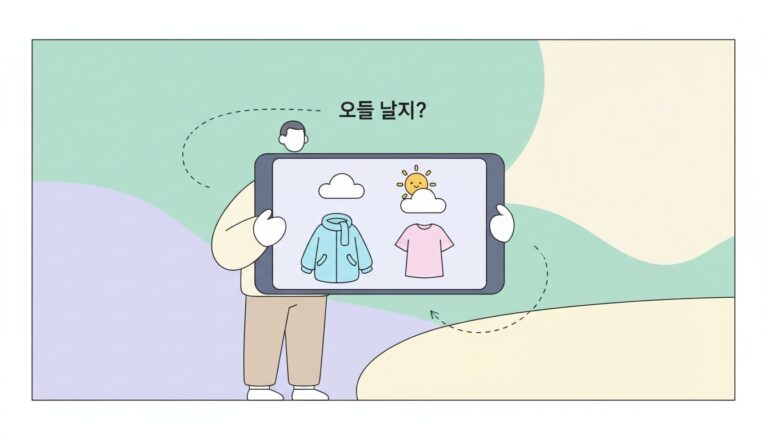
Have you ever watched a K-drama scene where the main character takes off their coat and wraps it around their partner? 😍 That usually happens because the weather in Korea can change very quickly!
Today, we are going to learn how to compare weather forecasts so you can decide what to wear. No more shivering in the cold or sweating in the heat during your Korea trip! Let’s learn how to say “It’s colder than yesterday” or “It’s sunny but windy.” Ready? Let’s go! 🚀
Key Expressions
Here are 4 essential expressions to compare things and talk about the weather!
1. ~보다 (boda)
- Meaning: Than (used for comparison)
- Pronunciation: [boda]
- Explanation: This is the magic particle for comparing! You attach it to the noun being compared. If you want to say “than yesterday,” you say “eoje-boda”.
- 💡 Pronunciation Tip: The ‘b’ and ‘d’ sounds are soft. It’s not an exploding ‘P’ or ‘T’. Keep it gentle!
2. 더 (deo)
- Meaning: More
- Pronunciation: [deo]
- Explanation: Use this before an adjective to increase its intensity.
- 더 추워요 (deo chuwoyo) = It is colder.
- 더 좋아요 (deo joayo) = It is better (literally “more good”).
3. ~지만 (jiman)
- Meaning: But / However
- Pronunciation: [jiman]
- Explanation: This connects two contrasting sentences. It’s perfect for weather like “It is sunny, but cold.”
- 맑지만 (malgjiman) = It is sunny, but…
- 💡 Pronunciation Tip: When combining verbs with ~jiman, pronounce the ‘j’ clearly.
4. 따뜻하게 입으세요 (Ttatteuthage ibeuseyo)
- Meaning: Please dress warmly.
- Pronunciation: [Ttatteutage ibeuseyo]
- Explanation: You will hear this A LOT in K-dramas! It shows you care about someone’s health. It’s a very sweet phrase to say to friends.
- 💡 Pronunciation Tip: Notice the spelling is ‘따뜻하게’ but we pronounce it [Tta-tteu-ta-ge]. The ‘h’ (ㅎ) sound often disappears or merges to make it flow smoother!
Real-life Conversation
Situation: Min-ji and Jason are checking the weather app to decide what to wear for their picnic.
Min-ji: 내일 날씨 어때요?
[Naeil nalssi eottaeyo?]
(How is the weather tomorrow?)
Jason: 오늘보다 더 추워요.
[Oneulboda deo chuwoyo.]
(It is colder than today.)
Min-ji: 정말요? 해는 안 떠요?
[Jeongmalyo? Haeneun an tteoyo?]
(Really? Is the sun not coming out?)
Jason: 맑지만 바람이 많이 불어요. 따뜻하게 입으세요!
[Malgjiman barami mani bureoyo. Ttatteuthage ibeuseyo!]
(It is sunny but the wind is blowing a lot. Please dress warmly!)
Culture Tip 🇰🇷
“Ganjeolgi” (간절기 – Change of Seasons)
Korea has four distinct seasons, and the transition period is called Ganjeolgi. During this time (spring and autumn), the temperature gap between day and night is huge! 🌡️
Koreans often check the weather forecast obsessively during Ganjeolgi. It’s common to see people carrying a cardigan or a light jacket even on a sunny day. If you tell a Korean friend, “Ganjeolgi-nikka ttatteuthage ibeuseyo” (Since it’s the change of seasons, dress warmly), they will be amazed by your Korean skills and kindness! 🥰
Conclusion & Quiz
Great job today! Now you can compare the weather and pick the perfect OOTD (Outfit of the Day) in Korea. Don’t forget to tell your friends to dress warmly!
📝 Mini Quiz
- How do you say “More” in Korean?
(A) Boda (B) Deo -
Fill in the blank: “It is hotter than yesterday.”
= 어제 ( _____ ) 더 더워요. [Eoje ( _____ ) deo deowoyo.] -
True or False: “~Jiman” is used to say “Because”.
(O / X)
Answers:
1. (B) Deo
2. 보다 (boda)
3. X (It means “But”)
Frequently Asked Questions (FAQ)
Q: What does "~보다 (boda)" mean in Korean and how do you pronounce it?
A: In Korean, "~보다 (boda)" is pronounced [boda] and means: Than (used for comparison)
Q: What does "더 (deo)" mean in Korean and how do you pronounce it?
A: In Korean, "더 (deo)" is pronounced [deo] and means: More
Q: What does "~지만 (jiman)" mean in Korean and how do you pronounce it?
A: In Korean, "~지만 (jiman)" is pronounced [jiman] and means: But / However
Q: What does "따뜻하게 입으세요 (Ttatteuthage ibeuseyo)" mean in Korean and how do you pronounce it?
A: In Korean, "따뜻하게 입으세요 (Ttatteuthage ibeuseyo)" is pronounced [Ttatteutage ibeuseyo] and means: Please dress warmly.







