

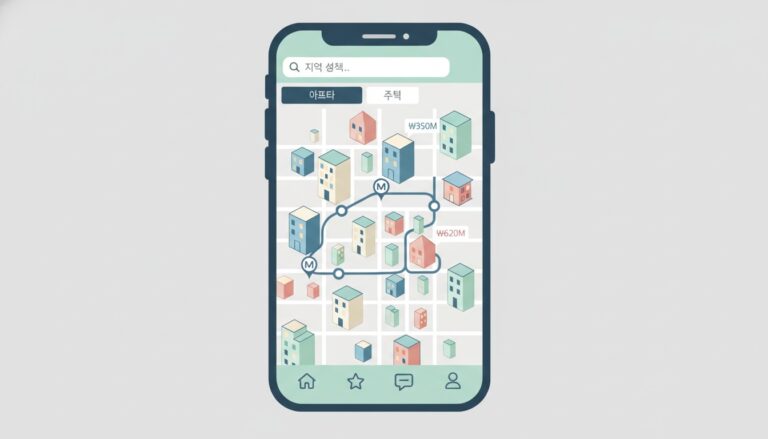
Introduction
Annyeonghaseyo! Hello! It’s Daily Hangul here to upgrade your Korean skills! 🚀
Have you ever watched a K-Drama and wondered how the characters find those cozy rooftop rooms (Oktapbang) or stylish officetels? If you are planning to live in Korea or just curious about daily life there, knowing how to read real estate apps is a superpower! 🦸♀️🦸♂️
Today, we are going to learn the essential words you’ll see on popular Korean housing apps like Zigbang (직방) or Dabang (다방). Let’s find your dream house together! 🏠✨
Core Expressions
Here are the top 4 words you MUST know to survive the Korean housing market!
1. 월세 (Wolse)
- Pronunciation: [Wolse]
- English Meaning: Monthly Rent
- Explanation: This is the most common payment method for foreigners and young people. You pay a specific amount every month to the landlord.
- 💡 Pronunciation Tip: Pronounce ‘Wol’ like the ‘wal’ in ‘wall’ but shorter, and ‘se’ like ‘say’ without the ‘y’.
2. 보증금 (Bojeunggeum)
- Pronunciation: [Bojeunggeum]
- English Meaning: Security Deposit
- Explanation: In Korea, the deposit is usually quite high (often starting from $5,000 ~ $10,000 USD equivalent). Important: Usually, if you raise your Bojeunggeum, your Wolse (monthly rent) goes down! 📉
- 💡 Pronunciation Tip: The ‘eu’ in ‘jeung’ is a sound deep in your throat, like the noise you make when you are disgusted (‘Eugh’).
3. 역세권 (Yeoksegwon)
- Pronunciation: [Yeoksegwon]
- English Meaning: Area near a subway station
- Explanation: This is a buzzword! ‘Yeok’ means station. Koreans love living near the subway. If an app says a house is 역세권, it means it’s super convenient for commuting (usually within a 5-10 min walk).
- 💡 Pronunciation Tip: When ‘k’ (ㄱ) meets ‘s’ (ㅅ), the ‘s’ sound becomes stronger/tenser. So it sounds like ‘Yeok-Sseh-gwon’.
4. 풀옵션 (Pul-opsyeon)
- Pronunciation: [Pu-rop-syeon]
- English Meaning: Fully Furnished (Full Option)
- Explanation: This is ‘Konglish’ (Korean + English). It means the room comes with essential appliances like a washing machine, fridge, and air conditioner. Perfect for students and travelers! 🧳
- 💡 Pronunciation Tip: Liaison Rule! The ‘L’ (ㄹ) at the bottom of ‘Pul’ moves over to the empty ‘O’ spot in ‘op’. So it flows like [Pu-rop-syeon] instead of [Pul-op-syeon].
Real Dialogue
Let’s see how friends Minji and Alex talk while looking at a housing app on a smartphone. 📱
Minji: 알렉스, 이 집 어때? 사진이 예뻐.
(Alex, i jip eottae? Sajin-i yeppeo.)
Alex, how is this house? The photos are pretty.
Alex: 오, 좋아 보여! 그런데 역세권이야?
(O, joa boyeo! Geureonde yeoksegwon-iya?)
Oh, looks good! But is it near the subway station?
Minji: 응, 강남역 5분 거리야. 그리고 풀옵션이야.
(Eung, Gangnam-yeok obun georiya. Geurigo pul-opsyeon-iya.)
Yeah, it’s 5 minutes from Gangnam Station. And it’s fully furnished.
Alex: 진짜? 보증금이랑 월세는 얼마야?
(Jinjja? Bojeunggeum-irang wolse-neun eolmaya?)
Really? How much are the deposit and monthly rent?
Minji: 보증금 1000만 원에 월세 70만 원이야.
(Bojeunggeum cheonman-won-e wolse chilshipman-won-iya.)
Deposit is 10 million won, and rent is 700,000 won.
Culture Tip 🇰🇷
“Adjusting the Price!” ⚖️
Did you know? In the Korean housing market, the price isn’t always fixed in stone. There is a unique system where you can adjust the ratio of Bojeunggeum (Deposit) and Wolse (Rent).
For example, if you have more cash on hand, you can tell the landlord: “I will pay more deposit, can you lower the monthly rent?”
So, if you see a house you like in a K-Drama or an app, remember: High Deposit = Low Rent! 😉
Wrap-up & Quiz
Great job today! Now you can browse Korean real estate apps like a pro. Let’s check what you remember! 📝
Quiz: Fill in the blanks!
- I want a room with a fridge and washer. I am looking for a (__________) room.
- I don’t have enough money for the (__________), so I can’t move in yet.
- I hate walking far. I need to live in a (__________).
[Answers]
1. 풀옵션 (Pul-opsyeon)
2. 보증금 (Bojeunggeum)
3. 역세권 (Yeoksegwon)
See you next time! 안녕! 👋
Frequently Asked Questions (FAQ)
Q: What does "월세 (Wolse)" mean in Korean and how do you pronounce it?
A: In Korean, "월세 (Wolse)" is pronounced [Wolse] and means: Monthly Rent
Q: What does "보증금 (Bojeunggeum)" mean in Korean and how do you pronounce it?
A: In Korean, "보증금 (Bojeunggeum)" is pronounced [Bojeunggeum] and means: Security Deposit
Q: What does "역세권 (Yeoksegwon)" mean in Korean and how do you pronounce it?
A: In Korean, "역세권 (Yeoksegwon)" is pronounced [Yeoksegwon] and means: Area near a subway station
Q: What does "풀옵션 (Pul-opsyeon)" mean in Korean and how do you pronounce it?
A: In Korean, "풀옵션 (Pul-opsyeon)" is pronounced [Pu-rop-syeon] and means: Fully Furnished (Full Option)







