
Let’s Meet Up! 📅 Deciding Time & Place Like a Pro
Hello, everyone! It’s your favorite Korean tutor, Daily Hangul! 👋✨
Are you planning to meet your Korean friends? Or maybe you’re watching a K-Drama and the main character says to their crush, “Come here right now!” 😍
Today, we are going to learn how to decide the time and place for a meeting using Imperatives (Command forms). Don’t worry, in close relationships, “commands” are just a cool way to say “Let’s do this!”
Ready to become a master of appointments? Let’s go! 🚀
🔑 Core Expressions
Here are 3 essential expressions you will hear in every Korean romance drama when they make plans!
1. 여기서 봐 (Yeogiseo bwa)
- Meaning: See me here / Let’s meet here.
- Original Verb: 보다 (Boda – to see/watch)
- Context: Literally, it means “Look here,” but when making plans, it means “See you here” or “Meet me here.” It’s casual and friendly.
- 💡 Pronunciation Tip:
- Yeogiseo: The ‘eo’ sounds like the ‘u’ in ‘cup’.
- Bwa: This is a combination of ‘Bo’ + ‘a’. Say it quickly like one syllable! (Bwa!)
2. …로 와 (…ro wa)
- Meaning: Come to [place].
- Original Verb: 오다 (Oda – to come)
- Context: Use this when telling someone where to move. You put the location before
~ro(to/towards).- Example: “Gangnam-euro wa” (Come to Gangnam).
- 💡 Pronunciation Tip:
- Wa: Similar to the English word “Wah” or the sound a baby makes, but shorter.
3. 늦지 마 (Neutji ma)
- Meaning: Don’t be late.
- Grammar:
~ji macreates a Negative Command (Don’t do X). - Context: This is the golden phrase! Use this to make sure your friend arrives on time.
- 💡 Pronunciation Tip:
- Neutji: The ‘t’ in ‘Neut’ is a stop sound. You don’t release air. It connects to ‘ji’ strongly. It sounds like
[Neut-chi]because of the tension.
- Neutji: The ‘t’ in ‘Neut’ is a stop sound. You don’t release air. It connects to ‘ji’ strongly. It sounds like
🗣️ Real-life Dialogue
Minji and Jason are deciding where to meet on Saturday. They are close friends! 👫
Minji: 우리 내일 어디서 볼까?
(Uri naeil eodiseo bolkka?)
Where shall we meet tomorrow?
Jason: 홍대 어때? 홍대입구역으로 와.
(Hongdae eottae? Hongdae-ipgu-yeog-euro wa.)
How about Hongdae? Come to Hongdae Station.
Minji: 좋아! 몇 시?
(Joa! Myeot si?)
Good! What time?
Jason: 6시에 9번 출구에서 봐.
(Yeoseot-si-e gu-beon chulgu-eseo bwa.)
See you at Exit 9 at 6 o’clock.
Minji: 알겠어.
(Algesseo.)
Okay.
Jason: 절대 늦지 마! 맛집 갈 거야.
(Jeoldae neutji ma! Matjip gal geoya.)
Don’t be late! We’re going to a delicious restaurant.
🇰🇷 Culture Tip & K-Drama Scene
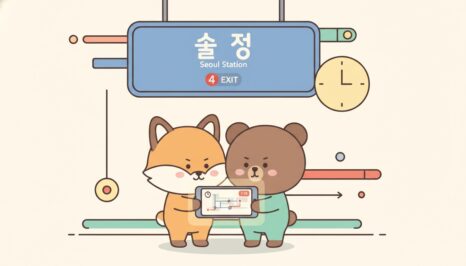
🚇 The Magic of “Subway Exits” (출구 – Chulgu)
In Korea, especially in Seoul, subway stations are huge! Just saying “Let’s meet at Gangnam Station” is a disaster because you might never find each other. 😱
Koreans always specify the Exit Number.
* “Exit 9” is 9번 출구 (Gu-beon chulgu).
📺 Drama Moment: In many dramas, you’ll see the lead character waiting anxiously in front of a specific subway exit or a landmark clock tower. If someone says “Meet me at Exit 3,” that is a strict instruction! Make sure you memorize the exit number!
📝 Wrap-up & Quiz
Today we learned how to tell friends where to come and not to be late!
- …ro wa (Come to…)
- …eseo bwa (See you at…)
- Neutji ma (Don’t be late)
🧠 Mini Quiz
Fill in the blanks with the correct Korean expression!
-
- You want to tell your friend to come to the park (Gongwon).
- “Gongwon-eu □ □!” (Come to the park!)
-
- You want to tell your friend “Don’t be late!”
- “□□ □!”
Answers:
1. ro wa (로 와)
2. Neutji ma (늦지 마)
See you next time! Annyeong! 👋💖
Frequently Asked Questions (FAQ)
Q: What does "여기서 봐 (Yeogiseo bwa)" mean in Korean and how do you pronounce it?
A: In Korean, "여기서 봐 (Yeogiseo bwa)" is pronounced [Tip:] and means: See me here / Let's meet here.
Q: What does "...로 와 (...ro wa)" mean in Korean and how do you pronounce it?
A: In Korean, "...로 와 (...ro wa)" is pronounced [see lesson guide] and means: Come to [place].
Q: What does "늦지 마 (Neutji ma)" mean in Korean and how do you pronounce it?
A: In Korean, "늦지 마 (Neutji ma)" is pronounced [Tip:] and means: Don't be late.


