

Hello! It’s Daily Hangul! 👋
Hello, Hangeul learners! It’s your favorite Korean tutor, Daily Hangul! 😊
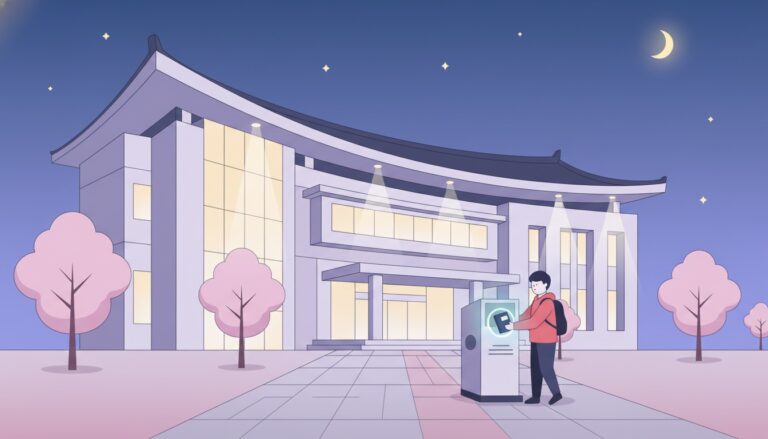
Have you ever rushed to the library to return a book, only to find the doors locked? 😱 In K-Dramas, characters often study late into the night at the library. But what happens if you need to return a book after hours? Don’t worry! Korea has a fantastic system for that.
Today, we are going to learn how to use the Unmanned Return Box (Drop box). This is super useful if you are living in Korea or studying abroad! Let’s master these expressions so you can return books anytime, 24/7! 🕒✨
3 Key Expressions 🔑
1. 무인 반납기 [Muin bannapgi]
- English: Unmanned return machine (Drop box)
- Detail: ‘무인 (Muin)’ means ‘unmanned’ (no person), and ‘반납기 (bannapgi)’ means ‘return machine’. You will see this machine outside most Korean libraries.
- 💡 Pronunciation Tip: When saying 반납 (bannap), the ‘ㅂ’ (b) at the bottom sounds more like a ‘p’ stop sound. So it sounds like [Ban-nap-gi].
2. 문 닫았어 [Mun dadasseo]
- English: The door is closed (It’s closed)
- Detail: Use this when a shop or building is closed for the day. It’s a casual way to say it to a friend.
- 💡 Pronunciation Tip: 닫았어 links together! The bottom ‘ㄷ’ moves to the next vowel. It sounds like [Da-da-sseo].
3. 넣다 [Neota]
- English: To put in / To insert
- Detail: You use this verb when you put the book into the machine. In a polite command, you say “넣으세요 (Neouseyo).”
- 💡 Pronunciation Tip: The ‘ㅎ’ (h) is weak here! When followed by a vowel, it often becomes silent. But as a base form, keep it short.
Real-life Conversation 🗣️
Situation: Jason arrived at the library, but it is already 10 PM. He meets his Korean friend, Sujin.
Jason: 어? 도서관 문 닫았어! 어떡하지?
[Eo? Doseogwan mun dadasseo! Eotteokaji?]
(Huh? The library is closed! What should I do?)
Sujin: 괜찮아. 저기 무인 반납기 있어.
[Gwaenchana. Jeogi muin bannapgi isseo.]
(It’s okay. There is an unmanned return machine over there.)
Jason: 아, 다행이다! 책을 그냥 넣으면 돼?
[Ah, dahaengida! Chaegeul geunyang neoumyeon dwae?]
(Oh, thank goodness! Can I just put the book in?)
Sujin: 응, 화면 누르고 책을 넣어.
[Eung, hwamyeon nureugo chaegeul neoeo.]
(Yeah, touch the screen and put in the book.)
Culture Tip & Drama Scene 🎬
Did you know? 🇰🇷
Korean libraries are very high-tech! Besides the 무인 반납기 (Muin bannapgi) at the library entrance, you can often find Smart Libraries (스마트 도서관) inside subway stations! 🚇
Just like in the drama Start-Up or Cheese in the Trap, students study very hard. These machines help busy students borrow and return books on their way to school or work without visiting the actual library building. If you see a machine that looks like a vending machine full of books in the subway, that’s it! Try using it next time! 😉
Wrap-up & Quiz 📝
Today we learned how to return books even when the library is closed! No more panic, right? 😎
Let’s check what you learned! (Answers are at the bottom)
- What do you call the machine where you return books without staff?
👉 무인 OOO -
How do you say “The door is closed” in casual Korean?
👉 문 OOO
Keep practicing, and see you in the next lesson! Annyeong! 👋❤️
Answers:
1. 반납기 (Bannapgi)
2. 닫았어 (Dadasseo)
Frequently Asked Questions (FAQ)
Q: What does "무인 반납기 [Muin bannapgi]" mean in Korean and how do you pronounce it?
A: In Korean, "무인 반납기 [Muin bannapgi]" is pronounced [Tip: When saying 반납 (bannap] and means: a key conversational Korean expression covered in this lesson.
Q: What does "문 닫았어 [Mun dadasseo]" mean in Korean and how do you pronounce it?
A: In Korean, "문 닫았어 [Mun dadasseo]" is pronounced [Tip: 닫았어 links together! The bottom 'ㄷ' moves to the next vowel. It sounds like [Da-da-sseo] and means: a key conversational Korean expression covered in this lesson.
Q: What does "넣다 [Neota]" mean in Korean and how do you pronounce it?
A: In Korean, "넣다 [Neota]" is pronounced [Tip: The 'ㅎ' (h] and means: a key conversational Korean expression covered in this lesson.







