Hello! This is Maeil Hangeul, here to upgrade your Korean skills!
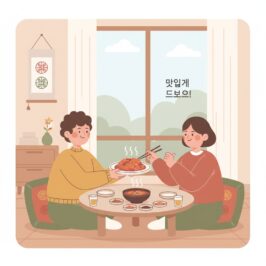
Have you ever wanted to invite a friend over to your place, share some delicious food, and watch a K-drama together? Today, we’re going to learn the essential phrases to do just that! Lately in Korea, hosting small “home parties” (홈파티) and “home cafes” (홈카페) has become a huge trend on social media, inspired by popular TV shows where idols and celebrities cook for each other. With these phrases, you’ll be ready to host your very own authentic Korean get-together!
Let’s get started!
Core Expressions You Need to Know
Here are four key phrases that will take you from sending the invitation to enjoying the meal.
1. The Casual Invitation: 우리 집에 놀러 올래?
- Korean Expression: 우리 집에 놀러 올래?
- Pronunciation [Romanization]: Uri jibe nolleo ollae?
- English Meaning: Wanna come over to my place (to hang out)?
- Detailed Explanation: This is the perfect, friendly way to invite a close friend over. Let’s break it down:
우리 집(uri jip) literally means “our house,” but it’s used to mean “my house” in a warm, inclusive way.놀러 오다(nolleo oda) means “to come over to hang out/play.”- The ending
~ㄹ래?(~llae?) is a casual way to ask “Do you want to…?” or “Wanna…?” Only use it with close friends!
- 💡 Pronunciation Tip:
Notice theㄹㄹsound in 놀러 올래 (nolleo ollae). When two ‘ㄹ’ (r/l) consonants are next to each other in the middle of a phrase, they combine to make a clear, smooth ‘L’ sound. So, instead of a rolling ‘r’, you pronounce it as [nol-leo ol-lae]. It flows much more naturally!
2. The Warm Offer: 내가 맛있는 거 해줄게.
- Korean Expression: 내가 맛있는 거 해줄게.
- Pronunciation [Romanization]: Naega masinneun geo haejulge.
- English Meaning: I’ll make you something delicious.
- Detailed Explanation: This phrase is full of warmth and hospitality. It shows your friend you’ve been thinking of them.
내가(naega) means “I.”맛있는 거(masinneun geo) means “a delicious thing.”해줄게(haejulge) comes from해주다(to do for someone) +~ㄹ게(a grammar ending that means “I will…”).
- 💡 Pronunciation Tip:
The pronunciation of 맛있는 (masinneun) is a classic example of a Korean sound-linking rule called liaison (연음 – yeoneum). The final consonant ‘ㅅ’ (s) from맛(mat) moves over to the empty vowel ‘ㅇ’ (i) in the next syllable. So, you don’t pronounce it as “mat-in-neun.” Instead, you say it smoothly as [ma-sin-neun]. This tip alone will make you sound much more natural!
3. The Best Compliment: 진짜 맛있다!
- Korean Expression: 진짜 맛있다!
- Pronunciation [Romanization]: Jinjja masitda!
- English Meaning: This is really delicious!
- Detailed Explanation: If you are the guest, this is the #1 phrase you need to know! Saying this will make your host incredibly happy.
진짜(jinjja) means “really” or “for real,” and맛있다(masitda) means “is delicious.” Use it with enthusiasm! - 💡 Pronunciation Tip:
Just like our last example, 맛있다 (masitda) also uses the liaison rule. The ‘ㅅ’ (s) sound from맛links to the next syllable, so it is pronounced [ma-sit-da], not “mat-it-da.” Also, notice the double consonantㅉin진짜(jinjja). It’s a tensed sound, made with a short, strong burst of air.
4. The Heart of Hospitality: 많이 먹어.
- Korean Expression: 많이 먹어.
- Pronunciation [Romanization]: Mani meogeo.
- English Meaning: Eat a lot. / Help yourself.
- Detailed Explanation: This is the essence of Korean hospitality. It’s not a command, but a warm, caring encouragement for your guest to feel comfortable and eat as much as they want. You will hear this from every Korean parent and friend when they serve you food.
- 💡 Pronunciation Tip:
Why is 많이 pronounced [mani] and not “man-hi”? In Korean, the consonant ‘ㅎ’ (h) is often silent or very weak when it’s between two other sounds. In this word, the ‘ㅎ’ sound basically disappears, making the pronunciation smooth and easy: [ma-ni].
Example Dialogue
Let’s see how these phrases work in a real conversation. Imagine Mina is inviting her friend Jake over to make tteokbokki, a trendy Korean snack.
- A (Mina): 제이크, 이번 주말에 뭐 해? 우리 집에 놀러 올래?
- (Jake, what are you doing this weekend? Wanna come over to my place?)
- B (Jake): 좋아! 뭐 할까?
- (Sounds good! What should we do?)
- A (Mina): 내가 맛있는 거 해줄게. 떡볶이 어때?
- (I’ll make you something delicious. How about tteokbokki?)
- B (Jake): 와, 최고! 지금 바로 갈게!
- (Wow, the best! I’m on my way right now!)
(Later, at Mina’s house…)
- B (Jake): (Tasting the food) 우와, 진짜 맛있다! 너 요리 천재야?
- (Whoa, this is really delicious! Are you a cooking genius?)
- A (Mina): 다행이다! 자, 많이 먹어.
- (I’m glad! Here, eat a lot.)
Culture Tip & Trend Deep Dive
In Korea, sharing food is a fundamental way of building relationships. The act of inviting someone to your home for a meal, or jib-bap (집밥, home-cooked meal), is a sign of deep friendship and care.
The phrase “많이 먹어 (Mani meogeo)” is directly connected to the Korean concept of 정 (jeong)—a deep and warm feeling of connection, affection, and community. When someone tells you to eat a lot, they are expressing their jeong for you. So don’t be shy; it’s a compliment to the host to eat well!
On Instagram today, you’ll see thousands of posts with hashtags like #홈파티 (home party) and #집밥스타그램 (home-cooked meal-stagram). By using the phrases we learned today, you can participate in this fun and heartwarming part of modern Korean culture!
Let’s Practice!
Time to check what you’ve learned.
- Fill in the blank: Your friend made you an amazing meal. You take a bite and want to compliment them. You say:
“와, ___________ 맛있다!”
- Make a sentence: How would you invite your friend over to your house to listen to a new K-pop album together? (Hint: Use our first key expression!)
Great job today! You’re now ready to host your own Korean-style get-together.
Why not try using one of today’s phrases in the comments below? Invite me over! 😉