
학습 블로그 내용
Unlocking K-Marketing: Brand Personas & Worldviews
1. Introduction
Hello! This is [Daily Hangul], here to upgrade your Korean skills to a professional level! 🌟
Today, we are diving into the fascinating world of Consumer Behavior and Marketing Psychology. specifically focusing on “Creating an Attractive Brand Persona.”
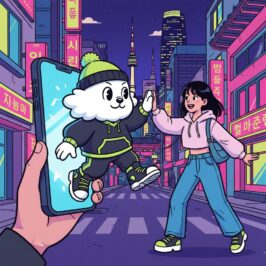
Have you noticed how Korean brands these days don’t just sell products? They tell stories! In Korea, the concept of a “Worldview” (세계관 – Segyegwan)—originally a term used in anime or games—has taken over marketing. From K-pop idols to snack companies, everyone is building a unique universe to engage the “MZ Generation.”
If you are working in a Korean business environment or studying marketing, knowing how to discuss these psychological strategies is essential. Let’s learn the sophisticated vocabulary you need to sound like a marketing pro in Korea!
2. Key Expressions
Here are 4 advanced expressions to help you discuss brand personas and marketing strategies.
1. 세계관 (Segyegwan)
- Pronunciation: [Se-gye-gwan]
- English Meaning: Worldview / Universe (in a storytelling context)
- Detailed Explanation: In the past, this meant one’s philosophical view of the world. However, in modern Korean marketing, it refers to the fictional universe or backstory created for a brand or character. It is the core of “Storytelling Marketing.”
- 💡 Pronunciation Tip:
- Pronounce each syllable clearly. There are no complex sound changes here, but make sure the ‘계 (gye)’ is pronounced distinctively. Sometimes in fast speech, ‘계’ can sound like ‘게 (ge)’, but in a professional setting, enunciating [Se-gye-gwan] sounds more intelligent.
2. 공감대를 형성하다 (Gong-gam-dae-reul hyeong-seong-ha-da)
- Pronunciation: [Gong-gam-dae-reul hyeong-seong-ha-da]
- English Meaning: To form a bond of sympathy / To build a consensus
- Detailed Explanation: ‘공감대’ means a shared feeling or understanding. ‘형성하다’ is a formal verb meaning “to form” or “to build.” This phrase is crucial when explaining that a brand persona must relate to the customer’s emotions to be successful.
- 💡 Pronunciation Tip:
- Linking (Yeon-eum): When you say ‘형성하다’, the ‘ㅎ’ sound often becomes weak. It sounds naturally like [hyeong-seong-a-da] in fluid speech.
3. 차별화 전략 (Chabyeol-hwa jeollyak)
- Pronunciation: [Chabyeol-hwa jeollyak] -> [Chabyeorhwa jeollyak]
- English Meaning: Differentiation strategy
- Detailed Explanation: ‘차별화’ means making something different or distinct. In a saturated market, having a unique persona is the key ‘differentiation strategy.’
- 💡 Pronunciation Tip:
- Liquidization (Rieul-hwa): Watch out for ‘전략 (strategy)’. The ‘ㄴ’ (n) in ‘전’ meets the ‘ㄹ’ (l/r) in ‘략’. The ‘n’ changes to an ‘l’ sound. So, it is pronounced [Jeollyak], not [Jeon-ryak]. This makes the pronunciation much smoother!
4. 팬덤을 구축하다 (Paendeom-eul guchuk-ha-da)
- Pronunciation: [Paendeom-eul guchukada]
- English Meaning: To build/establish a fandom
- Detailed Explanation: ‘구축하다’ is an advanced verb meaning “to construct” or “to establish (a system/base).” In modern marketing, brands want consumers to become ‘fans.’
- 💡 Pronunciation Tip:
- Aspiration (Gyeok-eum-hwa): Look at ‘구축하다’. The batchim ‘ㄱ’ (k) in ‘축’ meets the ‘ㅎ’ (h) in ‘하’. They combine to make the strong ‘ㅋ’ (k) sound. So, you say [Guchukada].
3. Example Dialogue
Let’s see how these words are used in a marketing strategy meeting.
Situation: A marketing team is discussing a new character for their brand.
Team Leader (팀장): 이번 신제품 마케팅에서는 우리 브랜드만의 확실한 정체성(Identity)을 보여줘야 합니다.
(For this new product marketing, we need to show our brand’s distinct identity.)Manager Park (박 대리): 네, 맞습니다. 요즘 소비자들은 단순히 제품만 보지 않아요. 흥미로운 세계관이 있어야 팬덤을 구축할 수 있습니다.
(Yes, that’s correct. Consumers these days don’t just look at the product. We need an interesting worldview to build a fandom.)Team Leader (팀장): 좋은 지적이에요. 그럼 타겟 고객층과 공감대를 형성할 수 있는 페르소나를 기획해 봅시다. 너무 완벽한 캐릭터보다는, 약간은 빈틈이 있는 친구 같은 느낌이 좋겠어요.
(Good point. Then let’s plan a persona that can form a bond of sympathy with our target audience. Rather than a perfect character, a friend-like vibe with some flaws would be better.)Manager Park (박 대리): 동의합니다! 그게 바로 경쟁사와의 확실한 차별화 전략이 될 것 같습니다.
(I agree! That will likely be a definite differentiation strategy against our competitors.)
4. Culture Tip & Trend Deep Dive
🔥 Trend Alert: The Era of “Bu-kae” (Secondary Character)
In Korea, the concept of “Bu-kae” (부캐 – Short for ‘Sub-Character’) has moved beyond entertainment and into corporate marketing.
Just like famous Korean comedians adopt completely different personas on TV (e.g., a rapper, a trot singer), brands are creating “Brand Personas” that act like real people on Instagram or YouTube.
- Why? The MZ Generation dislikes stiff, corporate advertising. They want authenticity.
- Example: A formal banking app might create a persona of a “clumsy intern” on social media who complains about work. This creates ‘Gong-gam-dae’ (Empathy) because customers feel, “Hey, they are just like me!”
Pro Tip: When discussing marketing in Korea, if you mention, “We need a solid ‘Segyegwan’ (Worldview) to make customers ‘Gwa-mol-ip’ (Over-immersed/Deeply engaged),” your Korean colleagues will be very impressed!
5. Conclusion & Practice
Today, we learned how to discuss Brand Personas using high-level Korean vocabulary. Remember, in the modern Korean market, selling a “story” (Worldview) is just as important as selling the product!
📝 Mini Practice
Fill in the blanks with the words we learned today:
- To succeed in this market, we need a unique ____________ (Differentiation strategy).
- The brand created a funny backstory to build a ____________ (Worldview).
(Answers: 1. 차별화 전략, 2. 세계관)
Did you enjoy today’s lesson? Try making a sentence using “공감대” in the comments below! I’d love to see your “Brand Persona.” 😉
See you next time!
[Daily Hangul]