Beyond Borders: Who Are Korea’s ‘제3문화 아이들’?
Hello! Welcome back to [매일한글], where we upgrade your Korean skills!
Today, we’re diving into a fascinating and deeply relevant topic for many of us living between cultures: identity. As a C1-level learner, you’re not just learning words; you’re learning to navigate complex social and personal ideas in Korean.
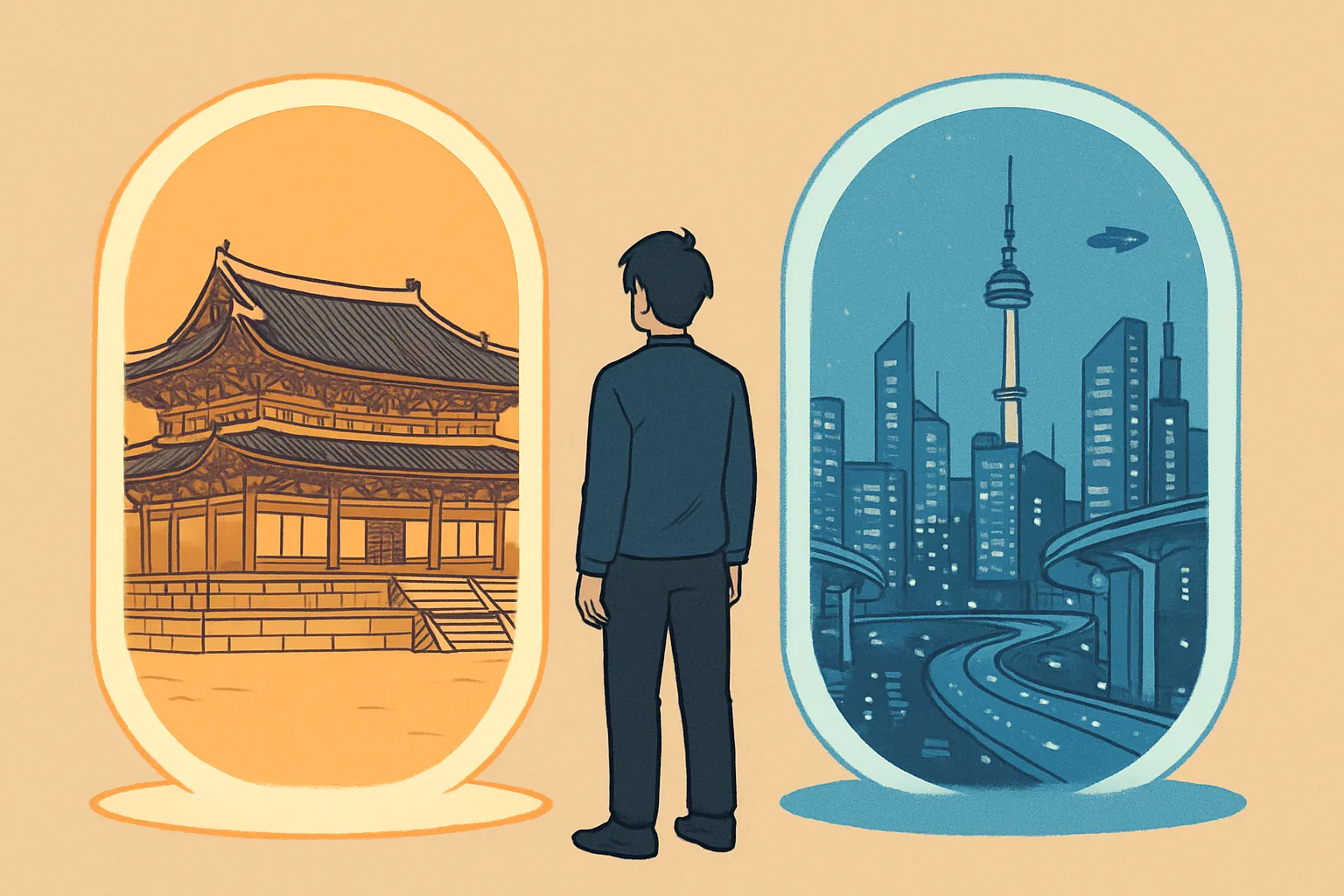
Lately in Korea, with the global rise of K-pop idols who grew up abroad and hit dramas featuring multicultural characters, there’s a growing conversation about what it means to belong. You’ve likely mastered the word ‘교포 (gyopo)’, but today we’re exploring a more nuanced concept that might resonate with you even more: ‘제3문화 아이들’ (Third Culture Kids). Let’s get started!
Core Expressions for Navigating Identity
Here are four essential terms to help you discuss the complex feelings of living between worlds.
1. 제3문화 아이들 (je-sam-mun-hwa a-i-deul)
- Romanization: [Je-sam-mun-hwa a-i-deul]
- English Meaning: Third Culture Kids (TCK)
- Detailed Explanation: This is a direct translation of “Third Culture Kids.” It refers to individuals who have spent a significant part of their developmental years outside their parents’ culture. The “third culture” is the unique, mixed identity they form, blending their home culture with their host culture(s). This term is distinct from ‘교포’ (gyopo), which typically refers to ethnic Koreans living abroad permanently, or ‘이민자’ (imigja – immigrant). ‘제3문화 아이들’ specifically captures the experience of a globally mobile upbringing.
- 💡 Pronunciation Tip:
In the phrase ‘제3문화 아이들’, let’s focus on the word 문화 [munhwa]. The character ‘ㅎ’ (h) is an aspirated sound. However, when it follows a consonant like ‘ㄴ’ (n), it often blends, causing the preceding consonant to become aspirated. But in this case, the ‘ㄴ’ and ‘ㅎ’ are pronounced distinctly. Make sure to pronounce the ‘n’ sound clearly in 문 [mun] and then release a puff of air for 화 [hwa]. It’s a subtle but clear separation: mun-hwa, not ‘muna’.
2. 정체성 (jeong-che-seong)
- Romanization: [Jeong-che-seong]
- English Meaning: Identity
- Detailed Explanation: This is the standard, formal term for “identity.” It’s a Sino-Korean word used in academic, psychological, and profound personal contexts. You’ll often see it paired with verbs like ‘정체성을 찾다’ (to find one’s identity) or in phrases like ‘정체성의 혼란을 겪다’ (to experience an identity crisis), a common theme for TCKs.
- 💡 Pronunciation Tip:
The vowel ‘ㅓ’ (eo) in 정 [jeong] and 성 [seong] is crucial. It’s an open-mid back unrounded vowel, which doesn’t have a perfect English equivalent. It’s similar to the “o” in “song” but with your mouth more relaxed and open, and your lips unrounded. Practice saying “uh” as in “but” and slowly transitioning to an “oh” sound without rounding your lips. That’s the sweet spot for ‘ㅓ’!
3. 소속감 (so-sok-gam)
- Romanization: [So-sok-gam]
- English Meaning: A sense of belonging
- Detailed Explanation: This is a fantastic compound noun. 소속 (sosok) means “affiliation” or “belonging to a group,” and 감 (gam) means “feeling” or “sense.” Together, they create the specific meaning of the feeling of belonging, which is often what TCKs search for. It’s the emotional connection to a place, group, or culture. You can ‘소속감을 느끼다’ (to feel a sense of belonging) or feel that it is lacking, ‘소속감이 부족하다’.
- 💡 Pronunciation Tip:
The final consonant (받침) ‘ㄱ’ in 속 [sok] is an unreleased stop. This means you move your tongue to the position to make a ‘k’ sound, but you don’t release the puff of air. This creates a subtle stop in sound before the next syllable begins. So, it’s not “so-sok-gam” with two audible ‘k’ sounds, but rather a smoother [so-sok(stop)-gam]. This makes your pronunciation sound much more natural.
4. 이방인 (i-bang-in)
- Romanization: [I-bang-in]
- English Meaning: A stranger; an outsider
- Detailed Explanation: While ‘외국인 (oegugin)’ simply means “foreigner,” 이방인 has a much deeper, more literary, and emotional nuance. It describes the feeling of being an outsider, someone who doesn’t quite fit in, regardless of their passport or ethnicity. It perfectly captures the alienation a TCK might feel, even in their “home” country. Albert Camus’s famous novel “The Stranger” is translated as ‘이방인’ in Korean.
- 💡 Pronunciation Tip:
This word beautifully illustrates the dual role of the character ‘ㅇ’. At the beginning of a syllable, as in 이 (i) and 인 (in), it is a silent placeholder; you only pronounce the vowel. But when it’s a final consonant (받침), as in 방 (bang), it makes the ‘ng’ sound. Recognizing this rule is fundamental to reading any Korean word correctly.
Example Dialogue
Let’s see these words in a real conversation! Minjun grew up in Seoul, and Hana is a TCK who just moved to Korea for university.
- 민준 (Minjun): 하나 씨는 해외에서 오래 살다 와서 한국 생활이 어색하지는 않아요?
- Hana, since you lived abroad for a long time, isn’t life in Korea a bit awkward for you?
- 하나 (Hana): 네, 솔직히 아직 이방인이 된 것 같은 기분이 들 때가 많아요. 제 정체성에 대해 다시 생각하게 되고요.
- Yes, honestly, there are many times I still feel like an outsider. It’s making me rethink my identity.
- 민준 (Minjun): 아, 그게 바로 ‘제3문화 아이들‘이 겪는 어려움이라고 들었어요. 어디에도 완벽한 소속감을 느끼기 어렵다고요.
- Ah, I heard that’s exactly the difficulty that ‘Third Culture Kids‘ experience. That it’s hard to feel a perfect sense of belonging anywhere.
- 하나 (Hana): 맞아요. 그래도 저와 비슷한 경험을 한 사람들이 있다는 걸 아는 것만으로도 위로가 돼요.
- Exactly. But just knowing there are other people who’ve had similar experiences is a comfort.
Culture Tip & Trend Analysis
This conversation isn’t just academic; it’s happening all over Korea right now.
The theme of searching for 정체성 and 소속감 is a powerful undercurrent in much of modern Korean media. The globally acclaimed drama “Pachinko” is a masterclass in depicting this struggle across generations of Koreans in Japan.
On a more contemporary note, think of K-pop idols who are TCKs or gyopo. BLACKPINK’s Rosé (grew up in Australia), Stray Kids’ Bang Chan (Australia), or Tomorrow X Together’s Huening Kai (born in Hawaii, lived in China and Korea) often share stories about their multicultural upbringings. They speak about the initial feeling of being an 이방인 in the Korean entertainment industry but eventually finding a deep 소속감 with their fellow members and fans worldwide.
By understanding these terms, you can unlock a deeper appreciation of their journeys and the complex, evolving tapestry of modern Korean society. You’re not just learning a language; you’re gaining insight into a global cultural phenomenon.
Wrap-up & Practice
Today, we’ve gone beyond simple vocabulary to discuss the profound concepts of 제3문화 아이들 (TCK), 정체성 (identity), 소속감 (a sense of belonging), and the feeling of being an 이방인 (outsider).
Now, it’s your turn to practice!
- Fill in the blank:
TCKs often struggle to feel a true _______________ because they feel connected to multiple cultures at once. - Short Answer:
In your own words, what is the main emotional difference between ‘외국인’ and ‘이방인’?
Share your answers or try making a sentence with today’s vocabulary in the comments below! We’d love to hear your story.