G7 Summit Ready: Master Diplomatic Korean for Global Health
Hello! Welcome back to [Maeil Hangul], your trusted partner in elevating your Korean proficiency to the next level!
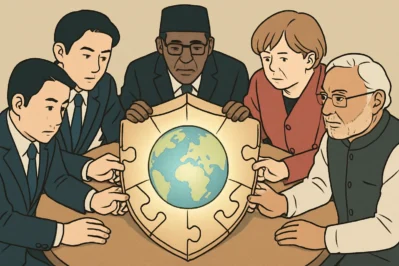
Are you ready to move beyond casual conversations and step into the world of high-level discourse? Today, we’re tackling a topic that’s more relevant than ever: global health and pandemic preparedness. Imagine yourself as a delegate at a G7 summit, negotiating critical policies that could shape the future. In today’s interconnected world, discussions around new pandemic treaties and international cooperation are constantly in the news. Mastering this vocabulary won’t just make you sound fluent; it will empower you to understand and engage with critical global issues in Korean. Let’s get started!
Core Diplomatic Expressions
Here are some essential phrases you’ll need to navigate a high-stakes discussion on global health.
1. 범지구적 보건 안보 (beomjigujeok bogeon anbo)
- Pronunciation [Romanization]: [beomjigujeok bogeon anbo]
- English Meaning: Global health security.
- Detailed Explanation: This is a highly formal, Hanja-based term perfect for policy documents and diplomatic statements. It breaks down into 범 (汎) meaning ‘pan-‘ or ‘all-encompassing’, 지구적 (地球的) for ‘global’, 보건 (保健) for ‘health’, and 안보 (安保) for ‘security’. It refers to the collective international efforts to prevent, detect, and respond to public health emergencies that cross borders.
- 💡 Pronunciation Tip:
- In a phrase like this, Koreans often pronounce the final consonant of one block with the first vowel of the next. However, since these are distinct compound nouns, focus on articulating each part clearly. The key is to maintain a steady, formal tone rather than speaking too quickly. Notice the slight pause between ‘보건’ and ‘안보’ for emphasis.
2. ~에 입각하여 (~e ipgak-hayeo)
- Pronunciation [Romanization]: [e ipgakayeo]
- English Meaning: Based on / Founded upon.
- Detailed Explanation: This grammatical pattern is a sophisticated way to say ‘based on’. It’s much more formal than the common
~를 바탕으로(reul batang-euro). You use it to signify that an action, argument, or policy is founded on a specific principle, law, or piece of evidence. It adds a layer of authority and formality to your statement. - 💡 Pronunciation Tip:
- This is a perfect example of the linking sound rule, or ‘연음’ (yeoneum). The final consonant ‘ㄱ’ (k) in ‘입각’ moves over to the empty ‘ㅇ’ slot in ‘하여’. So, instead of saying “ipgak-hayeo” as two separate words, it flows together smoothly as [입가카여/ipakayeo]. Mastering this will make your formal Korean sound incredibly natural.
3. 선제적인 조치 (seonjejeogin jochi)
- Pronunciation [Romanization]: [seonjejeogin jochi]
- English Meaning: Preemptive measures / Proactive actions.
- Detailed Explanation: This phrase is crucial for strategic discussions. 선제적 (先制的) means ‘preemptive’ or ‘proactive’, and 조치 (措置) means ‘measure’ or ‘action’. It contrasts with a reactive response (
대응 조치). Using this term shows you are thinking ahead and planning strategically, a key skill in diplomacy and crisis management. - 💡 Pronunciation Tip:
- The possessive particle ‘의’ (ui) has a simplified pronunciation in many contexts. When it follows a consonant and is not the first syllable of a word, like in ‘선제적인’, it is pronounced as ‘이’ [i]. Therefore, you’ll hear Koreans say [선제저긴/seonjejeogin], not [seonjejeog-ui].
4. 공조 체계를 구축하다 (gongjo chegyereul guchukada)
- Pronunciation [Romanization]: [gongjo chegyereul guchukada]
- English Meaning: To establish a cooperative system/framework.
- Detailed Explanation: This is a powerhouse phrase in international relations. 공조 (共助) means ‘joint cooperation’, 체계 (體系) is a ‘system’ or ‘framework’, and 구축하다 (構築하다) means ‘to build’ or ‘to establish’. It’s the go-to expression when proposing the creation of collaborative international structures, such as for sharing data or distributing medical supplies.
- 💡 Pronunciation Tip:
- Pay attention to the aspirated consonants ‘ㅊ’ (ch) and ‘ㅋ’ (k) sound in ‘체계’ and ‘구축’. They require a stronger puff of air than their unaspirated counterparts ‘ㅈ’ (j) and ‘ㄱ’ (g). Practice saying “체 (che)” with a distinct burst of air, as if you’re saying “CHair.” This subtle difference is a hallmark of advanced pronunciation.
Example Dialogue: At the G7 Summit
Let’s see how these expressions work in a conversation between two delegates.
- A (Delegate from Canada):
최근 팬데믹은 견고한 범지구적 보건 안보의 중요성을 다시 한번 일깨워주었습니다.
(The recent pandemic has once again reminded us of the importance of robust global health security.) -
B (Delegate from Korea):
전적으로 동의합니다. 과학적 데이터에 입각하여, 우리는 다음 위기를 막기 위한 선제적인 조치를 취해야 합니다.
(I couldn’t agree more. Founded upon scientific data, we must take preemptive measures to prevent the next crisis.) -
A (Delegate from Canada):
바로 그 점입니다. 백신 및 치료제에 대한 공평한 접근을 보장하기 위한 국제 공조 체계를 구축하는 것이 시급합니다.
(That is precisely the point. It is urgent to establish a cooperative system to ensure equitable access to vaccines and treatments.)
Cultural Tip & Trend Deep Dive
In South Korea, the government’s response to the COVID-19 pandemic, often branded as “K-방역” (K-Quarantine), became a major point of national pride and international discussion. This model, which emphasized rapid testing, contact tracing, and transparency, heavily influenced how Korea positions itself in global health discussions today.
When you watch Korean news or read government press releases about international affairs, you’ll notice these Hanja-based, formal expressions are everywhere. They are the language of power, policy, and academia. Understanding them is your key to unlocking a deeper comprehension of Korean society’s formal discourse. You might even hear characters in political K-dramas like Designated Survivor: 60 Days use these exact phrases when debating national security issues! Using them correctly demonstrates not just linguistic skill, but also cultural and political literacy.
Wrap-up & Practice
Today, we learned four powerful expressions to discuss global health policy like a seasoned diplomat:
* 범지구적 보건 안보 (Global health security)
* ~에 입각하여 (Based on / Founded upon)
* 선제적인 조치 (Preemptive measures)
* 공조 체계를 구축하다 (To establish a cooperative system)
Now it’s your turn to be the delegate!
- Fill in the Blank:
각국은 상호 신뢰에 ___________ 국제 보건 규약을 개정해야 합니다.
(Each country must revise the international health regulations ___________ mutual trust.) -
Sentence Building:
Using the phrase 선제적인 조치, write a short sentence about what the world should do to prepare for climate change.
We’d love to see your answers! Share your sentences in the comments below using the expressions you learned today. Let’s engage in some high-level Korean discussion