Sorry! How to Cancel Plans Politely in Korean
Hello! Welcome to [Daily Korean], where we upgrade your Korean skills!
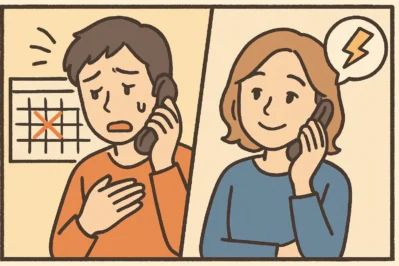
Have you ever made plans with a friend but then something unexpected happens? Life can be busy, and sometimes you just have to cancel. But how do you do it politely in Korean without hurting your friend’s feelings? Today, we’re going to learn exactly that!
Especially these days in Korea, with everyone juggling work, hobbies, and social events, plans can change in an instant. Knowing how to cancel gracefully is a super important social skill. Let’s learn how to do it like a pro!
Core Expressions You Need to Know
Here are three essential phrases for canceling plans smoothly.
1. 미안해요, 약속을 취소해야 할 것 같아요.
- Pronunciation [Romanization]: Mianhaeyo, yaksogeul chwiso-haeya hal geot gatayo.
- English Meaning: I’m sorry, I think I have to cancel our plan.
- Detailed Explanation: This is the perfect, polite way to start. 미안해요 (Mianhaeyo) means “I’m sorry,” 약속 (yaksok) means “plan” or “appointment,” and 취소해야 할 것 같아요 (chwiso-haeya hal geot gatayo) is a soft way of saying “I think I have to cancel.” Using “…ㄹ 것 같아요” (…l geot gatayo) makes your statement sound less direct and more considerate.
-
💡 Pronunciation Tip:
In 취소 (chwiso), the vowel ‘ㅟ’ is pronounced like the ‘wi’ in “witch.” For 같아요 (gatayo), you might notice it’s spelled with a ‘ㅌ’ (t) but sounds more like a ‘t’ or ‘d’ that rolls into the next vowel. This is because when a final consonant like ‘ㅌ’ is followed by a vowel, its sound often carries over. So instead of a sharp “gat-ayo,” it flows into a softer [gatayo].
2. 갑자기 일이 생겼어요.
- Pronunciation [Romanization]: Gapjagi iri saenggyeosseoyo.
- English Meaning: Something suddenly came up.
-
Detailed Explanation: This is a classic and very common excuse that works in almost any situation. 갑자기 (Gapjagi) means “suddenly,” 일 (il) means “matter” or “work,” and 생겼어요 (saenggyeosseoyo) means “it happened” or “it came up.” It’s a great phrase because it’s polite and you don’t need to share personal details.
-
💡 Pronunciation Tip:
Listen closely to 일이 [iri]. It’s not pronounced “il-i.” This is a perfect example of a Korean pronunciation rule called liaison (or 연음, yeoneum). The final consonant ‘ㄹ (l)’ from the first block 일 (il) moves over to the next syllable, which starts with a silent ‘ㅇ’. So, it naturally flows together to sound like [iri].
3. 다음에 꼭 봐요.
- Pronunciation [Romanization]: Daeume kkok bwayo.
- English Meaning: Let’s definitely meet next time.
-
Detailed Explanation: This is a must-use phrase! After canceling, you should always express your intention to meet in the future. It shows you still value the friendship. 다음에 (Daeume) means “next time,” 꼭 (kkok) means “definitely” or “for sure,” and 봐요 (bwayo) means “let’s see/meet.”
-
💡 Pronunciation Tip:
The sound in 꼭 [kkok] is very important. The double consonant ‘ㄲ (kk)’ is a “tensed” sound. To make this sound, you tighten your throat and push the sound out without any puff of air. Try saying ‘g’ (as in ‘go’) and ‘k’ (as in ‘king’). The ‘ㄲ’ sound is stronger and tighter than both. It’s what makes the word sound so firm and definite!
Example Dialogue
Let’s see how these expressions are used in a real conversation. Imagine two friends, A and B, were supposed to go to the new LE SSERAFIM pop-up store.
- A: 우리 내일 르세라핌 팝업 스토어 가는 거 맞지?
- (Uri naeil le sserafim pab-eop seuto-eo ganeun geo matji?)
- Are we still going to the LE SSERAFIM pop-up store tomorrow?
- B: 아, 정말 미안해요. 약속을 취소해야 할 것 같아요.
- (A, jeongmal mianhaeyo. Yaksogeul chwiso-haeya hal geot gatayo.)
- Oh, I’m so sorry. I think I have to cancel our plan.
- A: 진짜? 무슨 일 있어?
- (Jinjja? Museun il isseo?)
- Really? What happened?
- B: 응, 갑자기 일이 생겼어요. 정말 미안해.
- (Eung, gapjagi iri saenggyeosseoyo. Jeongmal mianhae.)
- Yeah, something suddenly came up. I’m really sorry.
- A: 괜찮아, 걱정 마.
- (Gwaenchana, geokjeong ma.)
- It’s okay, don’t worry.
- B: 이해해 줘서 고마워. 다음에 꼭 봐요!
- (Ihaehae jwoseo gomawo. Daeume kkok bwayo!)
- Thanks for understanding. Let’s definitely meet next time!
Culture Tip & Trend Deep Dive
In Korea’s relationship-focused culture, how you handle canceling plans says a lot about you. Simply not showing up or sending a last-minute text is considered very rude. This is called 잠수 (jamsu), which literally means “to go underwater” – it’s the Korean word for “ghosting”!
To avoid being seen as rude, always follow the three steps we learned:
1. Apologize sincerely (미안해요).
2. Give a brief, polite reason (갑자기 일이 생겼어요).
3. Promise to meet in the future (다음에 꼭 봐요).
This shows respect for the other person’s time and feelings. The phrase “다음에 꼭 봐요” is a key part of Korean social etiquette (인사치레, insachire). While it’s a polite phrase, if you truly want to meet again, make sure to follow up and schedule a new plan! That will show your sincerity and make you a great friend.
Wrap-up & Practice Time!
Great job today! You’ve learned three simple but powerful phrases to cancel plans politely in Korean. You can now say sorry, give a reason, and promise to meet again.
Now, let’s test your knowledge!
✏️ Practice Question:
You have to cancel dinner with your friend. What is the best phrase to say that means “Something suddenly came up”?
- 안녕하세요! (Annyeonghaseyo!)
- 다음에 꼭 봐요. (Daeume kkok bwayo.)
- 갑자기 일이 생겼어요. (Gapjagi iri saenggyeosseoyo.)
(The answer is 3!)
Now it’s your turn! Try making a sentence using one of today’s expressions in the comments below. See you next time