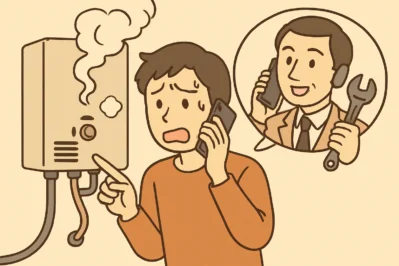
My Boiler’s Broken! How to Ask Your Landlord for Repairs in Korean
Hello! Welcome to Daily Hangul, here to upgrade your Korean skills!
Ever had your air conditioner give up on the hottest day of the year? Or the Wi-Fi suddenly stop working right before a big deadline? It happens! Dealing with household problems can be stressful, especially in a foreign language. But don’t worry! Today, we’re going to learn how to confidently and politely ask your landlord for repairs in Korean.
In Korea, where the ppalli-ppalli (빨리빨리, hurry-hurry) culture means people expect things to be fixed fast, knowing these phrases is a real lifesaver. Let’s learn how to solve these little conflicts smoothly and get your home back in working order!
Core Expressions You Need to Know
Here are the essential phrases to communicate any household issue to your landlord.
1. 고장 났어요 (gojang nass-eoyo)
- Pronunciation [Romanization]: [go-jang nas-seo-yo]
- English Meaning: It’s broken. / It’s out of order.
- Detailed Explanation: This is your go-to phrase for any machine or electronic device that has stopped working. It’s a polite and direct way to state the problem. You simply put the name of the broken item in front of it. (e.g., 에어컨이 고장 났어요. – The air conditioner is broken.)
- 💡 Pronunciation Tip:
The magic is in the ‘ㅆ’ (ss) sound in 났어요 (nasseoyo). This is a “tensed” consonant. To make this sound, make your tongue tense and release a short, strong burst of air, almost like a “hiss.” It’s stronger and quicker than a single ‘ㅅ’ (s). Listen carefully to the difference between ‘나서요’ (na-seo-yo) and ‘났어요’ (nas-seo-yo). That tension is key to sounding natural!
2. -이/가 안 돼요 (-i/ga an dwaeyo)
- Pronunciation [Romanization]: [-i/ga an dwae-yo]
- English Meaning: (Something) doesn’t work.
- Detailed Explanation: This is another incredibly versatile phrase. It’s a bit softer than “broken” and can be used for things that aren’t functioning correctly. For example, if the hot water isn’t coming out, you can say “따뜻한 물이 안 돼요” (The hot water isn’t working). Use 이 (i) after a noun ending in a consonant (e.g., 인터넷이 안 돼요) and 가 (ga) after a noun ending in a vowel (e.g., 와이파이가 안 돼요).
- 💡 Pronunciation Tip:
The word 돼요 (dwaeyo) can be tricky. It’s a combination of ‘ㄷ’ (d), ‘ㅗ’ (o), and ‘ㅐ’ (ae). Try saying “doh-ae” very quickly. It should blend into a single syllable: [dwae]. Practice saying it slowly at first, then speed up until it feels smooth.
3. 수리(를) 좀 부탁드립니다 (suri(reul) jom butakdeurimnida)
- Pronunciation [Romanization]: [su-ri(-reul) jom bu-tak-deu-rim-ni-da]
- English Meaning: I’d like to request a repair, please.
- Detailed Explanation: This is the golden phrase for politely asking for action. Let’s break it down: 수리 (suri) means “repair,” 좀 (jom) is a magic word that softens the request (like “please” or “a little”), and 부탁드립니다 (butakdeurimnida) is a very formal and polite way of saying “I ask of you.” Using this phrase shows respect and is more likely to get you a quick, positive response. The object particle ‘를’ (reul) is often omitted in spoken Korean.
- 💡 Pronunciation Tip:
Listen to how the end of this phrase changes! Because the syllable ‘드립’ is followed by ‘니다’, the final ‘ㅂ’ (b) sound changes to an ‘ㅁ’ (m) sound to make it easier to say. This is called nasalization. So, instead of saying “butak-deu-rib-ni-da,” it sounds like [butak-deu-rim-ni-da]. This small change will make you sound much more like a native speaker!
Example Dialogue
Let’s see how these phrases work in a real conversation. Imagine it’s the peak of summer, and your A/C just broke. Time to call the landlord (집주인님)!
- A (Tenant): 여보세요, 집주인님. 저 302호에 사는 제인입니다.
- Yeoboseyo, jipjuinnim. Jeo sambaek-i-ho-e saneun Jein-imnida.
- Hello, Landlord. This is Jane from unit 302.
- B (Landlord): 아, 네, 제인 씨. 무슨 일 있으세요?
- A, ne, Jein-ssi. Museun il isseuseyo?
- Ah, yes, Jane. What’s going on?
- A (Tenant): 다름이 아니라, 에어컨이 고장 났어요. 찬 바람이 전혀 안 돼요.
- Dareumi anira, eeokeon-i gojang nass-eoyo. Chan barami jeonhyeo an dwaeyo.
- Well, my air conditioner is broken. The cold air isn’t working at all.
- B (Landlord): 그래요? 알겠습니다. 제가 한번 확인해 볼게요.
- Geuraeyo? Algesseumnida. Jega hanbeon hwaginhae bolgeyo.
- Oh, really? I see. I will check on it.
- A (Tenant): 네, 날씨가 너무 더워서요. 바쁘시겠지만 수리 좀 부탁드립니다.
- Ne, nalssiga neomu deowoseoyo. Bappeusigetjiman suri jom butakdeurimnida.
- Yes, the weather is so hot. I know you must be busy, but I’d like to request a repair, please.
- B (Landlord): 알겠어요. 내일 오전에 바로 기사님 보내드릴게요.
- Algesseoyo. Naeil ojeone baro gisanim bonaedeurilgeyo.
- I understand. I’ll send a technician over tomorrow morning right away.
Culture Tip & Trend Deep Dive
Politeness is Power!
In Korea, your relationship with your landlord is important. Using polite language like adding -님 (nim) to 집주인 (landlord) to make 집주인님 (jipjuinnim) and using formal endings like -ㅂ니다/습니다 (-mnida/seumnida) shows respect. This isn’t just about language; it’s about resolving the “conflict” (the broken item) smoothly and maintaining a good relationship. A polite request is much more effective than a demanding one!
Who Pays for What?
A common question for renters in Korea is, “Who is responsible for the repair?” Generally, the landlord is responsible for fixing major fixtures that came with the apartment, like the boiler (보일러), air conditioner (에어컨), or a leaky pipe. However, the tenant is usually responsible for replacing small consumable items like lightbulbs. Knowing this can save you from an awkward conversation!
Let’s Wrap It Up & Practice!
Great job today! You’ve learned how to handle one of the most practical situations you might face while living in Korea.
- 고장 났어요 (It’s broken.)
- -이/가 안 돼요 (It doesn’t work.)
- 수리 좀 부탁드립니다 (I’d like to request a repair, please.)
Now, it’s your turn to practice!
Quiz Time!
- The heating (난방) isn’t working in the middle of winter! Fill in the blank to complete the sentence you’d say to your landlord.
- “집주인님, ___________이/가 안 돼요.”
- How would you say, “The refrigerator is broken” in a polite sentence? (Refrigerator = 냉장고, naengjanggo)
Let us know your answers in the comments! Trying to make your own sentences is the best way to remember. Good luck