
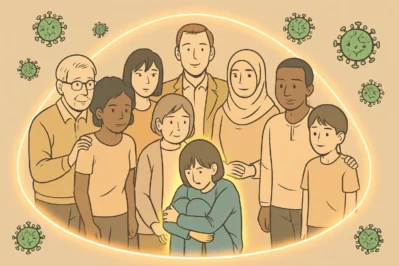
Beyond the Headlines: A C1 Guide to Discussing 집단 면역 (Herd Immunity) in Korean
Hello! This is 매일한글 (Maeil Hangeul), here to upgrade your Korean skills to the next level!
Today, we’re diving into a sophisticated topic that dominated global conversations: Public Health and Epidemics. Specifically, we’ll learn how to discuss the concept of ‘Herd Immunity’ (집단 면역) in Korean. This is essential for understanding news reports, academic articles, and high-level discussions.
You’ve likely heard about “K-방역” (K-Quarantine) and Korea’s response to the recent pandemic. A key term at the center of these strategic discussions was 집단 면역. Understanding how to use this and related vocabulary will not only boost your formal Korean but also give you a deeper insight into public discourse in Korea. Let’s get started!
Core Expressions for Your Expert Toolkit
Here are four key expressions you need to discuss herd immunity like a pro.
1. 집단 면역 (Jipdan Myeonyeok)
- Pronunciation [Romanization]: Jipdan myeonyeok
- English Meaning: Herd Immunity / Collective Immunity
- Detailed Explanation: This is a direct, formal term. It’s a compound word made of Hanja (Sino-Korean characters). 집단 (集團) means ‘group’ or ‘collective’, and 면역 (免疫) means ‘immunity’. It refers to the indirect protection from an infectious disease that happens when a sufficient percentage of a population has become immune. You will see this term constantly in news articles, government briefings, and scientific papers.
- 💡 Pronunciation Tip:
For the word 면역 [myeonyeok], notice the two distinct syllables. The first syllable ends with the consonant ‘ㄴ’ (n), and the second starts with the ‘ㅇ’ (ng/placeholder) followed by the ‘ㅕ’ (yeo) vowel. Pronounce them clearly as [myeon-yeok]. Avoid blending them into something like “myeo-nyeok.” Clear syllabic pronunciation is key to sounding articulate in formal Korean.
2. -을/를 형성하다 (-eul/reul hyeongseonghada)
- Pronunciation [Romanization]: -eul/reul hyeongseonghada
- English Meaning: to form; to build up; to constitute
- Detailed Explanation: While a beginner might use ‘만들다’ (to make), 형성하다 (形成하다) is the C1-level verb used for forming abstract concepts, relationships, or phenomena. It’s the perfect partner for 집단 면역. For example, “to form herd immunity” is “집단 면역을 형성하다.” It elevates your language, making it suitable for academic or professional contexts.
- 💡 Pronunciation Tip:
The ‘ㅎ(h)’ in 형성 [hyeongseong] is aspirated, meaning you should release a distinct puff of air. Also, pay attention to the final consonant ‘ㅇ(ng)’ in 형. It’s a nasal sound made at the back of your throat, similar to the ‘-ng’ in the English word “sing.”
3. 감염병 확산 방지 (Gamyeombyeong hwaksan bangji)
- Pronunciation [Romanization]: Gamyeombyeong hwaksan bangji
- English Meaning: Prevention of the spread of infectious diseases
- Detailed Explanation: This is a powerful noun phrase you’ll often hear in official announcements. Let’s break it down: 감염병 (感染病) = infectious disease, 확산 (擴散) = spread/diffusion, and 방지 (防止) = prevention. Mastering these Hanja-based components will unlock a huge amount of formal vocabulary.
- 💡 Pronunciation Tip:
In 확산 [hwaksan], the final ‘ㄱ(k)’ of ‘확’ and the initial ‘ㅅ(s)’ of ‘산’ interact. The ‘ㅅ(s)’ becomes a tensed sound, similar to ‘ㅆ(ss)’. This phenomenon is called ‘된소리되기’ (tensing). So, instead of a soft [hak-san], the natural pronunciation is a stronger [확싼 | hwak-ssan]. This is a subtle but crucial rule for advanced speakers!
4. 전제 조건 (Jeonje jogeon)
- Pronunciation [Romanization]: Jeonje jogeon
- English Meaning: Prerequisite; precondition
- Detailed Explanation: This is an essential term for any logical or academic argument. 전제 (前提) means ‘premise’ and 조건 (條件) means ‘condition’. It refers to something that is required as a prior condition for something else to happen or exist. For example, “A high vaccination rate is a prerequisite for herd immunity.”
- 💡 Pronunciation Tip:
The pronunciation is straightforward: [jeon-je jo-geon]. The key is to give equal stress to each of the four syllables. In formal Korean, enunciating each syllable clearly adds to the speaker’s authority and clarity.
Example Dialogue: In a News Interview
Let’s see these expressions in a realistic conversation between a public health expert (A) and a journalist (B).
A (전문가): 이 팬데믹을 극복하기 위해서는 집단 면역을 형성하는 것이 매우 중요합니다. 이것이 장기적인 감염병 확산 방지의 핵심입니다.
(Jeonmunga): I paendemigeul geukbokagi wihaeseoneun jipdan myeonyeogeul hyeongseonghaneun geosi mae-u jung-yohamnida. Igeosi jang-gijeogin gamyeombyeong hwaksan bangji-ui haeksimimnida.
(Expert A): In order to overcome this pandemic, forming herd immunity is very important. This is the core of long-term prevention of the spread of infectious diseases.
B (기자): 그렇다면, 집단 면역 형성의 가장 중요한 전제 조건은 무엇이라고 보십니까?
(Gija): Geureotamyeon, jipdan myeonyeok hyeongseong-ui gajang jung-yohan jeonje jogeon-eun mu-eosirago bosimnikka?
(Journalist B): In that case, what do you see as the most important prerequisite for forming herd immunity?
A (전문가): 과학적 데이터에 기반했을 때, 높은 수준의 백신 접종률이 바로 그 전제 조건입니다.
(Jeonmunga): Gwahakjeok deiteo-e gibanhaesseul ttae, nopeun sujun-ui baeksin jeopjongnyuri baro geu jeonje jogeon-imnida.
(Expert A): Based on scientific data, a high vaccination rate is precisely that precondition.
Culture Tip & Trend Deep Dive
In Korea, a society that often emphasizes collective well-being, the concept of 집단 면역 was framed not just as a scientific goal but as a civic duty. Public health campaigns frequently used language that appealed to a sense of community, like “나를 위해, 우리 모두를 위해” (For me, and for all of us).
This means that when you discuss 집단 면역 in Korean, you’re not just talking about a public health strategy. You’re tapping into a deeper cultural conversation about social responsibility. Pointing out that achieving herd immunity is a collective effort will show a sophisticated understanding that goes beyond simple language translation. Mentioning this in a discussion will surely make you sound like a true expert on Korean society!
Wrap-up & Practice Time!
Today we learned four advanced expressions to discuss the complex topic of herd immunity:
* 집단 면역 (Herd Immunity)
* -을/를 형성하다 (to form)
* 감염병 확산 방지 (Prevention of the spread of infectious diseases)
* 전제 조건 (Prerequisite)
Now, let’s put your knowledge to the test!
1. Fill in the blanks:
성공적인 방역 정책의 (A)______은/는 시민들의 적극적인 협조이다. 이것이 (B)______의 첫걸음이다.
(The (A)______ of a successful quarantine policy is the active cooperation of its citizens. This is the first step in the (B)______.)
(Scroll down for the answer!)
2. Your Turn!
Using the term 전제 조건, what do you think is a prerequisite for mastering a foreign language?
Leave your answers and sentences in the comments below! We’d love to see you use these powerful expressions.
(Answer to Quiz 1: A: 전제 조건, B: 감염병 확산 방지)