
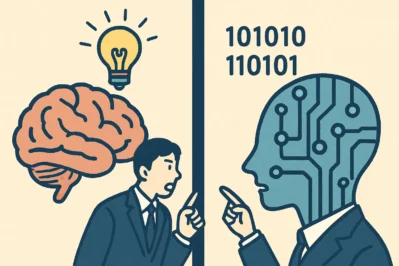
AI vs. The Human Brain: How to Debate in Advanced Korean
Hello! It’s your favorite Korean upgrade kit, [Maeil Hangeul], here to boost your fluency!
Ever found yourself in a deep conversation about technology, philosophy, or the future? Today, we’re tackling a massive topic that’s on everyone’s mind: Artificial Intelligence versus human cognition. These days in Korea, the conversation around AI is everywhere, from groundbreaking tech news and ethical debates in universities to the plots of the latest sci-fi K-dramas. This lesson will equip you with the sophisticated vocabulary and grammar you need to not just follow along, but to confidently share your own opinions on this complex subject. Let’s get started!
Core Expressions for Your AI Debate
Here are four essential expressions that will make you sound like a seasoned intellectual when discussing AI and the human mind.
1. ~에 비하면 (e bihamyeon) – Compared to…
- Korean Expression: 인공지능의 연산 속도에 비하면 인간의 뇌는 현저히 느리다.
- Pronunciation [Romanization]: In-gong-ji-neung-ui yeon-san sok-do-e bihamyeon in-gan-ui noe-neun hyeon-jeo-hi neu-ri-da.
- English Meaning: Compared to the processing speed of AI, the human brain is significantly slower.
- Detailed Explanation: While you might know
~보다for simple comparisons,~에 비하면is a more formal and analytical structure used in written language, presentations, and debates. It sets up a direct contrast, often to emphasize a particular difference between two subjects. Using this immediately elevates the sophistication of your argument. - 💡 Pronunciation Tip:
Let’s look at 현저히 [hyeon-jeo-hi]. The final syllable히 (hi)is pronounced clearly here. However, in Korean, theㅎ (h)sound can sometimes weaken or be silent, especially between voiced sounds. For example, in the word전화 (jeonhwa), it often sounds more like[jeo-nwa]. In현저히, because it’s a formal adverb, a clear pronunciation of[hyeon-jeo-hi]is preferred to maintain clarity.
2. ~(이)라는 측면에서 (-(i)raneun cheukmyeon-eseo) – In terms of… / From the aspect of…
- Korean Expression: 창의성이라는 측면에서는 인간이 인공지능을 능가한다.
- Pronunciation [Romanization]: Chang-ui-seong-iraneun cheuk-myeon-eseo-neun in-gan-i in-gong-ji-neung-eul neung-gwa-han-da.
- English Meaning: In terms of creativity, humans surpass AI.
- Detailed Explanation: This is a powerhouse phrase for structuring an argument. It allows you to isolate a specific characteristic (like creativity, efficiency, ethics) and analyze it separately. It shows that you are not making a blanket statement but are considering the topic from multiple, well-defined angles. Use it when you want to frame your point with precision.
- 💡 Pronunciation Tip:
The verb 능가한다 [neung-gwa-han-da] has an interesting phonetic change. Theㅎ(h)in한(han)comes after a syllable ending in a consonant (과gwa). In rapid speech, thisㅎ(h)is often weakened or nearly silent, making the phrase sound closer to[neung-gwan-da]. Mastering this subtle reduction will make your speech sound much more natural and fluid.
3. 모방하다 (mobanghada) – To imitate / To emulate
- Korean Expression: 현재 인공지능은 인간의 신경망을 모방하여 설계되었다.
- Pronunciation [Romanization]: Hyeon-jae in-gong-ji-neung-eun in-gan-ui sin-gyeong-mang-eul mo-bang-ha-yeo seol-gye-doe-eot-da.
- English Meaning: Current AI is designed by imitating the human neural network.
- Detailed Explanation:
모방하다is more than just “to copy” (따라 하다). It carries a nuance of emulating a model, system, or principle, making it the perfect verb for scientific and technical contexts. When you say AI emulates human neural networks, you’re using the precise, academic term that shows a deep understanding of the concept. - 💡 Pronunciation Tip:
The phrase 설계되었다 [seol-gye-doe-eot-da] is often contracted in speech.되었다becomes 됐다 [dwaet-da]. The vowel combinationㅚ (oe) + 었 (eot)merges into됐 (dwaet). This is an extremely common contraction for past tense passive verbs, so recognizing and using it is a key sign of an advanced speaker.
4. 고차원적 사고 (gocha-wonjeok sago) – Higher-order thinking
- Korean Expression: 인공지능이 과연 인간처럼 고차원적 사고를 할 수 있을지는 미지수이다.
- Pronunciation [Romanization]: In-gong-ji-neung-i gwa-yeon in-gan-cheo-reom go-cha-won-jeok sa-go-reul hal su is-seul-ji-neun mi-ji-su-i-da.
- English Meaning: It remains to be seen whether AI can truly perform higher-order thinking like humans.
- Detailed Explanation: This is a fantastic compound noun built from Hanja (Sino-Korean characters):
고(高)high,차원(次元)dimension/level, and사고(思考)thought. It refers to complex cognitive processes like abstract reasoning, critical analysis, moral judgment, and creativity—the very abilities often cited as the current frontier for AI development. - 💡 Pronunciation Tip:
In the word 미지수이다 [mi-ji-su-i-da], notice the smooth connection between수 (su)and이 (i). This is a classic example of linking, or 연음 (yeoneum). Because수ends in a vowel, the consonant from the next grammatical particle isn’t needed, and the two sounds flow together seamlessly as[su-i]. Don’t pause between them!
Example Dialogue
Let’s see these expressions in action! Two university students, A and B, are discussing the latest sci-fi K-drama.
A: 어제 새로 나온 SF 드라마 봤어? 인공지능의 학습 능력이 정말 소름 돋더라.
(Did you see the new sci-fi drama yesterday? The AI’s ability to learn was seriously creepy.)
B: 완전 공감해. 데이터 처리라는 측면에서는 인간이 상대가 안 되지. 근데 정말로 자의식이 있는 걸까?
(I totally agree. In terms of data processing, humans are no match. But does it really have self-awareness?)
A: 그게 핵심이지. 인공지능의 완벽한 기억력에 비하면 우리 뇌는 결함투성이잖아. 하지만 결국 인간의 사고 패턴을 모방하는 것뿐 아닐까?
(That’s the key question. Compared to its perfect memory, our brains are full of flaws. But in the end, isn’t it just imitating human thought patterns?)
B: 맞아. 감정을 이해하거나 윤리적 판단을 내리는 것 같은 고차원적 사고는 아직 인간 고유의 영역이라고 생각해.
(Exactly. I think higher-order thinking, like understanding emotions or making ethical judgments, is still a uniquely human domain.)
Culture Tip & Trend Deep Dive
In Korea, the AI conversation isn’t just theoretical; it’s a practical reality. Tech giants like Naver and Kakao are developing their own “초거대 AI” (hyper-scale AI), and you’ll constantly see this term in the news.
Furthermore, Korean pop culture loves to explore the philosophical side of AI. Popular K-dramas like My Holo Love and films like Jung_E delve into questions of AI consciousness, rights, and what it truly means to be human. When you watch these, listen for today’s vocabulary! Using phrases like ~(이)라는 측면에서 in a discussion will make you sound incredibly articulate and logical, earning you respect in any academic or professional setting in Korea.
Let’s Practice!
Ready to test your new knowledge?
- Fill in the blank:
정서적 교감 능력이라는 ___________는 아직 인공지능이 인간을 따라오기 어렵다.
(In terms of emotional connection ability, it’s still difficult for AI to catch up to humans.) -
Make a sentence:
Use the pattern~에 비하면to write a sentence comparing the efficiency of an AI translator and a human translator.
Great job today! You’ve just added some powerful tools to your Korean arsenal. Now you’re ready to engage in deep, meaningful conversations about one of the 21st century’s most important topics.
What are your thoughts? Can AI achieve true higher-order thinking? Share your opinion in the comments below using the expressions we learned today!