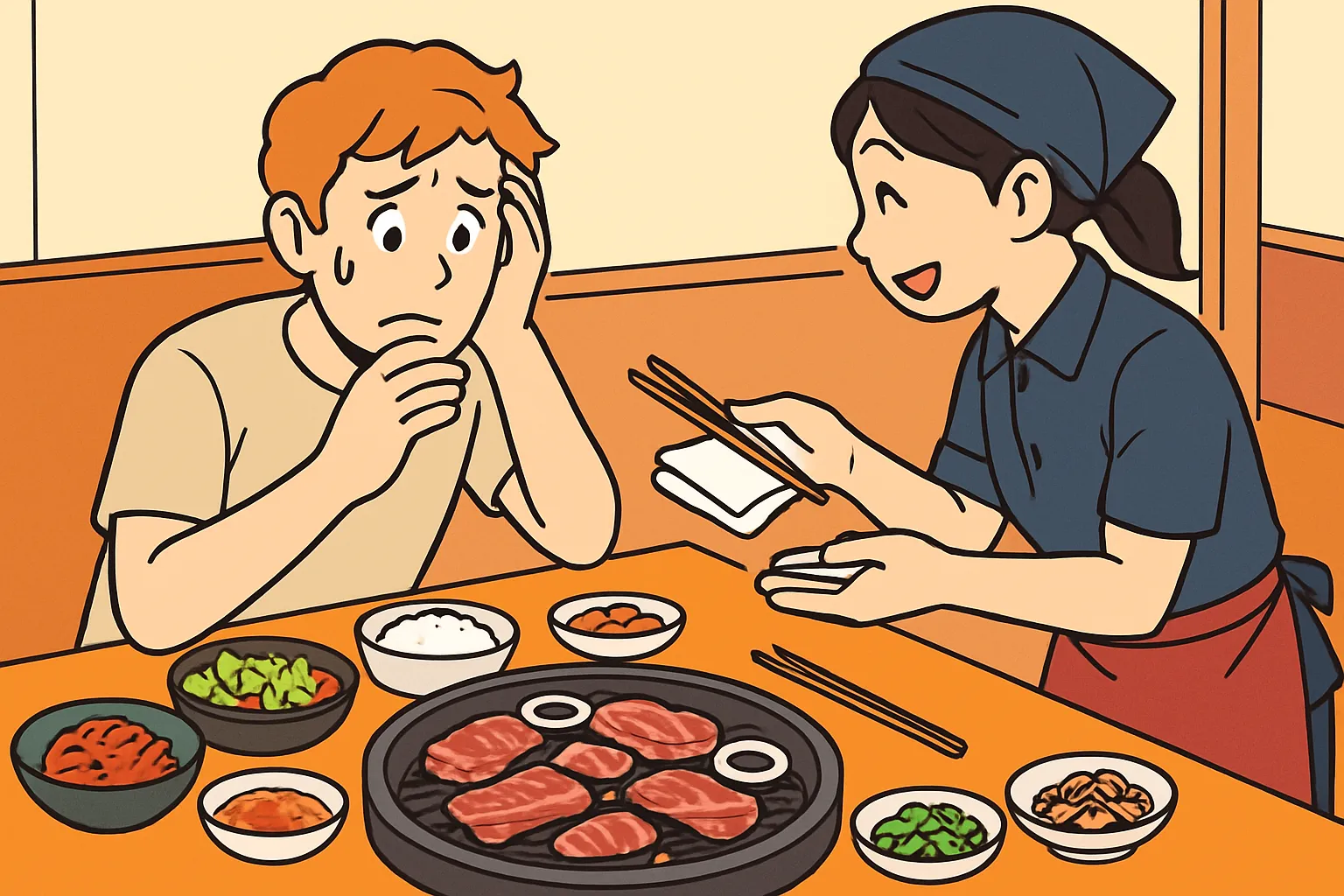

‘소식(小食)’ vs. ‘미식(美食)’, 당신의 선택은? 칼로리 제한 심층 토론
Hello! This is [Maeil Hangeul], here to upgrade your Korean skills!
Have you ever wondered about the secret to a long and healthy life? Today, we’re diving into a hot topic in the world of health science: Caloric Restriction. It’s a fascinating and sometimes controversial subject. This lesson will equip you with the advanced Korean you need to discuss its complex effects and side effects, just like a native speaker.
Especially these days in Korea (요즘 한국에서는), there’s a huge interest in wellness and anti-aging. From celebrities sharing their “small-portion” (소식) diets to the popularity of intermittent fasting (간헐적 단식), everyone seems to be talking about how to live healthier, longer. So, let’s learn how to jump into that conversation!
Core Expressions for Your Debate
Here are some key expressions that will allow you to discuss the pros and cons of any complex topic, including caloric restriction.
1. ~는/은/ㄴ 셈이다 (It can be said that… / It amounts to…)
- Korean Expression: 소식을 하면 수명을 늘리는 셈이다.
- Pronunciation [Romanization]: Sosigeul hamyeon sumyeongeul neullineun semida.
- English Meaning: It can be said that eating small portions extends one’s lifespan.
- Detailed Explanation: This pattern is used when you want to draw a conclusion or summarize a situation, suggesting that one thing is practically the same as another. It’s not a direct, factual statement but rather an interpretation or calculation. It’s perfect for making a point in a discussion, like “So, what you’re saying is…” or “In essence, it’s like…”
- 💡 Pronunciation Tip:
The final consonant of the verb stem determines what you use. For늘리다, the stem is늘리-. Since it ends in a vowel, you add-는 셈이다. Notice the pronunciation of늘리는as [늘리는/neullineun]. Theㄴsound is clear. Now, consider a verb like먹다(to eat). It would be먹는 셈이다. Here, the 받침 ‘ㄱ(k)’ meets the ‘ㄴ(n)’ and often assimilates, making the sound closer to [멍는 셈이다/meongneun semida]. This is called nasal assimilation and makes your speech sound much more natural.
2. 양날의 검 (A double-edged sword)
- Korean Expression: 칼로리 제한은 건강에 양날의 검이 될 수 있어요.
- Pronunciation [Romanization]: Kallori jehaneun geongange yangnarui geomi doel su isseoyo.
- English Meaning: Caloric restriction can be a double-edged sword for health.
- Detailed Explanation: This is a fantastic idiom, derived from Hanja (兩 날의 劍), literally meaning “a sword with a blade on both sides.” Just like in English, it refers to something that has both positive and negative consequences. It’s an elegant way to acknowledge the complexity of an issue.
- 💡 Pronunciation Tip:
The possessive particle ‘의’ can be tricky! While its official pronunciation is [ui], in natural, fast-paced conversation, it’s often pronounced as [에/e], especially when it follows a noun like양날. So, whileyangnarui geomis correct, you’ll often hear Koreans say [양나레 검/yangnare geom]. Listening for this will improve your comprehension skills dramatically!
3. ~다고 해서 반드시 ~는 것은 아니다 (Just because… doesn’t necessarily mean…)
- Korean Expression: 적게 먹는다고 해서 반드시 건강해지는 것은 아니다.
- Pronunciation [Romanization]: Jeokge meongneundago haeseo bandeusi geonganghaejineun geoseun anida.
- English Meaning: Just because you eat less doesn’t necessarily mean you’ll be healthy.
- Detailed Explanation: This is an essential structure for presenting a counter-argument. It allows you to acknowledge a common belief (
~다고 해서) and then refute or qualify it by saying it’s not always true (반드시 ~는 것은 아니다). It shows a high level of critical thinking and is frequently used in debates and academic discussions. - 💡 Pronunciation Tip:
In casual speech,~는 것은is very often contracted to~는 건. So,건강해지는 것은 아니다becomes [건강해지는 건 아니다/geonganghaejineun geon anida]. Using this contraction will make you sound less like a textbook and more like a native speaker.
Example Dialogue
Let’s see how these expressions work in a real conversation.
A: 요즘 장수 비결에 대한 다큐멘터리를 봤는데, 칼로리 제한이 핵심이더라고요. 결국 적게 먹는 게 오래 사는 비결인 셈이에요.
(I watched a documentary about the secrets to longevity, and caloric restriction was the key. In essence, it means eating less is the secret to a long life.)
B: 흠, 하지만 그게 그렇게 간단한 문제일까요? 칼로리 제한은 양날의 검 같아요. 영양 결핍이나 근육 감소 같은 부작용도 무시할 수 없잖아요.
(Hmm, but is it that simple? I think caloric restriction is a double-edged sword. You can’t ignore side effects like nutritional deficiencies or muscle loss.)
A: 그 말도 맞네요. 효과가 좋다는 연구 결과만 보고 무작정 따라 하면 안 되겠어요.
(You have a point. I guess I shouldn’t just blindly follow it after seeing research about its positive effects.)
B: 맞아요. 수명을 늘려준다고 해서 반드시 행복한 노년을 보장하는 것은 아니니까요. 삶의 질도 중요하죠.
(Exactly. Just because it might extend your lifespan doesn’t necessarily mean it guarantees a happy old age. Quality of life is important, too.)
Culture Tip & Trend Analysis
In Korea, the concept of caloric restriction is deeply intertwined with the cultural idea of “소식” (小食), or eating small amounts. Many celebrities are famous for their “소식가” (small-eater) lifestyles, which are often portrayed as a form of self-discipline and a key to maintaining their appearance.
However, this exists in stark contrast to another massive trend: “먹방” (Meokbang), or eating broadcasts, where people consume huge quantities of food for an audience. This cultural duality makes Korea a fascinating place to discuss this topic. You have one side praising moderation and another celebrating indulgence.
When you use a phrase like “양날의 검,” you can connect it directly to this cultural tension. You could say, “한국에서는 소식을 긍정적으로 보기도 하지만, 먹방 문화도 있어서 칼로리 제한은 정말 양날의 검 같아요.” (In Korea, eating small portions is seen positively, but there’s also the Meokbang culture, so caloric restriction really seems like a double-edged sword.) Mentioning these cultural touchstones will show you have a deep, nuanced understanding of not just the language, but the society itself.
Let’s Wrap Up & Practice!
Today, we learned some sophisticated expressions to help you navigate complex discussions.
- ~는/은/ㄴ 셈이다: To conclude or summarize a situation.
- 양날의 검: To describe something with both pros and cons.
- ~다고 해서 반드시 ~는 것은 아니다: To make a nuanced counter-argument.
Now, it’s your turn to practice!
- Fill in the blank:
엄격한 칼로리 제한의 장단점을 고려해 보면, 그것은 ______의 검이라고 할 수 있다. (Considering the pros and cons of strict caloric restriction, it can be called a ______ sword.) -
Your Opinion:
What do you think about intermittent fasting (간헐적 단식)? Try to write your opinion in Korean in the comments below, using at least one of today’s expressions!
We can’t wait to read your thoughts. Happy studying