
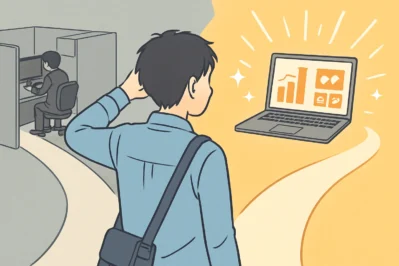
Level Up Your Career in Korea: From Upskilling to “God-seng”!
Hello, everyone! Welcome back to [Maeil Hangul], where we upgrade your Korean skills one post at a time!
Are you thinking about your career path? Maybe you’re considering a change or want to learn a new skill. You’re not alone! In Korea right now, “upskilling” (업스킬링) and “career change” (커리어 전환) are huge topics. Many people, especially the younger generation, are taking online courses to prepare for the future, embracing a lifestyle trend called ‘갓생’ (God-saeng) – living a productive, god-like life.
Today, we’ll learn essential C1-level Korean expressions to discuss learning new skills and changing careers. These phrases will help you have deeper conversations about your professional goals, whether you’re talking to a colleague, a friend, or even in a job interview!
Core Expressions You Need to Know
Let’s dive into some key phrases that will make you sound like a native speaker when discussing your career ambitions.
1. ~ㄹ/을까 생각 중이다 (I’m thinking of…)
- Pronunciation [Romanization]: ~l/eulkka saenggak jungida
- English Meaning: I’m thinking of… / I’m considering…
- Detailed Explanation: This grammar pattern is perfect for expressing a plan or intention that you are still considering and haven’t fully decided on yet. It’s softer and more tentative than “I will do…” (
~ㄹ/을 거예요). It shows you’re in the process of making a decision, making it great for talking about potential career moves.- Use
~ㄹ까 생각 중이다after a verb stem ending in a vowel (e.g.,바꾸다->바꿀까 생각 중이다). - Use
~을까 생각 중이다after a verb stem ending in a consonant (e.g.,옮기다->옮길까 생각 중이다).
- Use
- 💡 Pronunciation Tip:
The word생각is romanized assaenggak, but be careful with the finalㄱ (k)sound. When it’s followed by a consonant like in생각 중[saenggak jung], theㄱsound is often not fully released. It’s a soft stop, almost like you’re about to say “k” but you stop your breath right before. This makes the transition to중[jung] much smoother.
2. 전망이 밝다 (The prospects are bright)
- Pronunciation [Romanization]: Jeonmangi bakda
- English Meaning: The prospects are bright / It has a promising future.
- Detailed Explanation: This is a fantastic idiomatic expression used to describe a field, company, or technology that is expected to be successful in the future. It literally means “the outlook (전망) is bright (밝다).” You can use this to explain why you’re interested in a particular career path. The opposite would be
전망이 어둡다(the prospects are dim). - 💡 Pronunciation Tip:
Pay attention to the sound change in밝다[bakda]. The final consonant clusterᆰis simplified. When followed by another consonant (ㄷ), only theㄱ (k)sound is pronounced. So, it’s not “balk-da” but [bakda]. However, when followed by a vowel, like in밝아요(it’s bright), theㄹsound moves to the next syllable, resulting in [balgayo]. This is a key consonant cluster rule!
3. 커리어 전환 (Career Change/Transition)
- Pronunciation [Romanization]: Keorieo jeonhwan
- English Meaning: Career change / Career transition
- Detailed Explanation: While
이직(ijik) means changing companies but often within the same field,커리어 전환(keorieo jeonhwan) implies a more fundamental shift to a completely new type of job or industry. For example, a designer becoming a software developer is a커리어 전환. This is a key term in today’s Korean job market discussions. - 💡 Pronunciation Tip:
The word전환[jeonhwan] can be tricky. Notice theㄴ (n)sound in전and theㅎ (h)sound in환. Whenㄴis followed byㅎ, they often blend slightly, but it’s important to pronounce both clearly. Practice sayingjeonand then a slightly breathyhwanright after.
Example Dialogue
Let’s see how these expressions work in a real conversation between two colleagues, Mina and Junho.
A (Mina): 준호 씨, 요즘 좀 피곤해 보여요. 무슨 일 있어요?
(Junho, you look a bit tired these days. Is everything okay?)
B (Junho): 아, 민아 씨. 실은 요즘 제 미래에 대해 고민이 많아요. 지금 하는 일이 저랑 잘 안 맞는 것 같아서 커리어 전환을 해 볼까 생각 중이에요.
(Ah, Mina. Honestly, I’ve been worrying a lot about my future. I feel like my current job isn’t a good fit, so I’m thinking of making a career change.)
A (Mina): 정말요? 어떤 분야를 생각하고 있는데요?
(Really? What kind of field are you considering?)
B (Junho): 요즘 데이터 분석 분야가 전망이 밝다고 하더라고요. 그래서 온라인 강의를 듣고 있는데, 새로운 걸 배우는 게 커리어 전환을 하는 데에 도움이 될 것 같아요.
(I heard that the data analysis field has bright prospects these days. So I’m taking an online course, and I think learning something new will be helpful for making a career change.)
(Note: I’ve included ~는 데에 도움이 되다 (to be helpful for doing…) as a bonus C1 expression!)
Culture Tip & Trend Analysis: The ‘갓생’ Lifestyle
Why are so many Koreans focused on upskilling? It’s closely tied to the “갓생” (God-saeng) trend. “갓생” is a portmanteau of “God” and “인생” (insaeng – life), meaning to live an exemplary, productive, and self-disciplined life.
For the Korean MZ generation (Millennials + Gen Z), ‘갓생’ isn’t just about success; it’s a way to find stability and meaning in a highly competitive society. This often includes:
- The Miracle Morning: Waking up early (e.g., 5 AM) to exercise, read, or study before work.
- Upskilling: Using online platforms like “Class101” or “Inflearn” to learn coding, digital marketing, or data science after work.
- Side Hustles (부업): Developing new skills to start a small side business.
When you use expressions like 커리어 전환을 생각 중이다, you’re not just talking about a job—you’re tapping into this major cultural current of self-improvement and ambition. Mentioning that you’re taking an online course to live a more ‘갓생’ life will definitely make you sound like you’re in the know!
Let’s Wrap It Up & Practice!
Today, we learned some incredibly useful C1-level expressions for discussing career development:
- ~ㄹ/을까 생각 중이다: For when you’re considering a future plan.
- 전망이 밝다: To describe a field with a promising future.
- 커리어 전환: For a fundamental shift in your career path.
Now it’s your turn to practice!
Practice Question:
Imagine you want to change your career to a UX/UI designer. Using the expressions we learned today, how would you complete this sentence?
요즘 UX/UI 디자인 분야가 ( )고 해서, 그쪽으로 ( )을/를 해 볼까 ( ).
(These days, I heard the UX/UI design field…, so I’m… to that area.)
Leave your answer in the comments below! I can’t wait to see what you come up with. Keep up the great work