Korean Genetics 101: Sounding Smart with Mendel’s Laws!
Hello! Welcome to [Daily Hangul], here to upgrade your Korean skills!
Have you ever wondered why you have your mother’s eyes or your father’s smile? Today, we’re going to travel back to science class, but make it fun with Korean! We’ll be learning how to talk about genetics and family resemblance, all inspired by Gregor Mendel and his famous pea plants.
You might be thinking, “Science in Korean? Isn’t that difficult?” Not at all! Lately in Korea, there’s a fun trend on social media where people playfully analyze which celebrity kids inherited certain features from their famous parents. Using these words will not only make you sound smarter but also help you join in on these fun, everyday conversations!
Let’s dive in and unlock the secrets of Korean genetics!
Core Expressions
Here are three key expressions that will make you sound like a genetics pro in Korean.
1. 유전 (Yujeon)
- Pronunciation [Romanization]: [Yujeon]
- English Meaning: Heredity, Genetics
- Detailed Explanation: This is the main keyword for today! 유전 (Yujeon) is the noun for “heredity” or “genetics.” You can use it to talk about the traits passed down from parents to children. It’s a slightly formal word, but it’s widely understood and used in daily conversations, especially when talking about family resemblances.
- 💡 Pronunciation Tip:
- The first syllable ‘유 (yu)’ is straightforward. For the second syllable ‘전 (jeon)’, pay close attention to the final consonant ‘ㄴ (n)’. Make sure your tongue touches the roof of your mouth just behind your teeth to make a clear ‘n’ sound. It’s not a silent ‘n’ like in some English words; it must be clearly pronounced!
2. 우성 (Useong) & 열성 (Yeolseong)
- Pronunciation [Romanization]: [Useong] & [Yeolseong]
- English Meaning: Dominant & Recessive
- Detailed Explanation: This is a fantastic pair of words straight from Mendel’s laws. 우성 (Useong) means “dominant,” and 열성 (Yeolseong) means “recessive.” They are used just like in English to describe genetic traits. For example, you can say “double eyelids are a dominant trait” (쌍꺼풀은 우성 형질이에요).
- 💡 Pronunciation Tip:
- In both words, the initial vowel (‘우’ and ‘여’) is preceded by the consonant ‘ㅇ’. When ‘ㅇ’ comes at the beginning of a syllable block, it’s a silent placeholder. It has no sound! However, when it comes at the bottom (like in the ‘성’ of 우성), it makes the “ng” sound, like the end of “singing.” So, it’s [u-seong], not [ngu-seong]. This is a fundamental rule in Korean!
3. ~을/를 닮다 (~eul/reul damda)
- Pronunciation [Romanization]: [~eul/reul damtta]
- English Meaning: To resemble / to look like (someone)
- Detailed Explanation: This is the most practical phrase for today! It’s a verb used to say that someone resembles another person. You attach it to the person you look like, followed by the object particle 을 (eul) or 를 (reul). For example: “저는 아빠를 닮았어요 (Jeoneun appareul dalmasseoyo)” means “I resemble my dad.” It’s used very frequently among friends and family.
- 💡 Pronunciation Tip:
- This one is a great trick to sound more natural! The final consonants in ‘닮’ are ‘ㄹ(l)’ and ‘ㅁ(m)’. When spoken, Koreans almost always drop the ‘ㄹ(l)’ sound. So, ‘닮’ is pronounced simply as [담/dam]. Furthermore, when ‘다’ comes after it, the ‘ㄷ(d)’ sound becomes tense, like ‘ㄸ(tt)’. So, ‘닮다’ is pronounced [담따/damtta], not [dalm-da]. It’s a small change that makes a huge difference!
Example Dialogue
Let’s see how these words are used in a real conversation. Two friends, A and B, are looking at a picture of a famous K-pop idol with his father.
A: 이 아이돌 사진 봤어? 아빠랑 완전 똑같이 생겼네!
[I aidol sajin bwasseo? Apparang wanjeon ttokgachi saenggyeonne!]
Have you seen this idol’s picture? He looks exactly like his dad!
B: 와, 진짜다! 키가 큰 건 우성 유전인가 봐.
[Wa, jinjada! Kiga keun geon useong yujeonin-ga bwa.]
Wow, for real! I guess his tall height is a dominant genetic trait.
A: 맞아. 웃는 모습은 아빠를 정말 닮았어.
[Maja. Unneun moseubeun appareul jeongmal dalmasseo.]
Right. His smile really resembles his dad’s.
B: 신기하다. 나는 우리 가족 중에서 유일하게 곱슬머리인데, 이건 열성 형질이래.
[Singihada. Naneun uri gajok jungeseo yuilhage gopseulmeoriinde, igeon yeolseong hyeongjirirae.]
It’s fascinating. I’m the only one with curly hair in my family; they say it’s a recessive trait.
Culture Tip & Trend Deep Dive
In Korea, talking about who a child resembles is a very common and friendly topic of conversation. It’s a way of showing affection and building connection.
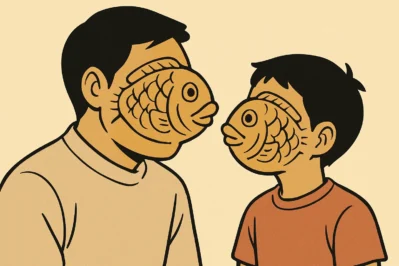
One of the most popular phrases you’ll hear is “붕어빵이다” (Bungeoppang-ida). A 붕어빵 is a fish-shaped pastry filled with red bean paste. They are made from a mold, so they all look exactly the same. When you say two people are “붕어빵,” it means they are spitting images of each other, like a child and their parent!
So, next time you see a friend’s baby picture, you can say, “와, 아빠랑 완전 붕어빵이네! (Wa, apparang wanjeon bungeoppang-ine!)” which means “Wow, he’s the spitting image of his dad!” This will surely impress your Korean friends!
Wrap-up & Practice!
Great job today! We learned some scientific but super useful Korean words: 유전 (genetics), 우성 (dominant), 열성 (recessive), and the essential verb ~을/를 닮다 (to resemble).
Now, it’s your turn to practice!
- Fill in the blank:
- 저는 엄마의 눈을 ________. (I resemble my mom’s eyes.)
- (Hint: Use the past tense of 닮다)
- Translate this short sentence:
- “My brown eyes are a dominant trait.”
Let us know your answers in the comments below, and feel free to share who you 닮았어요 (dalmasseoyo) in your family! Keep up the great work