
Master Your Schedule in Korean Like a K-Pop Idol!
Hello! It’s [Maeil Hangeul], here to upgrade your Korean skills! 😊
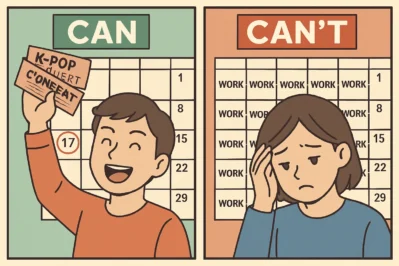
Have you ever looked at a K-pop idol’s schedule and thought, “Wow, how do they do it all?!” From music shows to fan signs, their days are packed! Today, we’re going to learn the essential Korean grammar for talking about what you can and can’t do. This will help you manage your own schedule, make plans with friends, and understand your favorite idols even better.
These days in Korea, being busy is a hot topic, and knowing how to express your availability is a superpower. Let’s get started!
Core Expressions You Need to Know
Here are the key phrases to talk about your abilities and schedule.
1. 할 수 있어요 (I can do it)
- Pronunciation [Romanized]: hal su isseoyo
- English Meaning: I can do (it). / It’s possible.
- Detailed Explanation: This is the most fundamental way to say you are able to do something. It combines the verb 하다 (hada – to do) with the grammar pattern -(으)ㄹ 수 있다 (-(eu)l su itda – can). It’s in the standard polite form (
-요), so you can use it in most daily situations. - 💡 Pronunciation Tip:
The secret to sounding natural here is the ‘ㅆ’ (ss) sound in 있어요 (isseoyo). It’s a “tense” or “hard” S sound. Make it short and strong, almost like the “ts” in “cats” but without the ‘t’ part. Don’t drag it out like “isssssseoyo.” Just a quick, sharp [isseoyo]!
2. 갈 수 없어요 (I can’t go)
- Pronunciation [Romanized]: gal su eopseoyo
- English Meaning: I can’t go.
- Detailed Explanation: This is the opposite! It uses the verb 가다 (gada – to go) with the “cannot” grammar pattern, -(으)ㄹ 수 없다 (-(eu)l su eopda). It’s the perfect polite phrase to decline an invitation when you’re unavailable.
- 💡 Pronunciation Tip:
This is a super important pronunciation rule called linking (연음 – yeoneum)! Even though it’s writteneops-eo-yo, Koreans pronounce it as [업서요 – eop-seo-yo]. The final consonant of a syllable (ㅂin없) moves over to the next syllable if it starts with a vowel (어). So,수 없다is notsu eopt-dabut sounds like [수업따 – su-eop-tta]. This makes your Korean flow much more smoothly!
3. 약속을 잡을 수 있어요 (I can make a plan/appointment)
- Pronunciation [Romanized]: yaksogeul jabeul su isseoyo
- English Meaning: I can make an appointment / We can set a plan.
- Detailed Explanation: 약속 (yaksok) means “promise” or “plan,” and 잡다 (japda) means “to catch” or “to grab.” Together, 약속을 잡다 (yaksogeul japda) is a common phrase for “making a plan” or “setting an appointment.” This phrase shows you’re ready and able to schedule something.
- 💡 Pronunciation Tip:
More linking practice! The word 잡을 (jabeul) is writtenjap-eul, but theㅂ (b/p)sound links to the next syllable. So, you pronounce it as [자블 – ja-beul]. It’s much easier and faster to say than a choppy “jap… eul.” Try it!
Example Dialogue
Let’s see these expressions in a real-life conversation about a K-pop concert!
A: 이번 주 토요일에 새로 온 스트레이 키즈 콘서트 갈래?
(Ibeon ju toyoire saero on Stray Kids keonseoteu gallae?)
Wanna go to the new Stray Kids concert this Saturday?
B: 아, 토요일은 안 돼. 일이 있어서 갈 수 없어요.
(A, toyoireun an dwae. Iri isseoseo gal su eopseoyo.)
Oh, I can’t on Saturday. I have work, so I can’t go.
A: 정말? 그럼 다음 주는 어때?
(Jeongmal? Geureom daeum juneun eottae?)
Really? What about next week then?
B: 다음 주는 괜찮아! 약속을 잡을 수 있어요. 우리 꼭 가자!
(Daeum juneun gwaenchana! Yaksogeul jabeul su isseoyo. Uri kkok gaja!)
Next week is fine! I can make a plan. Let’s definitely go!
A: 좋아! 그럼 우리 할 수 있어요!
(Joa! Geureom uri hal su isseoyo!)
Great! Then we can do it!
Culture Tip: The K-Idol “Packed Schedule”
In Korea, an idol’s schedule is a huge topic of interest for fans. Fans often track official schedules posted on platforms like Weverse or fan cafes.
When an idol has a very busy schedule with back-to-back activities, Koreans call it a 빡빡한 스케줄 (ppakppakan seukejul), which means a “tight” or “packed” schedule. While it seems tiring, having a packed schedule is often seen as a sign of popularity and success. So, when you hear a fan say, “우리 오빠는 스케줄이 너무 빡빡해서 걱정돼” (My oppa’s schedule is so packed, I’m worried), they are also expressing pride in their idol’s success. Understanding this helps you see why managing schedules and expressing ability is such a big part of daily conversation!
Let’s Wrap It Up & Practice!
Great job today! You’ve learned the super useful -(으)ㄹ 수 있다/없다 (can/cannot) grammar pattern to talk about your abilities and schedule like a pro.
Now, it’s your turn to practice!
Practice Quiz:
Fill in the blank with the correct expression we learned today.
- I’m free this weekend! We _______. (can meet)
- 주말에 시간이 있어요! 우리 ________. (만나다 – to meet)
- I’m sorry, I have a test tomorrow. I _______. (can’t play)
- 미안해요, 내일 시험이 있어요. ________. (놀다 – to play/hang out)
Leave your answers in the comments below using the expressions you learned! You can do it! 화이팅! (Hwaiting! – You can do it!)