
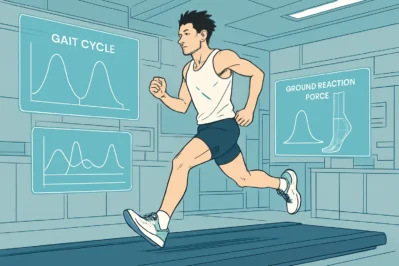
Data Doesn’t Lie: Mastering Korean for Marathon Gait Analysis
Hello! This is [Maeil Hangul], here to upgrade your Korean skills to the professional level!
Ready to move beyond everyday conversation and into the specialized world of science and athletics? Today, we’re diving deep into the fascinating field of sports biomechanics. We’ll learn the essential Korean terminology for analyzing a marathon runner’s gait. Lately in Korea, the “running crew” culture has exploded, and with advanced wearable tech becoming commonplace, discussions about performance data are no longer just for elite athletes. These expressions are perfect for anyone in physical therapy, sports science, or for those who simply want to discuss their favorite sport with technical precision.
Let’s get started!
Core Expressions for Biomechanical Analysis
Here are the key terms you’ll need to sound like a pro when discussing running form.
1. 보행 주기 (Gait Cycle)
- Pronunciation [Romanization]: Bo-haeng ju-gi
- English Meaning: Gait Cycle
- Detailed Explanation: This is a fundamental concept in biomechanics. ‘보행 (bohaeng)’ means walking or locomotion, and ‘주기 (jugi)’ means a cycle or period. Together, it refers to the entire sequence of events from the moment one foot touches the ground to the moment the same foot touches the ground again. In a clinical or research setting, this term is used to break down movement into phases like ‘입각기 (ipgakgi)’ (stance phase) and ‘유각기 (yugakgi)’ (swing phase). It’s a highly specific, academic term.
- 💡 Pronunciation Tip:
The Korean consonant ‘ㅈ’ (j) in ‘주기 (jugi)’ is an unaspirated affricate. This means it’s pronounced without the strong puff of air you hear in ‘ㅊ’ (ch). To an English speaker’s ear, it sounds somewhere between a ‘j’ and a ‘ch’. Try saying “jeep” but hold back the air. That tense, clipped sound is what you’re aiming for to sound natural.
2. 지면 반력 (Ground Reaction Force)
- Pronunciation [Romanization]: Ji-myeon bal-lyeok
- English Meaning: Ground Reaction Force (GRF)
- Detailed Explanation: This term is a direct translation of its scientific meaning. ‘지면 (jimyeon)’ means “ground surface,” and ‘반력 (banryeok)’ means “reaction force” (as in Newton’s Third Law). It refers to the force exerted by the ground on a body in contact with it. When analyzing running, scientists look at the vertical, anterior-posterior, and medial-lateral components of the GRF to understand impact, braking, and propulsion.
- 💡 Pronunciation Tip:
Notice the spelling is ‘ban-ryeok’ but the pronunciation is closer to [ballyeok]. This is a classic example of ‘유음화 (yuumhwa)’ or liquidization. When a syllable ending in ‘ㄴ’ (n) is followed by a syllable beginning with ‘ㄹ’ (r/l), the ‘ㄴ’ sound assimilates and is pronounced as ‘ㄹ’. So,반력becomes[발력]. Another common example is신라 (Silla)being pronounced[실라/Silla].
3. 운동 형상학적 변인 (Kinematic Variables)
- Pronunciation [Romanization]: Un-dong hyeong-sang-hak-jeok byeon-in
- English Meaning: Kinematic Variables
- Detailed Explanation: This is a very advanced, academic term, but let’s break it down. ‘운동 (undong)’ is motion, ‘형상학 (hyeongsanghak)’ is kinematics (the study of the geometry of motion), ‘-적 (-jeok)’ is a suffix meaning “-ic” or “related to,” and ‘변인 (byeonin)’ means variable. These variables describe motion without considering the forces that cause it. Examples include ‘관절 각도 (gwanjeol gakdo)’ (joint angle), ‘속도 (sokdo)’ (velocity), and ‘가속도 (gasokdo)’ (acceleration).
- 💡 Pronunciation Tip:
The pronunciation of ‘형상학적 (hyeong-sang-hak-jeok)’ involves a key rule: fortis (tensing). When a syllable ending in an unreleased stop consonant like ‘ㄱ’ (k), ‘ㄷ’ (d), or ‘ㅂ’ (b) is followed by certain consonants, that next consonant becomes tensed. Here, the ‘ㄱ’ in ‘학’ meets the ‘ㅈ’ in ‘적’, causing the ‘ㅈ’ to become the tense ‘ㅉ’ sound. So, it’s not pronounced [hak-jeok], but rather [학쩍/hakjjeok]. This tensing makes the flow of speech much smoother for native speakers.
Example Dialogue
Here’s how these terms might be used in a conversation between two sports scientists at a research institute.
- A (선임 연구원 – Senior Researcher): 이 선수의 마라톤 후반부 보행 주기 데이터를 좀 봐. 피로가 누적되면서 좌우 비대칭이 심해지는데.
- (Look at this athlete’s gait cycle data from the latter half of the marathon. The left-right asymmetry gets worse as fatigue accumulates.)
- B (후임 연구원 – Junior Researcher): 네, 특히 착지 시의 수직 지면 반력 그래프의 피크 값이 눈에 띄게 감소하고 있습니다. 충격 흡수 능력이 저하된 것 같습니다.
- (Yes, specifically, the peak value on the vertical ground reaction force graph during foot strike is noticeably decreasing. It seems their shock absorption capacity has declined.)
- A (선임 연구원 – Senior Researcher): 맞아. 관련된 다른 운동 형상학적 변인들도 같이 확인해 보자. 특히 무릎 굴곡 각도 변화를 집중적으로 분석해 줘.
- (Exactly. Let’s check the other related kinematic variables as well. Please focus your analysis on the changes in the knee flexion angle.)
Cultural Tip & Trend Deep Dive
In Korea, the line between amateur and professional sports is blurring thanks to technology. The rise of urban “러닝 크루 (reoning keuru – running crews)” has turned running into a social and highly data-driven activity. Many amateur runners now use smartwatches to track metrics that were once exclusive to labs, such as cadence (‘보속 (bosok)’) and vertical oscillation (‘수직 진폭 (sujik jinpok)’).
When you watch professional sports commentary in Korea, especially for track and field or even ball sports, you’ll hear analysts use terms like ‘지면 반력’ to explain an athlete’s explosive power or efficiency. Understanding these terms allows you to engage with Korean sports culture on a much deeper, more analytical level, showing that your Korean proficiency extends into specialized domains.
Let’s Practice!
Time to put your knowledge to the test.
- Fill in the blank: An athlete’s efficiency can be evaluated by analyzing the forces during their ________. (Hint: The sequence from one foot strike to the next).
- Sentence Building: Using the term ‘운동 형상학적 변인’, write a short Korean sentence about what a biomechanics researcher might study. (e.g., “We analyzed various kinematic variables…”)
Great job today! You’ve taken a huge step into the world of advanced, technical Korean.
Why not try using one of these new expressions in the comments below? Share a thought about running, sports, or science!