
Beyond Seoul: Is Speaking Satury the New Cool in Korea?
Hello! This is Maeil Hangeul, here to upgrade your Korean skills to the next level!
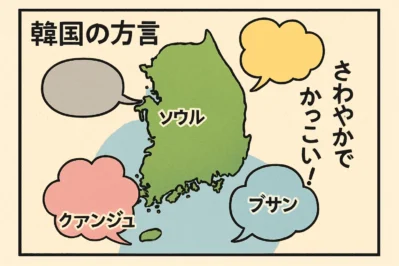
Today, we’re moving beyond textbook grammar and diving into the fascinating world of sociolinguistics. We’ll explore the difference between Standard Korean (표준어, pyojun-eo), the “prestige variety,” and regional dialects (사투리, saturi). You might wonder, “Why learn dialect if I’m supposed to learn the standard?” Great question! These days in Korea, the perception of saturi is undergoing a massive transformation. Thanks to hit K-dramas and K-pop idols like BTS’s V and Jimin (from the Gyeongsang province) or SEVENTEEN’s Seungkwan (from Jeju Island) who proudly use their local dialects, saturi is no longer seen as just “country talk.” It’s now often considered a source of charm, authenticity, and even “coolness.”
Understanding saturi will not only deepen your comprehension of Korean media but also give you a richer understanding of Korean culture and identity.
Core Expressions: Standard vs. Satury
Let’s look at some iconic expressions that showcase the unique flavor of different regional dialects compared to Standard Seoul Korean.
1. Gyeongsang-do Dialect (경상도 사투리)
- Korean Expression: 뭐라카노? (Mworakano?)
- Pronunciation [Romanization]: Mwo-ra-ka-no?
- English Meaning: What are you saying? / What did you just say?
- Detailed Description: This is perhaps the most famous phrase from the Gyeongsang dialect, spoken in cities like Busan and Daegu. It’s a condensed, punchy version of the standard “뭐라고 하는 거야? (Mworago haneun geoya?)”. While it can sound a bit aggressive or confrontational to the uninitiated due to its strong accent and intonation, among speakers, it’s a very common and neutral expression. In media, it’s often used to characterize a “tough” but charismatic person from Busan.
- 💡 Pronunciation Tip: The magic of Gyeongsang dialect is in its intonation, which is much more melodic and has more pitch variation than the relatively flat Seoul accent. The “라카노 (rakano)” part is a rapid contraction. Practice saying it with a confident, slightly rising tone at the end to capture its authentic feel.
2. Jeolla-do Dialect (전라도 사투리)
- Korean Expression: 겁나게 (Geomnage)
- Pronunciation [Romanization]: Geom-na-ge
- English Meaning: Very / Extremely / Hella
- Detailed Description: This is a signature adverb from the Jeolla region (home to Gwangju and Jeonju). While the standard words for “very” are 아주 (aju) or 매우 (maeu), “겁나게” adds a much stronger, more emphatic, and folksy nuance. It literally translates to “in a way that is frightening,” but it’s used just like English slang “wicked” or “hella” to mean “extremely.” For example, “겁나게 맛있어! (Geomnage masisseo!)” means “This is crazy delicious!”
- 💡 Pronunciation Tip: This is a great example of nasal assimilation (비음화, bieumhwa). The final consonant ‘ㅂ (b)’ in ‘겁’ comes before the nasal consonant ‘ㄴ (n)’. In this situation, the ‘ㅂ (b)’ sound transforms into an ‘ㅁ (m)’ sound for a smoother transition. So, instead of a clunky [geop-nage], it naturally becomes [geom-nage].
3. Chungcheong-do Dialect (충청도 사투리)
- Korean Expression: The ‘~유 (~yu)’ ending
- Pronunciation [Romanization]: ~yu
- English Meaning: (Polite sentence ending, equivalent to ~요)
- Detailed Description: The Chungcheong dialect, spoken in cities like Daejeon, is famous for its slower, gentler, and relaxed pace. Its most defining feature is replacing the standard polite sentence ending ‘~요 (~yo)’ with ‘~유 (~yu)’. For instance, “안녕하세요? (Annyeonghaseyo?)” becomes “안녕하세유? (Annyeonghaseyu?)” and “고마워요 (Gomawoyo)” becomes “고마워유 (Gomawoyu)”. This simple switch instantly gives the speaker’s words a warm, friendly, and slightly rustic charm.
- 💡 Pronunciation Tip: The difference between the vowels ‘요 (yo)’ and ‘유 (yu)’ is crucial. Both are diphthongs starting with a ‘y’ sound. For ‘요’, your mouth is more open and round, like the ‘o’ in ‘yo-yo’. For ‘유’, your lips should be more puckered and pushed forward, like the ‘u’ in the word ‘you’. This small change in mouth shape creates the distinct, gentle sound of the Chungcheong dialect.
Example Dialogue
Here’s how you might hear these expressions in a real-life conversation between two K-drama fans.
A: The new episode of “Busan Boys” was amazing! Did you see the scene where the main character got betrayed?
A: “부산 보이즈” 새 에피소드 진짜 대박이었어! 주인공이 배신당하는 장면 봤어?
B: Yes! And when his friend tried to lie, he just stared at him and said, “뭐라카노?” I got chills!
B: 응! 친구가 거짓말하려니까 그냥 쳐다보면서 “뭐라카노?” 하는데, 소름 돋았어!
A: Right? And the food scenes looked 겁나게 delicious. I suddenly want to go to Jeonju for a food trip.
A: 그치? 그리고 음식 장면들이 겁나게 맛있어 보이더라. 갑자기 전주로 먹방 여행 가고 싶어졌어.
B: Haha, my grandmother from Daejeon would love that. She’d probably say, “같이 가유~! (Gachi gayu~!)”
B: ㅋㅋ 대전 사시는 우리 할머니가 좋아하시겠다. 아마 “같이 가유~!”라고 하실걸.
Culture Tip & The Saturi Renaissance
For decades, Standard Korean (based on the Seoul dialect) was promoted as the 권위어 (prestige variety). In media and education, using a regional dialect was often seen as unsophisticated or something to be “corrected.”
However, we are now in a “Saturi Renaissance.” Why the change?
- Media Representation: Dramas like the Reply series (응답하라 시리즈) celebrated regional cultures and made dialects a central, beloved part of the story.
- K-pop & Authenticity: Idols who use their native saturi during live streams or on variety shows are seen as more genuine and relatable. It breaks down the formal barrier between the star and their fans, creating a stronger, more intimate connection.
- Regional Pride: Younger generations are increasingly proud of their local heritage, and language is a huge part of that identity.
Pro-Tip for Learners: When you meet a Korean and notice a distinct accent, don’t try to “correct” their pronunciation. Instead, showing your recognition can be a fantastic icebreaker! You could ask politely, “혹시 고향이 어디세요? 억양이 특색 있으셔서요.” (Where is your hometown, if you don’t mind me asking? Your accent is very distinctive.) This shows cultural sensitivity and a deeper interest in the language.
Wrap-up & Practice!
Today, we’ve seen how Korean is so much more than just its standard form. Dialects like the direct “뭐라카노?”, the emphatic “겁나게”, and the gentle “~유” ending add incredible color and personality to the language. Recognizing them is a key step to advancing from a good Korean speaker to a great one.
Now, let’s test your knowledge!
- Fill in the Blank: You are describing an incredibly exciting K-pop concert to your friend from Gwangju. You would say: “The performance was ___________ amazing!”
- Scenario Question: An idol from Busan is on a live stream, and a fan leaves a confusing comment. How might the idol playfully respond using a Gyeongsang-do expression?
Leave your answers in the comments below! Do you have a favorite saturi phrase or an idol who uses it well? Share with us