No More Getting Lost! Ask for a Brochure in Korean
Hello! Welcome to [Maeil Hangeul], where we upgrade your Korean skills!
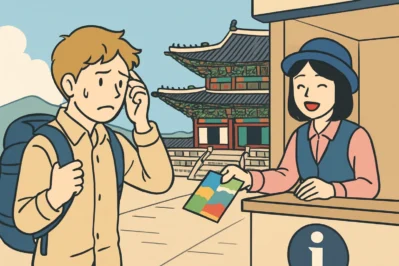
Ever felt a little lost while traveling? Don’t worry, it happens to the best of us! Today, we’re going to learn some super useful phrases for a situation every traveler faces: visiting a tourist information center.
These days, Korea is a top travel destination, thanks to the global popularity of K-Pop and K-Dramas. Imagine you want to visit a beautiful palace you saw in your favorite show. With the phrases we learn today, you’ll be able to confidently ask for a map or a brochure in your own language. Let’s get started!
Core Expressions You Need to Know
Here are three essential expressions to help you get the information you need.
1. 안내 책자 (annae chaekja)
- Pronunciation [Romanization]: [annae chaekjja]
- English Meaning: Information booklet / Brochure
- Detailed Explanation: This is your magic phrase for any kind of guide or brochure. It’s made of two words: 안내 (annae), which means ‘guidance’ or ‘information’, and 책자 (chaekja), which means ‘booklet’. You can use it to ask for maps, guides, and pamphlets.
- 💡 Pronunciation Tip:
Notice the pronunciation is [chaekjja], not [chaekja]. In Korean, when a consonant like ‘ㄱ (g/k)’ is followed by ‘ㅈ (j)’, the ‘ㅈ (j)’ sound becomes tense, like ‘ㅉ (jj)’. It’s a small change that makes you sound much more natural!
2. 있어요? (isseoyo?)
- Pronunciation [Romanization]: [i-sseo-yo?]
- English Meaning: Do you have…? / Is there…?
- Detailed Explanation: This is one of the most useful questions in Korean! You can attach it to the end of any noun to ask if it exists or if someone has it. It’s a polite and standard way to ask a question. For example, “물 있어요? (Mul isseoyo?)” means “Do you have water?”.
- 💡 Pronunciation Tip:
The spelling is ‘있어요’, but the sound flows together. The final consonant ‘ㅆ (ss)’ from ‘있’ moves over to the next syllable, making the sound [isseoyo]. Instead of a pause like ‘it-eoyo’, it becomes a smooth ‘i-sseo-yo’. This is a very common Korean pronunciation rule called ‘linking sound’ (연음 – yeoneum).
3. 영어 (yeongeo) / 중국어 (junggugeo) / 일본어 (ilboneo)
- Pronunciation [Romanization]: [yeong-eo] / [jung-gu-geo] / [il-bo-neo]
- English Meaning: English / Chinese / Japanese
- Detailed Explanation: To ask for a brochure in a specific language, you just put the language name in front of “안내 책자 (annae chaekja)”. The particle -어 (-eo) is often attached to a country’s name to mean its language. For example, 한국 (Hanguk) + 어 (eo) = 한국어 (Hangugeo), the Korean language!
- 💡 Pronunciation Tip:
Just remember to pronounce each syllable clearly. For 영어 (yeongeo), the first syllable sounds like “young” without the “ng” at the end.
Example Dialogue
Let’s see how these expressions work in a real conversation. Imagine a tourist (B) talking to a staff member (A) at an information center in Seoul.
A: 안녕하세요. 무엇을 도와드릴까요?
(Annyeonghaseyo. Mueoseul dowadeurilkkayo?)
Hello. How may I help you?
B: 안녕하세요. 영어 안내 책자 있어요?
(Annyeonghaseyo. Yeongeo annae chaekja isseoyo?)
Hello. Do you have an English brochure?
A: 네, 여기 있습니다.
(Ne, yeogi itseumnida.)
Yes, here you are.
B: 감사합니다! 이 책자로 드라마에 나온 경복궁에 갈 수 있어요?
(Gamsahamnida! I chaekjaro deurama-e naon Gyeongbokgung-e gal su isseoyo?)
Thank you! Can I get to Gyeongbokgung Palace, the one from the drama, with this brochure?
A: 네, 물론이죠!
(Ne, mullonijyo!)
Yes, of course!
Culture Tip & Trend Deep Dive
- Tourist-Friendly Korea: You’ll find Tourist Information Centers all over major cities in Korea, especially in popular spots like Myeongdong, Hongdae, and near major palaces and stations. The staff are usually multilingual and incredibly friendly, so don’t be shy!
- Dial 1330: If you’re ever truly lost or need help, you can call the 1330 Korea Travel Helpline. It offers 24/7 multilingual assistance (including English, Chinese, and Japanese) for free! It’s a lifesaver for many travelers.
- K-Drama Pilgrimage: Mentioning a K-Drama location, like our tourist in the dialogue, is a great icebreaker! Staff are used to these questions and can often give you special tips or point you to brochures specifically designed for “Hallyu” (Korean Wave) tourists. It shows you’re not just a tourist, but a fan!
Let’s Review & Practice!
Great job today! You’ve learned how to confidently ask for help at a tourist information center in Korea.
Now, let’s test your knowledge with a quick quiz!
- Fill in the blank: You want a brochure in Chinese. How would you ask?
“____________ 안내 책자 있어요?” -
Sentence Building: Using the expressions we learned, how would you politely ask, “Do you have a Japanese brochure?”
You’re all set for your next adventure in Korea!
Now it’s your turn! Leave a comment below asking for a brochure for a place you want to visit in Korea. For example: “서울 안내 책자 있어요? (Seoul annae chaekja isseoyo?)” We can’t wait to see your sentences