Beyond the Bias: Debating the Ideal Fan-Star Dynamic
Hello! Welcome back to Daily Hangul, your go-to for leveling up your Korean!
Today, we’re diving into a fascinating and very relevant topic in modern Korean culture: the relationship between stars and their fans. This isn’t just about cheering at a concert; it’s about a complex dynamic that is constantly being discussed and redefined. Lately in Korea, there has been a lot of conversation online about what constitutes a healthy and supportive fandom, especially concerning artists’ privacy. So, how do you express nuanced opinions on this topic like a native speaker? Let’s find out!
Core Expressions for the Discussion
Here are some key phrases that will elevate your conversation from a simple fan to a thoughtful culture critic.
1. 선을 지키다 (Seoneul jikida)
- English Meaning: To maintain a boundary / To not cross the line.
- Detailed Explanation: This is a crucial idiom for this topic. ‘선’ literally means ‘line’. ‘선을 지키다’ means to respect personal or social boundaries and act appropriately. It’s the opposite of ‘선을 넘다’ (seoneul neomda), which means ‘to cross the line’. This expression is used constantly in daily life when talking about appropriate behavior between people.
- 💡 Pronunciation Tip:
In ‘지키다’ [jikida], the initial ‘ㅈ’ (j) is an unaspirated consonant. It’s a sound that sits between an English ‘j’ and ‘ch’. Avoid making a strong “ch” sound as in “cheese.” It should be a soft, plain sound.
2. 상호 존중 (Sangho jonjung)
- English Meaning: Mutual respect.
- Detailed Explanation: This is a Sino-Korean (Hanja-based) term that adds a level of formality and seriousness to your statement. ‘상호’ (相互) means ‘mutual’ or ‘reciprocal’, and ‘존중’ (尊重) means ‘respect’. It’s the perfect term to use when arguing that the fan-star relationship should be a two-way street built on consideration.
- 💡 Pronunciation Tip:
The word ‘존중’ [jonjung] can be tricky. Pay attention to the final consonant ‘ㅇ’ (ng) in both syllables. It’s a nasal sound made at the back of your throat, similar to the “ng” in “singing.” Make sure you don’t pronounce it as ‘n’.
3. -는 것을 지양하다 (neun geoseul jihanghada)
- English Meaning: To refrain from doing something / To avoid (as a matter of principle).
- Detailed Explanation: This is a more formal and sophisticated way to say “you shouldn’t do something.” It implies a conscious and principled decision to avoid a certain negative action. You will often see this phrase in official statements from entertainment companies or in news articles discussing social issues. Using it shows a high level of vocabulary.
- Example: 과도한 비판은 지양해야 합니다. (We should refrain from excessive criticism.)
- 💡 Pronunciation Tip:
In ‘지양하다’ [jihanghada], the ‘ㅎ’ (h) sound can sometimes be weakened or even silent when it’s between voiced sounds, making it sound closer to [jiyang-ada]. This is a common occurrence in fast, natural Korean speech.
4. 바람직한 관계 (Baramjikan gwangye)
- English Meaning: A desirable/ideal relationship.
- Detailed Explanation: ‘바람직하다’ is an adjective that means ‘to be desirable’ or ‘advisable’. It’s used to describe a model situation or a goal to strive for. When you talk about the kind of fandom culture you want to see, describing it as ‘바람직한 팬덤 문화’ (a desirable fandom culture) or a ‘바람직한 관계’ makes your point clear and constructive.
- 💡 Pronunciation Tip:
In ‘바람직한’ [baramjikan], the final consonant ‘ㄱ’ (k) of ‘직’ links with the ‘ㅎ’ (h) of ‘한’. This combination creates an aspirated ‘ㅋ’ (k) sound. So, instead of ‘jik-han’, the natural pronunciation is [바람지칸 / baramjikan]. This is a key consonant assimilation rule called aspiration.
Example Dialogue
Let’s see how these expressions work in a real conversation about a popular K-Pop group.
A: 요즘 몇몇 팬들의 아이돌 사생활 침해 문제가 너무 심각한 것 같아.
(Yojeum myeotmyeot paendeurui aidol sasaenghwal chimhae munjega neomu simgakan geot gata.)
Lately, the issue of some fans invading idols’ privacy seems too serious.
B: 맞아. 스타와 팬 사이에는 상호 존중을 바탕으로 선을 지키는 게 가장 중요하다고 생각해.
(Maja. Seutawa paen saieneun sangho jonjungeul batangeuro seoneul jikineun ge gajang jung-yohadago saenggakae.)
I agree. I think maintaining boundaries based on mutual respect is the most important thing between stars and fans.
A: 동감이야. 아티스트를 위한다는 명분으로 사적인 영역까지 침범하는 행동은 지양해야 해.
(Donggamiya. Atiseuteureul wihandaneun myeongbuneuro sajeogin yeong-yeokkkaji chimbeomhaneun haengdongeun jihanghaeya hae.)
I feel the same. We must refrain from actions that invade their private space under the pretext of supporting the artist.
B: 바로 그거야. 그래야만 장기적으로 더 건강하고 바람직한 관계가 형성될 수 있을 거야.
(Baro geugeoya. Geuraeyaman janggijeogeuro deo geonganghago baramjikan gwangyega hyeongseongdoel su isseul geoya.)
Exactly. Only then can a healthier and more desirable relationship be formed in the long run.
Culture Tip & Trend Analysis
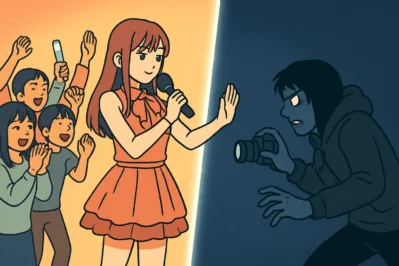
In the world of K-Pop, the conversation around fandom etiquette is constant. The term 사생 (sasaeng) refers to obsessive “fans” who engage in stalking and other forms of privacy invasion. The expressions we learned today are the exact tools Koreans use to criticize such behavior and advocate for a better culture.
You’ll often see idols themselves gently reminding fans on platforms like Weverse or Bubble, saying things like “선을 지켜주시면 좋겠어요” (I would appreciate it if you maintained the line). When entertainment agencies issue official warnings against sasaengs, they almost always use formal, powerful language like “아티스트의 사생활을 침해하는 행위를 지양해 주시기 바랍니다” (Please refrain from acts that violate our artist’s privacy).
By understanding and using these expressions, you’re not just learning vocabulary; you’re participating in a real, ongoing cultural conversation in Korea.
Let’s Practice!
Ready to share your opinion? Let’s put your new vocabulary to the test.
- Fill in the blanks:
스타와 팬의 ( ___________ ) 관계를 위해서는 서로 ( ___________ )을/를 지키는 노력이 필요하다.
(For a (___________) relationship between stars and fans, effort is needed to maintain (___________) with each other.) -
Your Opinion:
여러분이 생각하는 ‘바람직한 팬덤 문화‘는 무엇인가요? 오늘 배운 표현 중 하나 이상을 사용해서 여러분의 의견을 댓글로 남겨주세요!
(What do you think is a ‘desirable fandom culture‘? Leave your opinion in the comments using at least one of the expressions we learned today!)
Great job today! Mastering these expressions will allow you to engage in deeper, more meaningful conversations about the pop culture you love. We can’t wait to read your thoughts in the comments