Find Your “Life Color” in Seoul: The Ultimate K-Beauty Personal Color Guide
Phase 1: The Immersive Hook
Greeting: 안녕하세요! This is your Daily Hangul Editor, reporting from the vibrant streets of Garosu-gil.
K-Culture Cold Open: Imagine this: You’re watching a K-Drama makeover scene. The protagonist, who used to wear dull greys, suddenly switches to a pastel pink blouse. Instantly, her face glows, her dark circles vanish, and the male lead stares at her like he’s seeing her for the first time. Magic? No. This is the power of “Personal Color” (퍼스널 컬러).
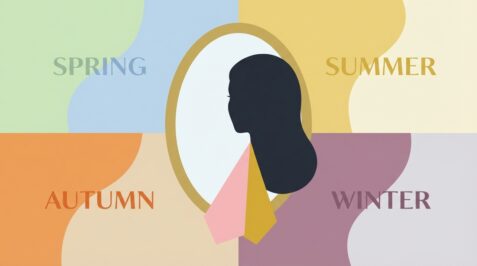
In Korea, knowing whether you are a “Spring Warm” or a “Winter Cool” is almost as important as your MBTI. It’s not just about vanity; it’s about efficiency—finding the exact shades that make you look your best with minimal effort.
The ‘Why’: If you walk into a Korean cosmetic store and ask for “red lipstick,” the staff might panic. They need to know: “Are you Warm or Cool?” Without this vocabulary, you might end up buying a shade that makes you look tired or sickly. Today, we unlock the secrets of K-Beauty color analysis.
Transparency: This guide is based on real experiences at Seoul’s top color consulting studios, designed for B2 (Intermediate) learners who want to go beyond basic phrases.
Phase 2: Deep Dive into Core Expressions
1. 웜톤 / 쿨톤 (Weom-ton / Kul-ton)
- Pronunciation: [Weom-ton] / [Kul-ton] (Sounds exactly like English “Warm tone” and “Cool tone”)
- Meaning: Warm Tone / Cool Tone
- K-Culture Moment: Watch any K-Beauty YouTuber’s review. The first thing they say is, “This palette is strictly for Yeo-Kul (Summer Cool) tones!”
- Editor’s Insight: Koreans love abbreviating. You will often hear combinations like ‘봄웜’ (Spring Warm), ‘여쿨’ (Summer Cool), ‘갈웜’ (Autumn Warm), and ‘겨쿨’ (Winter Cool).
- Situation Spectrum:
[🚫 Formal: X] ———— [⚠️ Semi-formal: ✅] ———— [✅ Casual: ✅] - 🤔 Think About It: Why does Korea categorize beauty so strictly? Is it helpful guidance, or does it limit individual expression?
2. 얼굴에 형광등을 켜다 (Eolgure hyeong-gwang-deungeul kyeoda)
- Pronunciation: [Eol-gu-re hyeong-gwang-deung-eul kyeo-da]
- Meaning: Literal: To switch on a fluorescent light on the face. Real Nuance: To look instantly brighter and more vibrant.
- K-Culture Moment: On a variety show, when an idol changes their hair color to blonde and suddenly looks stunning, the captions will scream: “Human Fluorescent Light!” (인간 형광등).
- Editor’s Insight: This is the highest compliment in color analysis. It means the color erases shadows and makes your skin look clear.
- Situation Spectrum:
[🚫 Formal: ⚠️] ———— [⚠️ Semi-formal: ✅] ———— [✅ Casual: ✅]
3. 찰떡이다 (Chal-tteok-i-da)
- Pronunciation: [Chal-tteok-i-da] (Think of ‘sticky rice cake’)
- Meaning: Literal: It is sticky rice cake. Real Nuance: It’s a perfect match; it suits you perfectly.
- K-Culture Moment: A friend tries on a dress. You scream, “Wa, wanjeon chal-tteok!” (Wow, completely perfect!). It implies the item and the person are inseparable, like sticky rice.
- Editor’s Insight: Useful not just for colors, but for hairstyles, outfits, and even casting choices in dramas.
- Situation Spectrum:
[🚫 Formal: 🚫] ———— [⚠️ Semi-formal: ⚠️] ———— [✅ Casual: ✅]
Phase 3: Textbook vs. Real Life
| Situation | 📖 Textbook Korean | 🗣️ Real Korean (In the Studio) | 💡 Why the difference? |
|---|---|---|---|
| Expressing a match | 이 색깔이 저에게 잘 어울려요. (This color suits me well.) | 이거 완전 제 인생 컬러인데요? (This is totally my ‘life color’!) | “Life [noun]” (인생OO) is a trendy prefix for the “best ever.” |
| Rejection | 이 색깔은 별로예요. (This color is not good.) | 이 색은 얼굴이 좀 칙칙해 보여요. (This color makes my face look a bit dull.) | Koreans prefer describing the effect on the face rather than just disliking the color. |
| Asking for advice | 어떤 색이 좋아요? (Which color is good?) | 저한테 베스트가 뭐예요? (What is the ‘Best’ for me?) | Using Konglish words like “Best” and “Worst” is standard professional jargon here. |
Note: At a B2 level, try to use descriptive verbs like 칙칙하다 (dull/somber) or 화사하다 (bright/blooming) instead of just “good/bad.”
Phase 4: Cultural Context — K-Culture Deep Dive
4-1. The “Saeng-eol” (Bare Face) Etiquette
In Western color analysis, you might wear minimal makeup. In Korea, you must arrive with a complete 쌩얼 (Saeng-eol – Bare face). The consultant needs to see your natural skin undertones, redness, and dark circles to give an accurate diagnosis. Don’t be shy; it’s a sign of respect for the process!
4-2. The “Best Face” Obsession
K-Pop idols change concepts every comeback. Notice how styling changes their vibe? A “Winter Cool” idol like Karina (aespa) looks fierce in black hair and silver accessories but might look softer (or slightly washed out) in warm brown. Korean fans analyze these changes obsessively. When you get your color done, you aren’t just picking a shirt; you are defining your “Image” (이미지).
Phase 5: Immersive Roleplay Scenario
Setting: A chic, minimalist studio in Seongsu-dong. Sunlight streams in. Colorful fabric drapes are everywhere. You are sitting in front of a mirror, wearing a white cape.
Characters:
– YOU: A foreign student who wants to stop buying the wrong makeup.
– Consultant (Teacher): A stylish expert with perfect makeup. Professional but direct.
Dialogue:
Consultant: 자, 이제 핑크 계열 드레이프 올려볼게요. 거울 보세요.
(Ja, ije ping-keu gye-yeol deu-re-i-peu ol-ryeo-bol-ge-yo. Geo-ul bo-se-yo.)
(Okay, I’m going to put up the pink tone drapes now. Look at the mirror.)
YOU: (Nervous) 네, 알겠습니다.
(Ne, al-get-seum-ni-da.)
(Okay, understood.)
Consultant: (Switches from Hot Pink to Salmon Pink) 어때요? 핫핑크는 다크서클이 좀 부각되죠?
(Eo-ttae-yo? Hat-ping-keu-neun da-keu-seo-keul-i jom bu-gak-doe-jyo?)
(How is it? The hot pink highlights your dark circles, right?)
🔀 Your Turn! How do you respond?
A) “네, 진짜 이상하네요.” (Yes, it’s really weird.)
B) “아, 진짜 그렇네요! 얼굴이 좀 창백해 보여요.” (Ah, really! My face looks a bit pale/washed out.)
C) “아니요? 예쁜데요?” (No? It’s pretty?)
✅ Best Choice: B — At B2 level, acknowledging the specific effect (창백하다 – pale/lifeless) shows you understand the diagnosis.
⚠️ Choice C Analysis: You can disagree, but in this context, the consultant is teaching you to see technical details. It might sound stubborn.
(Continuing from B)
Consultant: 맞아요. 고객님은 웜톤이라서 코랄 핑크가 얼굴에 형광등을 켜주네요! 완전 찰떡이세요.
(Ma-ja-yo. Go-gaeng-nim-eun weom-ton-i-ra-seo ko-ral ping-keu-ga eol-gu-re hyeong-gwang-deung-eul kyeo-ju-ne-yo! Wanjeon chal-tteok-i-se-yo.)
(Right. Since you are a Warm Tone, coral pink lights up your face! It’s a perfect match.)
Phase 6: 10-Second Shadowing Drill
Context: You finally found a color that makes you look amazing.
😊 와! / 이 색깔을 대니까 / 얼굴이 확 / 사는 것 같아요!
(Wa! / I saek-kkar-eul dae-ni-kka / eol-gur-i hwak / sa-neun geot ga-ta-yo!)
“Wow! / When I put this color on / my face really / seems to come alive!”
Key Grammar: ~니까 (Because/When) + 얼굴이 살다 (Face looks lively/vivid)
Phase 7: K-Culture Mini Glossary
| Korean | Romanization | Meaning | Context |
|---|---|---|---|
| 명도 | Myeong-do | Brightness | Light vs. Dark. Very important in diagnosis. |
| 채도 | Chae-do | Saturation | Vivid vs. Dull. |
| 뮤트 | Myu-teu | Mute | Soft, grayish colors. Very trendy in Korea right now. |
| 워스트 | Weo-seu-teu | Worst | The colors you should avoid. |
| 퍼스널 컬러 진단 | Peo-seo-neol keol-leo jin-dan | Personal Color Diagnosis | The formal term for the appointment. |
Phase 8: Traveler’s Survival Kit
Going to a salon? Here is what you need to know.
🆘 Survival Phrases
– 🇰🇷 “혹시 영어 가능한 선생님 계신가요?” (Hoksi yeong-eo ga-neung-han seon-saeng-nim gye-sin-ga-yo?)
– Do you happen to have a consultant who speaks English?
– 🇰🇷 “평소에 파스텔 톤을 자주 입어요.” (Pyeong-so-e pa-seu-tel ton-eul ja-ju i-beo-yo.)
– I usually wear pastel tones.
– 🇰🇷 “예약금은 어떻게 보내드리면 될까요?” (Ye-yak-geum-eun eo-tteo-ke bo-nae-deu-ri-myeon doelk-ka-yo?)
– How should I send the deposit?📌 Editor’s Travel Note:
Most popular studios require a Deposit (예약금) via bank transfer to confirm your booking. If you don’t have a Korean bank account, look for studios on platforms like Creatrip or Trazy that accept foreign cards!
Phase 9: Think Deeper — The Standardization of Beauty
🧠 Think Deeper: MBTI for Your Face?
Korea has a fascination with categorization—blood types, MBTI, and now Personal Color. Why? In a hyper-competitive, fast-paced society, these labels act as efficiency tools. They help people present their “best self” quickly and avoid social errors (like looking tired in a meeting). But does this pressure to find the “correct” answer for your face make beauty too standardized?
💬 Your Turn: Does your culture have rules about which colors you “should” or “should not” wear? Share in the comments!
Phase 10: FAQ & Troubleshooting
- Q: Do men get this done too?
- A: YES! Especially men preparing for job interviews or weddings. Use the same vocabulary; it’s gender-neutral.
- Q: Can I wear colored contact lenses?
- A: No. Clear lenses or glasses are best. They need to see your natural iris color.
- ❌ Common Mistake: Saying “I like this color” too much.
- Correct Attitude: It’s not about what you like, it’s about what suits you. Be open to colors you hate. You might hate olive green, but if the consultant says it’s your “Best,” trust the mirror!
Phase 11: Wrap-up & Action Items
One-Liner: Knowing your Personal Color in Korea isn’t just about fashion; it’s about mastering the art of first impressions (눈치).
Action Missions:
– 🥉 Bronze: Look in the mirror and ask yourself: “Am I Warm or Cool?” (Wom-ton or Kul-ton?)
– 🥈 Silver: Go to a Korean cosmetic store (like Olive Young) and try to find a section labeled “Cool Tone.”
– 🥇 Gold: Visit a color studio in Korea and ask, “Jeo-han-te be-seu-teu-ga mwo-ye-yo?”
K-Culture Mission: Watch a K-Pop music video. Identify one member who has “black hair” vs “blonde hair.” Who looks better? Apply your new “Tone” knowledge!
Phase 12: Interactive Quiz
- Situation: The consultant puts a neon orange cloth under your chin, and your skin looks yellow and sick.
- A) “와! 형광등을 켰네요!” (Wow! It lit up my face!)
- B) “얼굴이 너무 칙칙해 보여요.” (My face looks too dull.)
- C) “이거 찰떡이네요.” (It’s a perfect match.)
- True or False: You should wear your full daily makeup to a Personal Color diagnosis to show your style.
- (True / False)
Answers:
1. B (A and C are positive reactions suitable for good colors.)
2. False (You must go Saeng-eol / bare-faced!)