Phase 1: The Immersive Hook
Hello, Daily Hangul family! It’s your Senior Editor here.
Imagine this: You are at a pojangmacha (street food tent) in Jongno, the rain drumming on the tarpaulin roof. You’re on your third bottle of soju with your Korean university friends. The conversation has moved from K-Pop and dating to something heavier. Someone mentions a recent movie about the 1980s democratization movement—maybe something like The Attorney (변호인) or 1987.
Suddenly, the mood shifts. One friend slams their glass down and says, “We still need it for security!” The other rolls their eyes, “Are we still living in the Cold War? It’s anachronistic!”
They are arguing about the National Security Act (국가 보안법 – Gukga Boanbeop).
This isn’t just a legal debate; it’s a fault line that runs through modern Korean history, touching upon trauma, freedom, and the ever-present shadow of North Korea. As a C1 learner, you’ve mastered ordering food and booking tickets. Now, are you ready to understand the soul of Korean political discourse?
This guide isn’t about taking sides. It’s about giving you the vocabulary and cultural context to understand what the heck is going on when the news turns serious.
Phase 2: Deep Dive into Key Expressions
Here are the three heavy-hitters you’ll hear in any debate regarding the National Security Act.
1. 시대착오적이다 (Sidae-chago-jeok-ida)
- Pronunciation: [Si-dae-cha-go-jeok-i-da] -> Think of “See-day” + “Cha-go” (garage) + “Jug” (jug of water).
- Meaning: To be anachronistic; outdated; behind the times.
- K-Culture Moment: You’ll hear this in political dramas like Chief of Staff (보좌관) when a young politician attacks an old-guard senator. It implies, “You are stuck in the past.”
- Editor’s Insight: This is the #1 weapon for the abolitionist side. It suggests the law belongs in a museum, not in a modern democracy.
- Situation Spectrum:
[🚫 Casual Chat] ———— [⚠️ Semi-Formal Debate] ———— [✅ Formal/News]- 🤔 Think About It: Why is “time” such a sensitive concept in Korean politics? (Hint: Korea modernized incredibly fast, creating a huge generation gap.)
2. 안보 불감증 (Anbo Bulgumjeung)
- Pronunciation: [An-bo Bul-gam-jeung] -> An-bo (Security) + Bul-gam-jeung (Insensitivity/Numbness).
- Meaning: Security insensitivity; lack of awareness regarding national security.
- K-Culture Moment: In disaster movies or spy thrillers like Iris or Shiri, when characters ignore warning signs, the stern general will scream this phrase.
- Editor’s Insight: This is the counter-attack used by the conservative side. It accuses the other person of being naive about the threat from North Korea. It’s a strong accusation.
- Situation Spectrum:
[🚫 To a Stranger] ———— [⚠️ Heated Debate] ———— [✅ News/Op-ed]- 🤔 Think About It: Does your country have a specific term for “forgetting the dangers of war”? Korea does, because the war technically never ended.
3. 표현의 자유 침해 (Pyo-hyeon-ui Jayu Chim-hae)
- Pronunciation: [Pyo-hyun-e Jayu Chim-hae] -> Pyo-hyun (Expression) + Jayu (Freedom) + Chim-hae (Invasion/Infringement).
- Meaning: Infringement on freedom of expression.
- K-Culture Moment: Think of the protest scenes in 1987. Students shouting against censorship. Today, it’s used when K-Pop idols or artists get banned or censored for controversial topics.
- Editor’s Insight: This elevates the argument from “I don’t like this law” to “This law violates Human Rights.” It’s C1 level because uses Chim-hae (infringement) instead of just eop-da (don’t have).
- Situation Spectrum:
[🚫 Flirting] ———— [⚠️ Casual] ———— [✅ Intellectual Discussion]
Phase 3: Textbook vs. Real Life
| Context | 📖 Textbook Korean | 🗣️ Real Korean (The “Soju” Version) | 💡 Why the difference? |
|---|---|---|---|
| Disagreeing | 저는 그 의견에 반대합니다. (I oppose that opinion.) | 에이, 그건 좀 아니지 않나요? (Ey, isn’t that a bit much?) | “Ban-dae” sounds like a formal vote. “Ey~” softens the blow while disagreeing. |
| Calling it old | 그 법은 오래되었습니다. (That law is old.) | 쌍팔년도 얘기도 아니고… (It’s not like we’re in 1988…) | “Ssang-pal-nyeon-do” (1988) is a cultural idiom for “the old days” or “outdated style.” |
| Mentioning Spies | 간첩이 우려됩니다. (I am worried about spies.) | 간첩이 어딨냐, 요즘 세상에! (Where are spies in this day and age?!) | Rhetorical questions are the preferred weapon in heated Korean debates. |
Phase 4: Cultural Deep Dive — The “Red” Complex
4-1. The Power of “Saek-kkal” (Color)
In Korean politics, you might hear the phrase “색깔론 (Saek-kkal-lon – Color Theory).” This doesn’t mean color matching your outfit. It refers to labeling someone as “Red” (Communist/Pro-North). Even mentioning the repeal of the NSA can get you labeled.
Non-verbal Tip: If the table goes quiet after you ask about this topic, use your Nunchi. It might be that someone at the table has family roots in the North or strong military background. Take a sip of water and shift to, “So, how about that new BTS song?”
4-2. K-Drama Connection: Crash Landing on You
Remember Crash Landing on You? While it was a massive hit, it actually sparked a mini-debate involving the National Security Act. Some conservative groups argued the drama “glamorized” North Korean soldiers and violated the NSA. Understanding this law explains why a romantic comedy could suddenly become a political scandal in Korea.
Phase 5: Immersive Roleplay Scenario
Setting: A loud, smoky BBQ restaurant in Hongdae. You are with Min-su (34, progressive, works in IT) and Ji-hoon (35, conservative, former military officer). The TV news mentions a protest about the NSA.
Min-su: (Sighs) 아휴, 저 법은 진짜 없애야 돼. 시대착오적이잖아. 솔직히 말해서 표현의 자유 침해라고.
(Ahyu, jeo beobeun jinjja eopsaeya dwae. Sidae-chago-jeok-ijana. Soljikhi malhaeseo pyohyeon-ui jayu chimhae-rago.)
(Sigh, we really need to get rid of that law. It’s anachronistic. Honestly, it’s an infringement on freedom of expression.)
Ji-hoon: 야, 민수야. 너는 너무 이상적이야. 아직 북한이랑 휴전 중인데 안보 불감증 아니냐?
(Ya, Min-su-ya. Neoneun neomu isangjeok-iya. Ajik Bukhani-rang hyujeon jung-inde anbo bulgamjeung aninya?)
(Hey, Min-su. You’re too idealistic. We are still in a truce with North Korea; isn’t that security insensitivity?)
🔀 YOUR TURN! The tension is rising. How do you intervene?
- A) “맞아요, 김치가 참 맛있네요!” (Totally ignore it and praise the Kimchi.)
- B) “저는 외국인이라 잘 모르지만, 인권 문제도 중요한 것 같아요.” (Play the ‘foreigner card’ but acknowledge the human rights angle.)
- C) “지훈 씨 말이 맞아요. 간첩은 무서워요.” (Agreeing with the conservative side strongly.)
✅ Best Choice: B
Reasoning: As a foreigner, strictly taking sides can be risky. Option B uses humble language (“I don’t know well”) but demonstrates C1 vocabulary (In-gwon – Human Rights). It validates Min-su without offending Ji-hoon too much.
⚠️ Choice A Analysis: Too abrupt. Koreans respect foreigners who try to engage with serious topics, even if clumsily.
Phase 6: 10-Second Shadowing Drill
Let’s practice a sentence that balances both views. Use a serious, thoughtful tone.
“안보도 중요하지만 / 개인의 자유도 / 지켜져야 한다고 생각해요.”
Pronunciation: An-bo-do jung-yo-ha-ji-man / gae-in-ui ja-yu-do / ji-kyeo-jyeo-ya han-da-go saeng-gak-hae-yo.
Meaning: “Security is important, but / I think individual freedom / must also be protected.”
Emotion: 🤔 Thoughtful & Diplomatic
Phase 7: K-Culture Mini Glossary
| Korean | Romanization | Meaning | Context |
|---|---|---|---|
| 검열 | Geom-yeol | Censorship | Often discussed regarding K-Arts or Internet restrictions. |
| 종북 | Jong-buk | Pro-North Follower | A highly offensive/political slur used to attack liberals. Use with extreme caution. |
| 국가정보원 (국정원) | Guk-jeong-won | NIS (National Intelligence Service) | The Korean CIA. The main agency enforcing the NSA. |
| 시위 | Si-wi | Protest/Demonstration | You will see these often in Gwanghwamun regarding this law. |
Phase 8: Traveler’s Survival Kit (Gwanghwamun Edition)
Since discussions about the NSA often lead to protests in Gwanghwamun Square, here is a survival kit for the politically active traveler.
🆘 Survival Expression #1
– 🇰🇷 “지나가도 될까요?” (Ji-na-ga-do doel-kka-yo?)
– 🗣️ Meaning: “May I pass through?”
– 📍 Usage: When you are stuck in a crowd of protesters or police lines.
– 💡 Pro Tip: Make eye contact and bow slightly. Even riot police will usually let a polite foreigner pass.📌 Editor’s Travel Note
If you see a protest involving the NSA, you will likely see two flags: The Korean flag (Taegukgi) often used by conservatives, and yellow ribbons or specific banners by progressives. It’s a fascinating sight, but keep a safe distance if police barricades go up!
Phase 9: Think Deeper — Language & Power
Language as a Weapon:
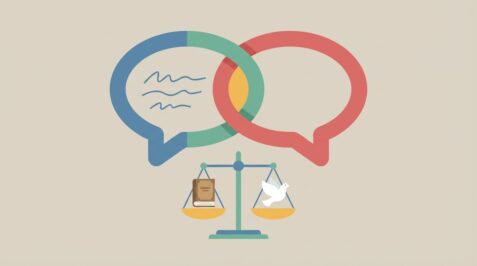
The debate around the National Security Act isn’t just about spies; it’s about definitions. The law forbids “praising anti-state organizations.” But who defines “praise”? If I say “North Korean beer tastes good,” is that praise? In the past, it could have been.
This ambiguity is why the language used in this debate is so fierce. The conservative side uses words triggering fear (Destruction, Spy, War), while the progressive side uses words triggering indignation (Human Rights, Democracy, Censorship). As you learn Korean, pay attention to how a single word choice reveals a speaker’s entire political stance.
💬 Your Turn: Does your country have a law that prioritizes national security over free speech? How do people talk about it? Share in the comments!
Phase 10: FAQ & Troubleshooting
Q: Is it safe to talk about North Korea/NSA in South Korea?
A: Yes, absolutely. It’s a democracy. However, it’s a polarizing topic (like discussing gun control in the US). It’s best not to bring it up first with older people (50s+) you don’t know well. With younger friends (20s-30s), it’s usually an intellectual debate.
Q: Can I get in trouble for reading books about North Korea?
A: As a foreigner/tourist? Extremely unlikely. But for Koreans, possessing “enemy-benefiting materials” with the intent to praise the North can theoretically be an issue under the NSA, though strict enforcement has relaxed significantly in recent years.
❌ Common Mistake: Jokingly calling a Korean friend a “Communist” or “Spy.”
✅ Fix: Don’t do it. The history of “Red-baiting” (falsely accusing rivals of being communist to imprison them) makes this a very sore spot, not a joke.
Phase 11: Wrap-up & Action Mission
One-Liner: The National Security Act debate is the tug-of-war between Korea’s traumatic past (War) and its democratic present (Freedom).
Your Mission:
– 🥉 Bronze: Say “시대착오적이다” (It’s anachronistic) out loud 3 times to master the rhythm.
– 🥈 Silver: Watch the trailer for the movie The Attorney (변호인) on YouTube and listen for the tone of the courtroom arguments.
– 🥇 Gold: Ask a close Korean friend, “Do you think the National Security Act is still necessary?” (NSA법이 아직 필요하다고 생각해?) and listen to their reasoning.
Phase 12: Quiz — Interactive Challenge
Situation: You are reading a Korean Op-Ed. The author writes: “In the age of Netflix and global internet, blocking access to North Korean media is _________.”
- 안보 불감증 (Security insensitivity)
- 시대착오적 (Anachronistic)
- 효도 (Filial piety)
Answer: 2. 시대착오적
Explanation: The context mentions modern technology (Netflix) making old banning laws seem outdated. “Security insensitivity” would be the argument for keeping the ban.